


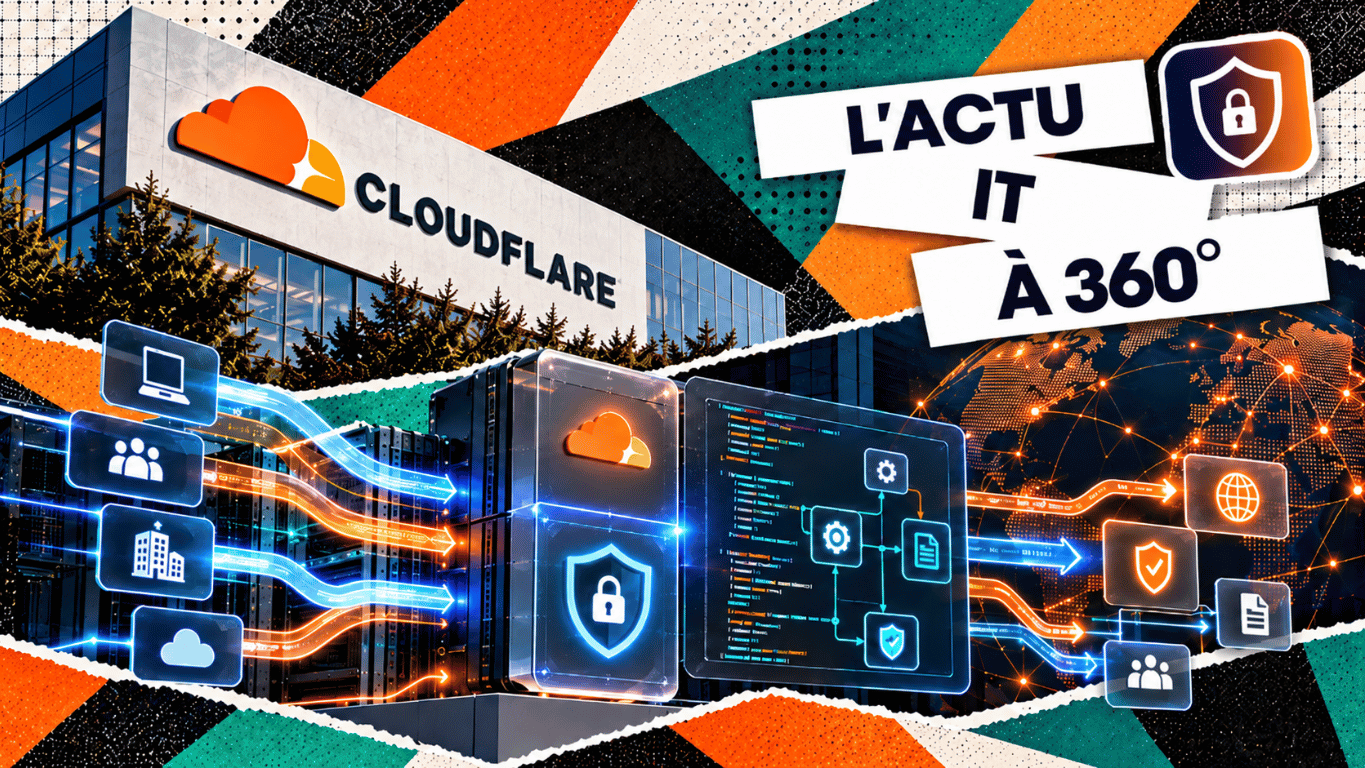
Cloudflare is bringing its secure web gateway closer to its Workers development platform. With Forward, available in public beta, businesses can add code to the processing of certain authorised HTTP requests.[2] For IT teams, this development opens up a concrete possibility: adapting controls to business uses. It also requires this code to be treated as a sensitive component, since an error could disrupt users’ work.
The gateway becomes a point of customisation
A secure web gateway controls users’ access to web services. Its role differs from that of a WAF, which is usually placed in front of an application to protect it. The subject here is the traffic passing through Cloudflare Gateway and the processing the company wishes to apply to it.
The Worker can modify a request or a response, produce its own response or launch a background task. Gateway retains management of the proxy connection, TLS decryption and routing to the service.[2] The company therefore adds application logic to a network path that is already managed.
This flexibility may appeal to a team that needs to apply a specific exception to a business tool. But the need must be clearly defined: adding code also increases the number of behaviours to understand in the event of an incident.
Two mechanisms with different timelines
The announcement of 15 October distinguishes between Forward and Custom Functions. The latter are expected before the end of 2026: they will return a value that can be used in the conditions of a Gateway policy, based on logic specific to the organisation.[1] Their timeline should not be confused with the beta that is already available.
Cloudflare illustrates this approach with pages asking for an access justification, header transformations and notifications. Calls to Workers follow their usual pricing, with the quotas and execution limits associated with the chosen plan.[1] Customisation must therefore be assessed together with its operating cost.
Three questions for choosing the right control
This grid suggests decision criteria for a pilot, without assuming any gains measured in production.
| Need | Expected benefit | Useful check |
|---|---|---|
| Adapt an exchange | Transform a request or a response with Forward.[2] | Does the application still work after the change? |
| Enrich a decision | Introduce a calculated value with the upcoming Custom Functions.[1] | What decision should be taken if the data is missing or out of date? |
| Inform teams | Trigger a contextual notification.[1] | Is the alert useful without exposing confidential content? |
The code remains bound by the gateway’s scope
The documentation states that Forward does not bypass a block rule. Inspection may interrupt the Worker, and WebSocket traffic goes directly to the origin service without passing through it.[2] The presence of a Worker therefore does not prove that all of an application’s exchanges are covered.
The announcement states that Gateway and Workers share the same infrastructure, which avoids a network hop between them.[1] This does not eliminate the execution time of the code, nor that of any external services called. A slow dependency can affect the user experience: the full journey needs to be measured.
An SME can start with a single business use case
Take an illustrative scenario: an SME wants to display a reminder before users access a file-sharing service. A pilot could target one domain and a small test group. The team would check that the reminder appears at the right moment, that connections remain possible and that unaffected traffic continues normally.
Testing should include a standard request, an unexpected format and the unavailability of any service called. Response times should be compared, logs reviewed and a rollback to the previous configuration prepared. This scenario is a suggested test, not a customer deployment reported by Cloudflare.
Professionals design and maintain verifiable controls
This development draws directly on Cybersecurity. Professionals must translate a business requirement into precise behaviour: which traffic to control, which information to use, which action to allow and which record to keep. A rule must be explainable both to those it protects and to those who maintain it.
The work now includes reviewing the code and its dependencies. Permissions, secrets and data written to logs deserve particular attention. Tests must verify both the expected blocking and the continuity of legitimate uses.
Maintenance continues after deployment. A change in an application or an identity can invalidate an assumption. Versioning changes, appointing an owner and keeping a removal procedure make it possible to retain control over the mechanism over time.
Editorial note
A programmable gateway gives more latitude to teams able to maintain their extensions. For a small organisation, the right criterion remains the need being addressed: does customisation provide a useful, verifiable control with an acceptable maintenance burden?
Further reading
Four CCCLX reads to explore infrastructure security and control in more depth.
Open-source security scales up: IBM, Red Hat and Palo Alto join forces
Sandbox, terminal, policies: GitHub puts guardrails around its coding agents
Project Glasswing: Anthropic goes on the offensive against software vulnerabilities
AI voice agents: Oracle details a LiveKit architecture on OCI
Sources
- 01
Gerstenhaber, A. J. and Carryl, A., Cloudflare (15 October 2026). “A fully programmable secure web gateway”. Overview of Gateway customisation with Workers and of the announced Custom Functions.
- 02
Cloudflare One, documentation (updated 15 October 2026). “Integrate Workers”. Documentation on the Forward action, request and response processing, Gateway rules and known limitations.

Europe accuses Anthropic of discrimination after Fable 5 is blocked
A US decision that sparks an international crisis The sudden suspension of access to Anthropic’s Fable 5 and Mythos 5 models outside the United States now goes well beyond technology. What initially looked like a national security measure is taking on a major...

Mobi Fold and Spotlight 2: Logitech aims to simplify everyday hybrid working
The office is everywhere, but the tools do not always keep up Hybrid working has profoundly changed professional habits. Video-conference meetings, frequent travel, days split between home, the office and coworking spaces: employees now move between multiple...
+80%: agentic AI triggers a record surge in enterprise SSD prices
Artificial intelligence is putting new strain on infrastructure Artificial intelligence is often associated with graphics processors and massive computing centres. Yet another essential component of digital infrastructure is coming under unprecedented pressure:...
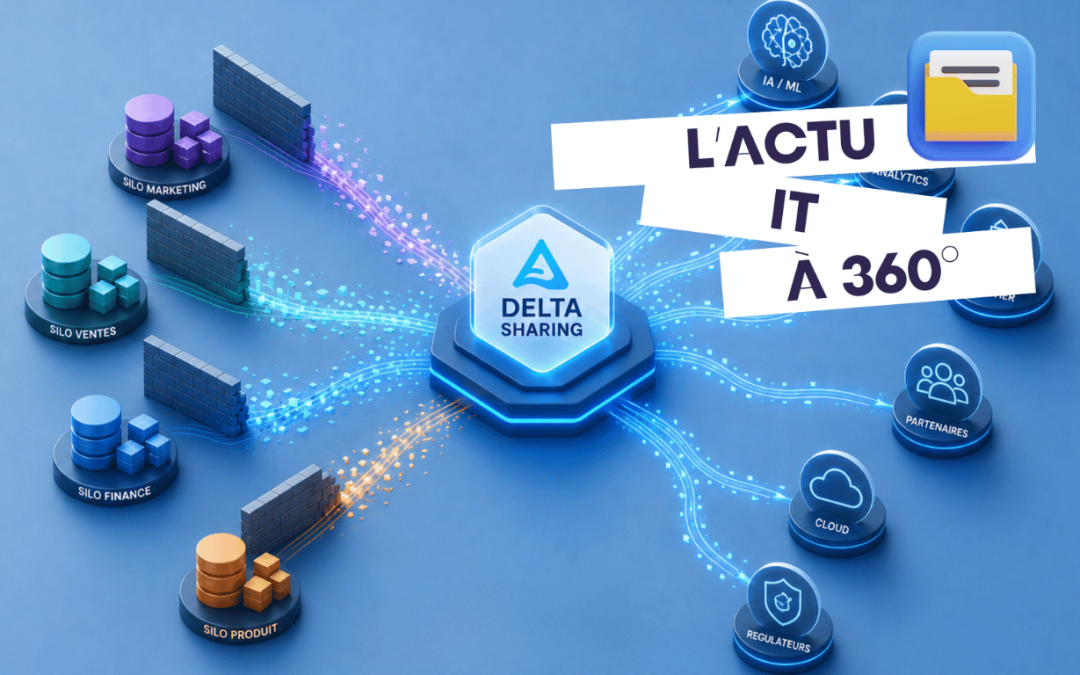
Databricks extends Delta Sharing to AI and aims to break down data silos
Data is no longer enough: intelligence must now be shared too Artificial intelligence is transforming the way companies use their data. Yet one major obstacle remains: the resources needed for AI projects are often scattered across different platforms, teams and...

RTX Spark: Nvidia accelerates the shift to AI-optimised PCs
Nvidia wants to redefine the PC for the age of artificial intelligence Unveiled at Computex 2026, the RTX Spark chip marks a new stage in the evolution of personal computers. With this Arm-based platform, Nvidia is not simply seeking to offer a more powerful...

WiFi 8 is arriving sooner than expected: what it means for businesses
A new generation of networking is already on the horizon While WiFi 7 is only just beginning to spread among businesses and consumers, the industry is already preparing the next step. TP-Link has just unveiled the first WiFi 8-compatible router, confirming that the...

Webedia-Elephant turns to Gemini Enterprise to industrialise generative AI
IT outages become a board-level issue Long regarded as mere technical incidents, service outages are now taking on a whole new dimension. According to a study by Oxford Economics for Splunk, Global 2000 companies suffer an average of 60 downtime incidents a year, at...

$600 billion lost: IT outages take on a new dimension
IT outages are becoming a boardroom issue Long regarded as mere technical incidents, service interruptions are now taking on a whole new dimension. According to a study conducted by Oxford Economics for Splunk, Global 2000 companies suffer an average of 60 downtime...

Lightwell: IBM and Red Hat tackle the open source patching headache
AI finds flaws faster than companies can fix them Artificial intelligence is profoundly transforming cybersecurity. While it makes it possible to detect vulnerabilities more quickly, it also creates a new challenge: the ability to fix a growing number of flaws within...

AWS strengthens OpenSearch to connect AI to enterprise data
AI agents are forcing the cloud to evolve The rise of agentic AI is profoundly transforming cloud infrastructure. Unlike traditional conversational assistants, intelligent agents must access data, interact with several systems and carry out tasks autonomously. To meet...