



Cloudflare is bringing its secure web gateway closer to its Workers development platform. With Forward, available in public beta, businesses can add code to the processing of certain authorised HTTP requests.[2] For IT teams, this development opens up a concrete possibility: adapting controls to business uses. It also requires this code to be treated as a sensitive component, since an error could disrupt users’ work.
The gateway becomes a point of customisation
A secure web gateway controls users’ access to web services. Its role differs from that of a WAF, which is usually placed in front of an application to protect it. The subject here is the traffic passing through Cloudflare Gateway and the processing the company wishes to apply to it.
The Worker can modify a request or a response, produce its own response or launch a background task. Gateway retains management of the proxy connection, TLS decryption and routing to the service.[2] The company therefore adds application logic to a network path that is already managed.
This flexibility may appeal to a team that needs to apply a specific exception to a business tool. But the need must be clearly defined: adding code also increases the number of behaviours to understand in the event of an incident.
Two mechanisms with different timelines
The announcement of 15 October distinguishes between Forward and Custom Functions. The latter are expected before the end of 2026: they will return a value that can be used in the conditions of a Gateway policy, based on logic specific to the organisation.[1] Their timeline should not be confused with the beta that is already available.
Cloudflare illustrates this approach with pages asking for an access justification, header transformations and notifications. Calls to Workers follow their usual pricing, with the quotas and execution limits associated with the chosen plan.[1] Customisation must therefore be assessed together with its operating cost.
Three questions for choosing the right control
This grid suggests decision criteria for a pilot, without assuming any gains measured in production.
| Need | Expected benefit | Useful check |
|---|---|---|
| Adapt an exchange | Transform a request or a response with Forward.[2] | Does the application still work after the change? |
| Enrich a decision | Introduce a calculated value with the upcoming Custom Functions.[1] | What decision should be taken if the data is missing or out of date? |
| Inform teams | Trigger a contextual notification.[1] | Is the alert useful without exposing confidential content? |
The code remains bound by the gateway’s scope
The documentation states that Forward does not bypass a block rule. Inspection may interrupt the Worker, and WebSocket traffic goes directly to the origin service without passing through it.[2] The presence of a Worker therefore does not prove that all of an application’s exchanges are covered.
The announcement states that Gateway and Workers share the same infrastructure, which avoids a network hop between them.[1] This does not eliminate the execution time of the code, nor that of any external services called. A slow dependency can affect the user experience: the full journey needs to be measured.
An SME can start with a single business use case
Take an illustrative scenario: an SME wants to display a reminder before users access a file-sharing service. A pilot could target one domain and a small test group. The team would check that the reminder appears at the right moment, that connections remain possible and that unaffected traffic continues normally.
Testing should include a standard request, an unexpected format and the unavailability of any service called. Response times should be compared, logs reviewed and a rollback to the previous configuration prepared. This scenario is a suggested test, not a customer deployment reported by Cloudflare.
Professionals design and maintain verifiable controls
This development draws directly on Cybersecurity. Professionals must translate a business requirement into precise behaviour: which traffic to control, which information to use, which action to allow and which record to keep. A rule must be explainable both to those it protects and to those who maintain it.
The work now includes reviewing the code and its dependencies. Permissions, secrets and data written to logs deserve particular attention. Tests must verify both the expected blocking and the continuity of legitimate uses.
Maintenance continues after deployment. A change in an application or an identity can invalidate an assumption. Versioning changes, appointing an owner and keeping a removal procedure make it possible to retain control over the mechanism over time.
Editorial note
A programmable gateway gives more latitude to teams able to maintain their extensions. For a small organisation, the right criterion remains the need being addressed: does customisation provide a useful, verifiable control with an acceptable maintenance burden?
Further reading
Four CCCLX reads to explore infrastructure security and control in more depth.
Open-source security scales up: IBM, Red Hat and Palo Alto join forces
Sandbox, terminal, policies: GitHub puts guardrails around its coding agents
Project Glasswing: Anthropic goes on the offensive against software vulnerabilities
AI voice agents: Oracle details a LiveKit architecture on OCI
Sources
- 01
Gerstenhaber, A. J. and Carryl, A., Cloudflare (15 October 2026). “A fully programmable secure web gateway”. Overview of Gateway customisation with Workers and of the announced Custom Functions.
- 02
Cloudflare One, documentation (updated 15 October 2026). “Integrate Workers”. Documentation on the Forward action, request and response processing, Gateway rules and known limitations.

Salesforce wants to acquire Loops to help Tableau explain KPI changes
Salesforce has announced a definitive agreement to acquire Loops, an AI-based analytics platform, with the intention of integrating its technology into Tableau after closing.[1] The aim is to monitor metrics and bring out the factors associated with their changes. For...

Cisco and NVIDIA prepare 400 Gb/s-per-lane optical connections for AI infrastructure
Cisco and NVIDIA have announced a project for a pluggable optical form factor, USFP, capable of supporting 400 Gb/s per lane. Cisco is also unveiling the Silicon One G302 switching chip, rated at 51.2 Tb/s.[1] These announcements address a key challenge for AI...
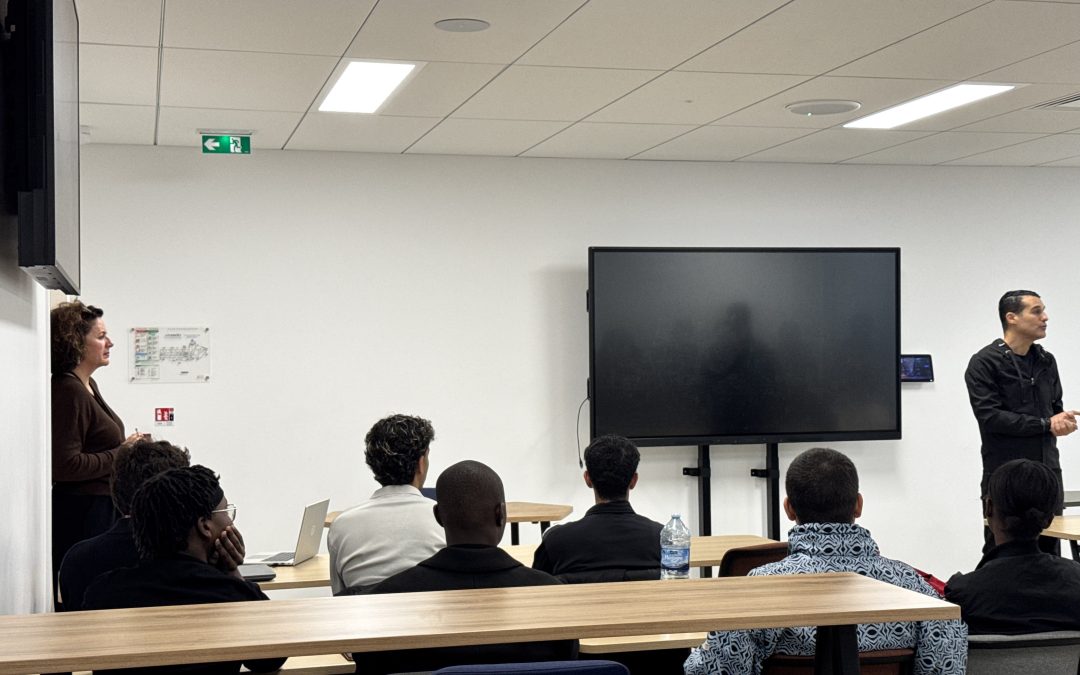
A new year begins at CCCLX!
The Paris-Villejuif campus welcomes CCCLX students for a new year of learning, projects and experiences at the heart of 360° IT.

VMware HyperArmor strengthens hypervisor protection against cyberattacks
Broadcom has unveiled VMware HyperArmor, a solution designed to protect the ESX hypervisor of VMware Cloud Foundation, with announced support for ESX 8.x and later versions.[1] The stakes go beyond the security of a single application: the hypervisor is a shared...

SolarWinds Avior: IT teams set the goals and agents coordinate the actions
SolarWinds has launched Avior, an agentic AI system designed to pursue operational goals in hybrid IT environments. Available since 14 October as part of a guided onboarding programme, it combines specialised agents with control mechanisms.[1] For technical teams, the...
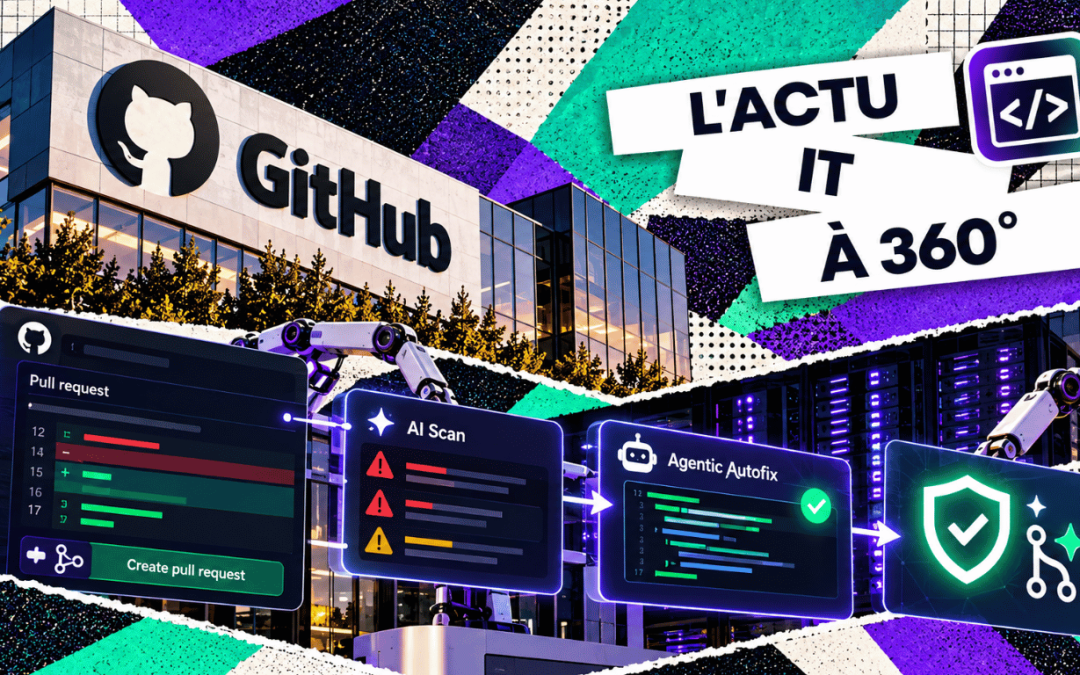
GitHub steps up vulnerability detection and remediation with AI Scan and Agentic Autofix
GitHub has announced the general availability of AI Scan for pull requests and Agentic Autofix for code scanning alerts.[1][2] These features bring AI assistance closer to the work of securing code. They do, however, operate on different scopes: proposed...

Palo Alto Networks strengthens AI agent security around Claude Enterprise
PPalo Alto Networks has unveiled several updates to Prisma AIRS: protection of interactions with Claude Enterprise, analysis of the components used by agents and control of their exchanges with tools.[1] The stakes are concrete for businesses: preventing an assistant...

ServiceNow prepares AI Passport to control AI agents’ access rights
ServiceNow has announced AI Passport, a cryptographically signed authorisation credential designed to govern AI agents and MCP servers while workflows are running. It is scheduled to be available in the fourth quarter of 2026.[1] The image of a digital badge helps to...

SAP wants to acquire TechWolf to link tasks, skills and the transformation of jobs
SAP has announced an agreement to acquire TechWolf, an AI platform that links tasks, skills and changes in the labour market. Completion is expected in the fourth quarter of 2026, subject in particular to regulatory approvals.[1] The deal raises a practical...

ServiceNow wants to turn process improvement into a continuous AI-driven loop
With AI Workflow Factory, ServiceNow aims to link the identification of inefficient processes with building and running their improvements. The announcement notably includes Autonomous Engineer, a tool designed to automate more of the implementation work.[1] For...