


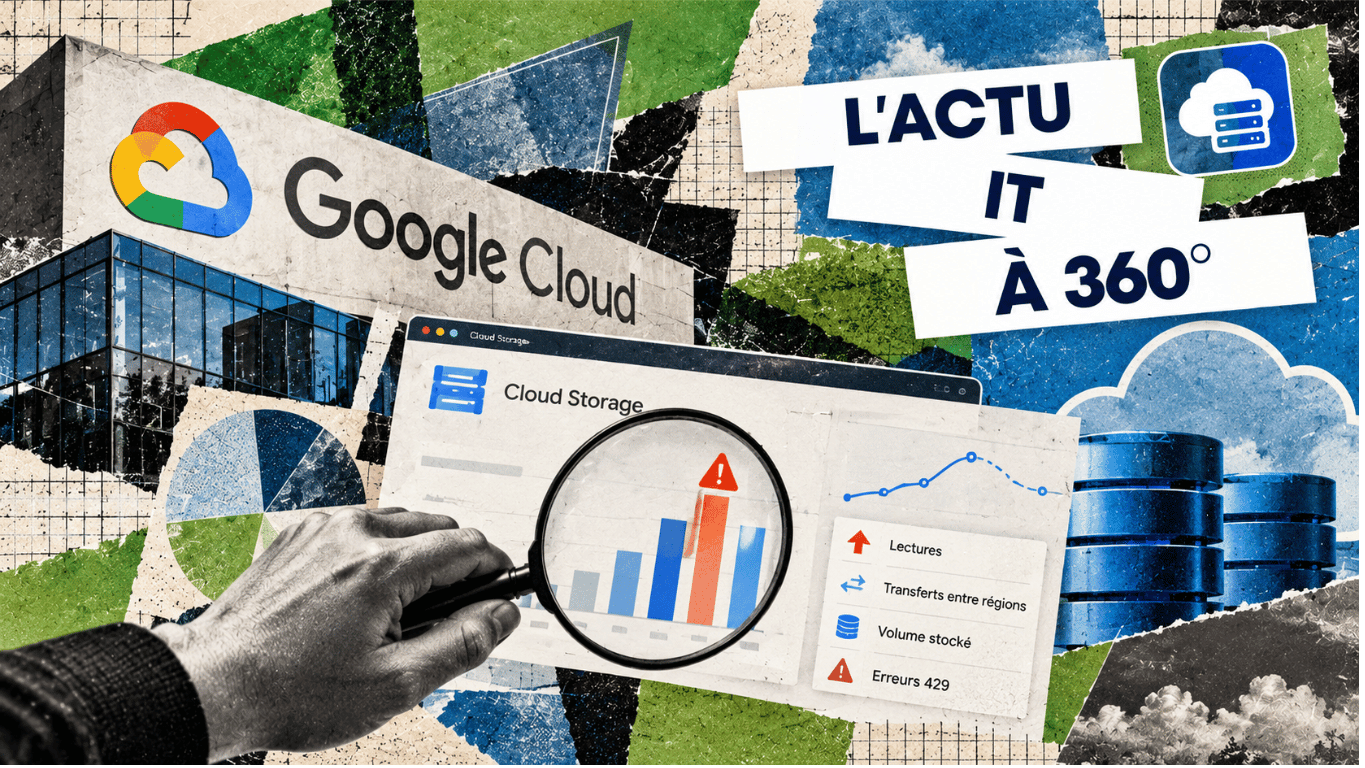
A rise in reads, cross-region transfers or stored volume can inflate the cloud bill and disrupt applications. With Storage Intelligence advisor, Google offers a view of unusual changes in Cloud Storage, along with leads for investigating them. For businesses, the challenge is to link these signals to the workloads that generate them, and then to decide on a course of action.
Editorial note. Google dates the tool’s general availability to 10 September 2026. Its blog post presents the features but provides no independent measurement of their detection rate or of the savings achieved.[1], [2]
Monitoring built into cloud storage
In a blog post published on 25 September, Google presented Storage Intelligence advisor and updates to batch operations. The release notes, however, date the advisor’s general availability to 10 September and the batch-processing additions to 3 September. This timeline clarifies the scope of the news: the post brings together and illustrates features that had already become available during the month.[1], [2]
The advisor displays metrics and findings at the level of a Google Cloud project, folder or organisation. In particular, it provides a view of volumes, objects and trends, accompanied by recommendations. This interface can spare teams from building bespoke reporting for the needs it covers. Its scope, however, remains limited to Cloud Storage.[3]
What the advisor can actually detect
The catalogue documents four signals: an increase in operations on the Coldline or Archive classes, a rise in 429 errors caused by request throttling, a spike in cross-region transfers and storage growth above the trend. These findings concern storage usage and performance; they do not amount to an analysis of the business quality of the files’ content.[4]
Google explains that detection is based on the project’s usual activity and on daily readings, with spikes reported within 24 hours. This delay therefore needs to be factored into the monitoring set-up. The post describes a way of tracking deviations to be examined, without providing any independent measurement of its detection rate or of the savings achieved.[1]
Tracing the symptom back to the workload responsible
Cloud Storage organises objects in containers called buckets. The advisor lets users drill down to the buckets concerned, then to the object prefixes and the service accounts associated with the rise in requests. A service account usually represents an application or an automated process. These indications can help the IT team identify the process to examine.[5]
Take an illustrative example: an analytics job rereads files intended for archiving every day. The team should check the frequency of reads, the chosen storage class and the business need. A spike may reflect a malfunction, but also expected activity, such as a computing campaign. Diagnosis therefore requires knowledge of the processing schedule.
What this development changes in the IT ecosystem
Storage brings several responsibilities together here: data teams build the workloads, developers determine access, cloud administrators monitor resources and the FinOps function reviews spending. FinOps refers to the shared management of the costs and value of cloud usage. For an SME already using Cloud Storage, the potential benefit is to make it easier for these teams to work together around a single signal, with a clearly identified owner for the investigation.
Four signals and four decisions to consider
The signals below are documented by Google. The suggested questions are intended to guide the organisation’s analysis.[4]
| Observed signal | Possible effect | Useful check |
|---|---|---|
| Increased reads on Coldline or Archive | Higher access charges. | Does the frequency of use justify this storage class? |
| Rise in 429 errors | Throttled requests and disrupted workloads. | Which process is increasing requests, and how can they be spread out? |
| Spike in cross-region transfers | Additional transfer costs. | Are the data and workloads located in appropriate regions? |
| Growth above the trend | Rising storage volume and cost. | Do the new objects meet an identified need and a defined retention period? |
Moving from finding to approved action
Batch operations are the execution layer: an organisation configures a job to apply transformations to a set of objects, then monitors its progress. They support, in particular, storage class changes, certain metadata updates and deletions. The service handles execution and automatic retries of failed operations.[6]
The September updates add metadata-based filters, multi-bucket processing and a simulation mode, or dry run. The latter makes it possible to check the selection before execution. For businesses, moving from a recommendation to a large-scale change must remain an explicit decision, with a defined scope and an owner.[2]
What an organisation should assess before adopting it
Access to the advisor requires enabling Storage Intelligence and having the appropriate permissions. The documentation notably cites the Storage Admin role, while also allowing custom roles. The choice of permissions therefore deserves careful consideration: viewing a diagnosis and authorising large-scale changes are different responsibilities.[5]
The business case must include Storage Intelligence fees and the cost of the operations performed. Standard pricing includes a management fee based on the number of objects, to which other usage charges may be added. A class change may itself incur rewrite costs and, depending on the case, other data-related charges. A recommendation must be assessed on the full cost of the transition.[6], [7]
Before a wide roll-out, a limited trial would make it possible to measure investigation time, the relevance of findings and the cost of corrections. Any deletion should be reviewed with the business owner of the data and in line with the organisation’s retention rules. The practical aim is to reduce unnecessary operations while maintaining essential uses.
Managing the cloud starts with understanding how it is used
The growth in stored volumes increases the importance of Cloud Computing in the day-to-day management of infrastructure. Professionals must be able to interpret a rise in requests, identify the workloads responsible and understand their impact on performance and costs.
An unusual signal does not automatically justify a correction: it may correspond to expected activity or reveal a poor configuration choice. Mastering the cloud therefore also means assessing the effects of a storage class change, a data move or a deletion before acting.
For businesses, this ability makes it possible to take decisions suited to application needs, budget constraints and availability requirements. The professional’s role is thus evolving towards a form of management in which every technical action must be linked to a business need and to measurable effects.
The value will depend on the decisions taken after the signal
Storage Intelligence advisor provides an entry point for examining deviations in Cloud Storage usage. Its value will have to be measured in operations: do teams find the cause of a problem more quickly, avoid unnecessary spending and apply appropriate fixes? The question to watch will be organisations’ ability to establish this monitoring loop, with clear responsibilities and measured results.
READ ALSO
These four CCCLX analyses explore further the issues of cloud costs, data architecture and AI-related storage needs.
Google Cloud tackles the hidden bill of AI agents
Agentic Data Cloud: Google rethinks data for the age of AI agents
Databricks extends Delta Sharing to AI and aims to break down data silos
+80%: agentic AI triggers a record surge in enterprise SSDs
Sources
- 01
Google Cloud, Hafid S. and Kohli H. (25 September 2026). Storage Intelligence advisor: Know what changed in your storage estate and act on it.
- 02
Google Cloud (2026). Cloud Storage release notes, entries of 3 and 10 September.
- 03
Google Cloud. About Storage Intelligence advisor.
- 04
Google Cloud. Findings reference catalog for Storage Intelligence advisor.
- 05
Google Cloud. View Storage Intelligence advisor.
- 06
Google Cloud. Storage batch operations.
- 07
Google Cloud. Storage pricing.

Europe accuses Anthropic of discrimination after Fable 5 is blocked
A US decision that sparks an international crisis The sudden suspension of access to Anthropic’s Fable 5 and Mythos 5 models outside the United States now goes well beyond technology. What initially looked like a national security measure is taking on a major...

Mobi Fold and Spotlight 2: Logitech aims to simplify everyday hybrid working
The office is everywhere, but the tools do not always keep up Hybrid working has profoundly changed professional habits. Video-conference meetings, frequent travel, days split between home, the office and coworking spaces: employees now move between multiple...
+80%: agentic AI triggers a record surge in enterprise SSD prices
Artificial intelligence is putting new strain on infrastructure Artificial intelligence is often associated with graphics processors and massive computing centres. Yet another essential component of digital infrastructure is coming under unprecedented pressure:...
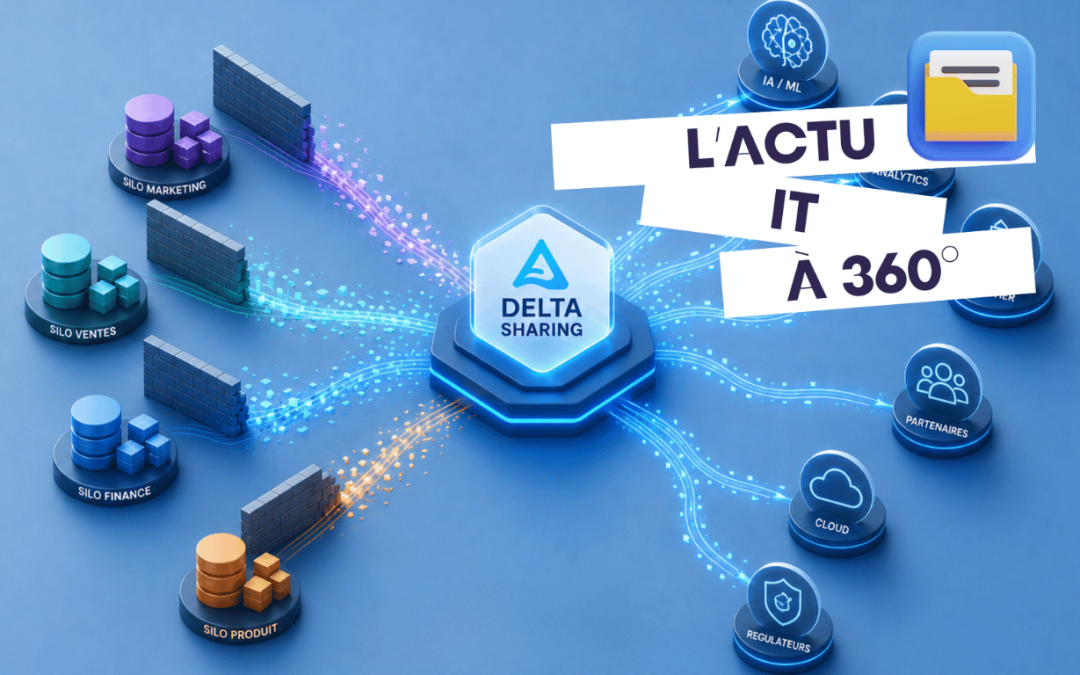
Databricks extends Delta Sharing to AI and aims to break down data silos
Data is no longer enough: intelligence must now be shared too Artificial intelligence is transforming the way companies use their data. Yet one major obstacle remains: the resources needed for AI projects are often scattered across different platforms, teams and...

RTX Spark: Nvidia accelerates the shift to AI-optimised PCs
Nvidia wants to redefine the PC for the age of artificial intelligence Unveiled at Computex 2026, the RTX Spark chip marks a new stage in the evolution of personal computers. With this Arm-based platform, Nvidia is not simply seeking to offer a more powerful...

WiFi 8 is arriving sooner than expected: what it means for businesses
A new generation of networking is already on the horizon While WiFi 7 is only just beginning to spread among businesses and consumers, the industry is already preparing the next step. TP-Link has just unveiled the first WiFi 8-compatible router, confirming that the...

Webedia-Elephant turns to Gemini Enterprise to industrialise generative AI
IT outages become a board-level issue Long regarded as mere technical incidents, service outages are now taking on a whole new dimension. According to a study by Oxford Economics for Splunk, Global 2000 companies suffer an average of 60 downtime incidents a year, at...

$600 billion lost: IT outages take on a new dimension
IT outages are becoming a boardroom issue Long regarded as mere technical incidents, service interruptions are now taking on a whole new dimension. According to a study conducted by Oxford Economics for Splunk, Global 2000 companies suffer an average of 60 downtime...

Lightwell: IBM and Red Hat tackle the open source patching headache
AI finds flaws faster than companies can fix them Artificial intelligence is profoundly transforming cybersecurity. While it makes it possible to detect vulnerabilities more quickly, it also creates a new challenge: the ability to fix a growing number of flaws within...
AWS strengthens OpenSearch to connect AI to enterprise data
AI agents are forcing the cloud to evolve The rise of agentic AI is profoundly transforming cloud infrastructure. Unlike traditional conversational assistants, intelligent agents must access data, interact with several systems and carry out tasks autonomously. To meet...