


Data storage is reaching its limits
Every day, humanity produces a gigantic amount of data. In 2025, the volume generated worldwide each day is estimated at almost 300 exabytes, the equivalent of a century of European audiovisual archives created every 24 hours1. With the rise of artificial intelligence, the cloud and connected devices, this growth is becoming exponential. Behind this explosion lies a major problem: today’s storage infrastructure is gradually approaching its technical, energy and environmental limits.
PearCode wants to turn DNA into digital infrastructure
Against this backdrop, the French deeptech company PearCode, a spin-off from the I3S laboratory in Sophia Antipolis, has just launched a first archiving solution based on synthetic DNA. Long regarded as a futuristic technology, DNA storage is now starting to leave the laboratory and enter the market. The principle is to encode digital data as genetic sequences that can be preserved for decades, or even centuries, without significant degradation.
A gram of DNA could hold an entire data centre
One of the most spectacular arguments for DNA storage lies in its density. According to several studies, a single gram of DNA could theoretically hold the equivalent of an entire data centre’s data2. On top of this comes a major advantage: unlike traditional infrastructure, DNA does not require a continuous power supply to retain data. At a time when data centres already account for 1 to 2% of global electricity consumption, this prospect is attracting strong interest from the technology industry3.
The real challenge: automating data writing and reading
While the promise is immense, the main obstacle remains automation. Today, writing and reading data on DNA is still slow and expensive. The challenge for companies like PearCode is therefore to industrialise these processes in order to reduce costs and access times. This is precisely where the global competition is being played out. The players able to make this technology fast, reliable and accessible could redefine digital storage infrastructure in the coming decades.
A potential revolution for businesses and critical archives
The first target uses concern sensitive data and long-term archives: administrative documents, scientific data, digital heritage or medical records. For businesses, this approach could sharply reduce cold storage costs while improving data durability. SMEs could also benefit indirectly from this development through more efficient, less energy-hungry cloud services.
Between science, cloud and digital sovereignty
DNA storage is not just about technology; it also raises strategic issues. Controlling the storage infrastructure of the future could become a major digital sovereignty issue. While traditional data centres require massive amounts of energy and materials, DNA paves the way for a new, more compact and potentially more sustainable approach to the cloud. This transition could transform the way states and companies manage their critical data.
Understanding tomorrow’s infrastructure becomes essential
This development highlights a key skill: data and digital infrastructure. Future IT professionals will need to understand new storage architectures, their constraints and their uses. It is no longer just a matter of managing servers or conventional cloud, but of anticipating technologies capable of completely redefining the digital ecosystem.
Towards a biological cloud?
Even though DNA storage is still emerging, PearCode shows that the technology is gradually entering an industrial phase. The idea of storing data in a biological molecule may seem futuristic, but it addresses a very concrete problem: the saturation of digital infrastructure. For students and future IT professionals, this is a fascinating development. It shows that the future of the cloud may no longer rest solely on giant servers, but also on technologies directly inspired by living organisms.
360° IT News — decoding technology to understand the jobs of tomorrow.
Further reading
The emergence of DNA storage illustrates a profound transformation of digital infrastructure in the face of the explosion in data volumes generated by artificial intelligence and the cloud. This development is part of a worldwide search for more compact, durable solutions capable of overcoming the limits of traditional data centres. On a related topic, read our article “Data centre boom: Legrand goes on the offensive in China and the United Kingdom”, which analyses how storage and computing infrastructure is becoming a major strategic issue for the digital economy.
References
1. Statista. (2025). Global data creation forecast.
https://www.statista.com
2. Nature. (2021). DNA data storage density research.
https://www.nature.com
3. International Energy Agency. (2024). Data centres and electricity consumption.
https://www.iea.org

F5 strengthens its WAF to tackle the cyber threats of the AI era
Cyberattacks are evolving faster than patches Artificial intelligence is transforming corporate cybersecurity, but it is also benefiting attackers. New models capable of rapidly identifying vulnerabilities or automating certain exploitation phases are dramatically...
Europe accuses Anthropic of discrimination after Fable 5 is blocked
A US decision that sparks an international crisis The sudden suspension of access to Anthropic’s Fable 5 and Mythos 5 models outside the United States now goes well beyond technology. What initially looked like a national security measure is taking on a major...
Mobi Fold and Spotlight 2: Logitech aims to simplify everyday hybrid working
The office is everywhere, but the tools do not always keep up Hybrid working has profoundly changed professional habits. Video-conference meetings, frequent travel, days split between home, the office and coworking spaces: employees now move between multiple...

+80%: agentic AI triggers a record surge in enterprise SSD prices
Artificial intelligence is putting new strain on infrastructure Artificial intelligence is often associated with graphics processors and massive computing centres. Yet another essential component of digital infrastructure is coming under unprecedented pressure:...
Databricks extends Delta Sharing to AI and aims to break down data silos
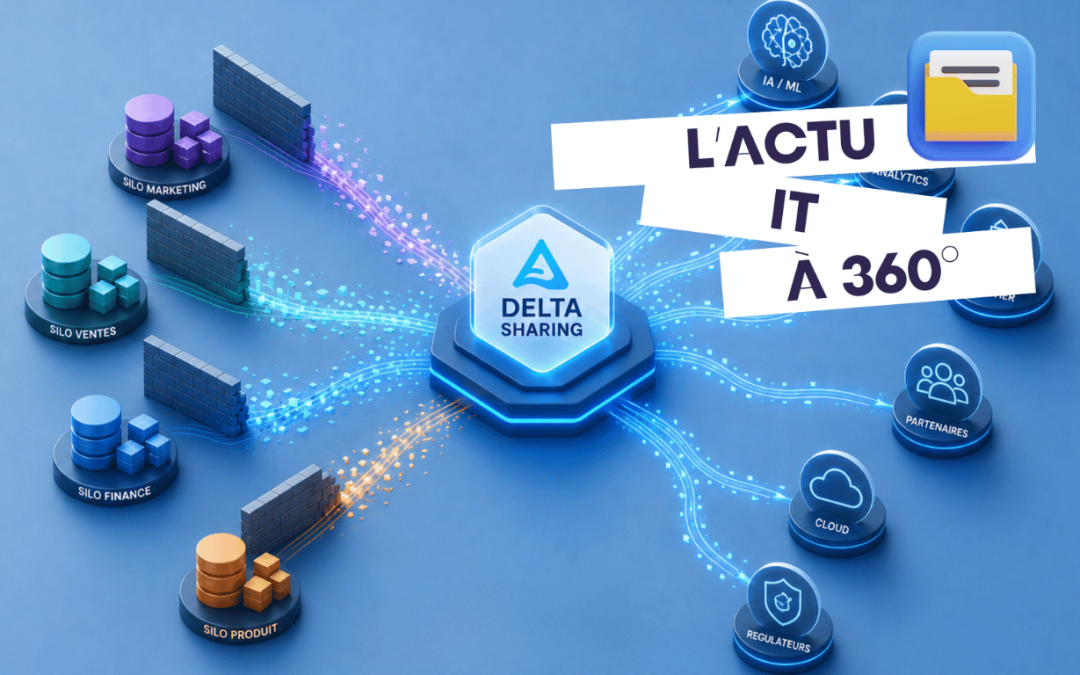
Data is no longer enough: intelligence must now be shared too Artificial intelligence is transforming the way companies use their data. Yet one major obstacle remains: the resources needed for AI projects are often scattered across different platforms, teams and...

RTX Spark: Nvidia accelerates the shift to AI-optimised PCs
Nvidia wants to redefine the PC for the age of artificial intelligence Unveiled at Computex 2026, the RTX Spark chip marks a new stage in the evolution of personal computers. With this Arm-based platform, Nvidia is not simply seeking to offer a more powerful...

WiFi 8 is arriving sooner than expected: what it means for businesses
A new generation of networking is already on the horizon While WiFi 7 is only just beginning to spread among businesses and consumers, the industry is already preparing the next step. TP-Link has just unveiled the first WiFi 8-compatible router, confirming that the...

Webedia-Elephant turns to Gemini Enterprise to industrialise generative AI
IT outages become a board-level issue Long regarded as mere technical incidents, service outages are now taking on a whole new dimension. According to a study by Oxford Economics for Splunk, Global 2000 companies suffer an average of 60 downtime incidents a year, at...

$600 billion lost: IT outages take on a new dimension
IT outages are becoming a boardroom issue Long regarded as mere technical incidents, service interruptions are now taking on a whole new dimension. According to a study conducted by Oxford Economics for Splunk, Global 2000 companies suffer an average of 60 downtime...

Lightwell: IBM and Red Hat tackle the open source patching headache
AI finds flaws faster than companies can fix them Artificial intelligence is profoundly transforming cybersecurity. While it makes it possible to detect vulnerabilities more quickly, it also creates a new challenge: the ability to fix a growing number of flaws within...