


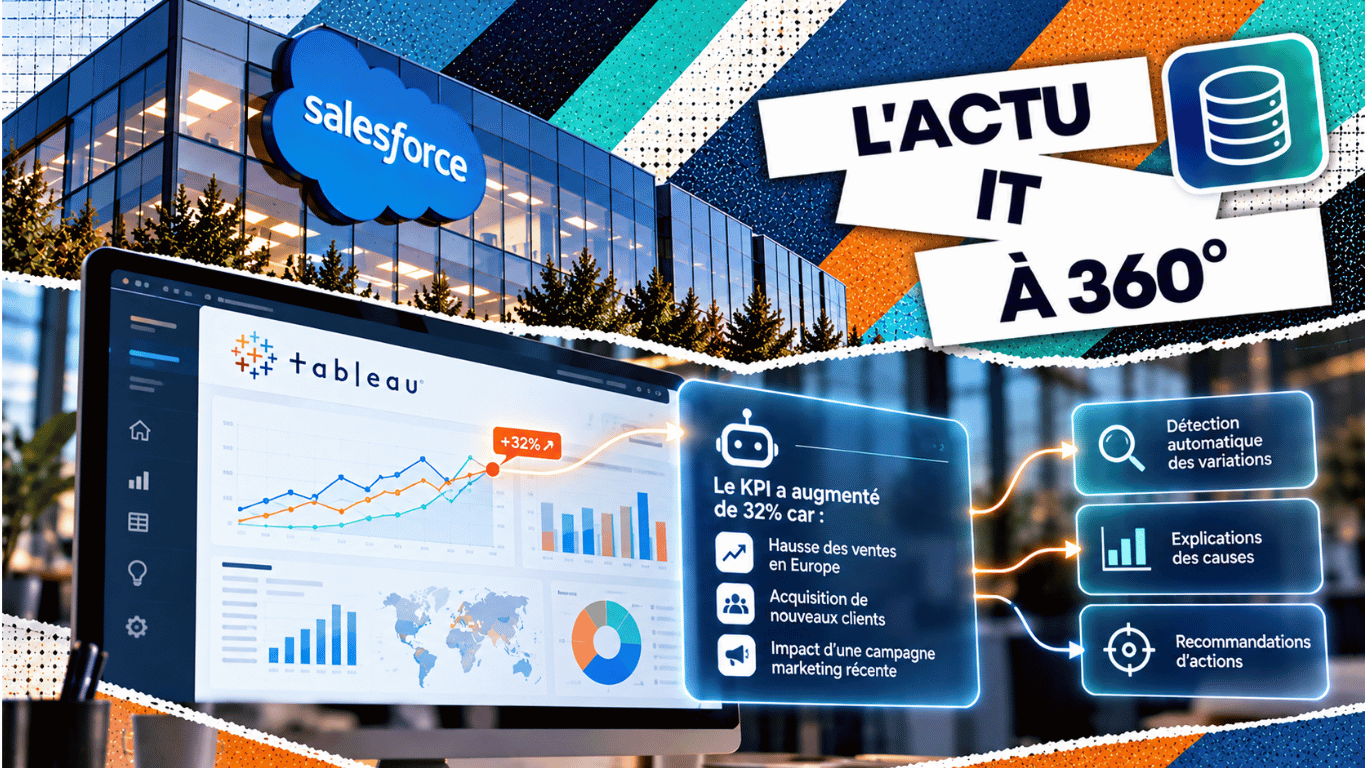
Salesforce has announced a definitive agreement to acquire Loops, an AI-based analytics platform, with the intention of integrating its technology into Tableau after closing.[1] The aim is to monitor metrics and bring out the factors associated with their changes. For businesses, the promise is to spot earlier what deserves analysis, provided they have reliable data and do not mistake a suggested explanation for a proven cause.
A deal announced before an integration that has yet to be built
The transaction is expected to close in early November, during Salesforce’s fiscal year 2027, subject to customary conditions. The press release gives no precise date for when Loops’ capabilities will be available in Tableau.[1] This is therefore an announced product direction, not a new feature already available to all users.
This distinction matters for a team preparing its budget or its analytics architecture. It can follow the project and identify its needs, but it should not base an operational deadline on an integration whose terms have yet to be specified.
Metrics become the starting point for an investigation
According to Salesforce, Loops monitors performance, detects trends and anomalies, and then brings out what contributes to changes. Its functions can be triggered from Slack or by email. The vendor wants to use them to strengthen Tableau’s agentic analytics and the prioritisation of actions.[1]
A key performance indicator, or KPI, summarises one dimension of the business: conversion, processing time or retention, for example. When it changes, the first need is often to work out where to look. Does the change concern all customers, or one particular region, product or channel? Proactive analysis can help organise this search.
Detecting a change is not enough to make a decision
This grid distinguishes three stages of analytical reasoning and the checks they require. It is an editorial reading of the business need.
| Stage | Question to address | Useful check |
|---|---|---|
| Detection | Which metric has changed and over what period? | Check data freshness and the comparison baseline. |
| Explanation | Which segments contribute to the change? | Examine volumes, changes in measurement and other factors. |
| Action | What intervention could improve the result? | Validate the hypothesis and measure the effects before rolling it out. |
A factor associated with a decline is not always its cause
A channel may account for a large share of a drop in sales because its traffic has changed, because a product is unavailable there or because data collection is incomplete. Breaking down a result helps locate the phenomenon; it does not automatically decide between all these explanations.
Before changing a campaign or a process, the analysis must be compared with business events. A controlled comparison or an experiment can then help test a hypothesis. The decision depends as much on this verification as on the clarity of the generated commentary.
Defining KPIs remains essential groundwork
Two departments may use the same word for different measures. A conversion rate calculated per visit does not match a rate calculated per user. Likewise, a cancelled order or a late-arriving event can change the result depending on the rules applied.
Continuous monitoring therefore requires a shared definition: formula, population, period, exclusions and reference source. The history of changes must also be kept. An alert triggered after a formula change does not necessarily describe a real change in activity.
An SME can test the value on a single metric
Take an illustrative scenario: an online shop notices a drop in its conversion rate. The team compares devices, channels and product categories. If the drop is concentrated on mobile, it then checks for payment incidents, stock shortages and recent changes to the customer journey. This scenario is not a customer result published by Salesforce.
The pilot should check that the tool surfaces useful observations without multiplying secondary alerts. The team can measure the time to a confirmed anomaly, the time needed to qualify the explanation and the share of alerts that are genuinely actionable. Nor does the absence of an alert prove the absence of a problem.
To assess a future integration, data access, costs and the scope of sources will need to be clarified. The press release provides no independent measure of accuracy or of generalisable time savings. These points remain to be verified on the company’s own data.
The IT skill to remember: Data Management
This development draws directly on Data Management. Professionals must know where information comes from, check its quality and ensure that transformations preserve the meaning of measures. A convincing explanation can still be misleading if the starting data is incomplete or poorly reconciled.
Their role includes documenting metrics and managing access rights. Users must understand what a KPI measures and what limits frame its interpretation. The details surfaced in an alert must also respect authorised access, particularly when they concern customers or employees.
The work continues in dialogue with business teams. Analysts must be able to verify the observations put forward, spell out uncertainties and track the effect of decisions taken. Automation can speed up investigation; the responsibility for giving results a reliable meaning remains.
Proactive analysis must steer a useful investigation
The value of proactive analysis is measured by its ability to steer a useful investigation. A dashboard that comments on its own changes does not thereby become an autonomous decision-maker: data quality, hypothesis testing and monitoring of results remain decisive.
Further reading
Four CCCLX reads to explore data quality, sharing and use in more depth.
Google Cloud Storage Intelligence Advisor detects storage anomalies
Talk to your database: Oracle improves its NL2SQL AI
Databricks extends Delta Sharing to AI and aims to break down data silos
Merck and Google Cloud commit one billion dollars to agentic AI
Sources
- 01
Salesforce (12 October 2026). “Salesforce Signs Definitive Agreement to Acquire Loops”. Announcement of the acquisition agreement and plans to integrate Loops technology into Tableau.

Cisco and NVIDIA prepare 400 Gb/s-per-lane optical connections for AI infrastructure
Cisco and NVIDIA have announced a project for a pluggable optical form factor, USFP, capable of supporting 400 Gb/s per lane. Cisco is also unveiling the Silicon One G302 switching chip, rated at 51.2 Tb/s.[1] These announcements address a key challenge for AI...
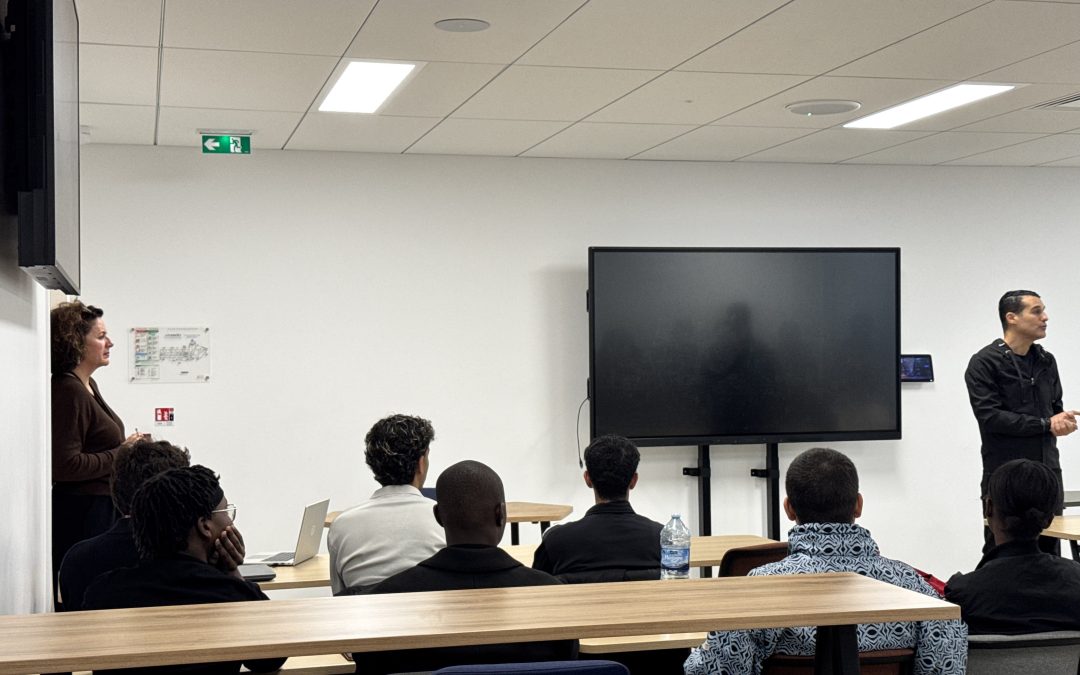
A new year begins at CCCLX!
The Paris-Villejuif campus welcomes CCCLX students for a new year of learning, projects and experiences at the heart of 360° IT.

VMware HyperArmor strengthens hypervisor protection against cyberattacks
Broadcom has unveiled VMware HyperArmor, a solution designed to protect the ESX hypervisor of VMware Cloud Foundation, with announced support for ESX 8.x and later versions.[1] The stakes go beyond the security of a single application: the hypervisor is a shared...

SolarWinds Avior: IT teams set the goals and agents coordinate the actions
SolarWinds has launched Avior, an agentic AI system designed to pursue operational goals in hybrid IT environments. Available since 14 October as part of a guided onboarding programme, it combines specialised agents with control mechanisms.[1] For technical teams, the...
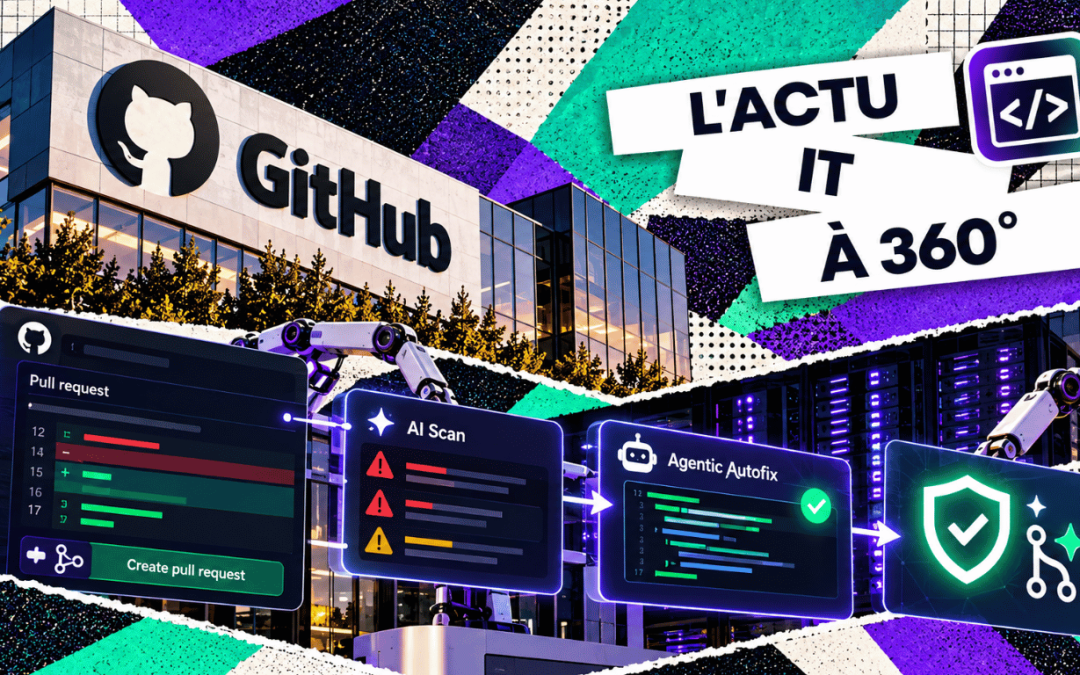
GitHub steps up vulnerability detection and remediation with AI Scan and Agentic Autofix
GitHub has announced the general availability of AI Scan for pull requests and Agentic Autofix for code scanning alerts.[1][2] These features bring AI assistance closer to the work of securing code. They do, however, operate on different scopes: proposed...

Cloudflare makes web security programmable with Workers
Cloudflare is bringing its secure web gateway closer to its Workers development platform. With Forward, available in public beta, businesses can add code to the processing of certain authorised HTTP requests.[2] For IT teams, this development opens up a...

Palo Alto Networks strengthens AI agent security around Claude Enterprise
PPalo Alto Networks has unveiled several updates to Prisma AIRS: protection of interactions with Claude Enterprise, analysis of the components used by agents and control of their exchanges with tools.[1] The stakes are concrete for businesses: preventing an assistant...

ServiceNow prepares AI Passport to control AI agents’ access rights
ServiceNow has announced AI Passport, a cryptographically signed authorisation credential designed to govern AI agents and MCP servers while workflows are running. It is scheduled to be available in the fourth quarter of 2026.[1] The image of a digital badge helps to...

SAP wants to acquire TechWolf to link tasks, skills and the transformation of jobs
SAP has announced an agreement to acquire TechWolf, an AI platform that links tasks, skills and changes in the labour market. Completion is expected in the fourth quarter of 2026, subject in particular to regulatory approvals.[1] The deal raises a practical...
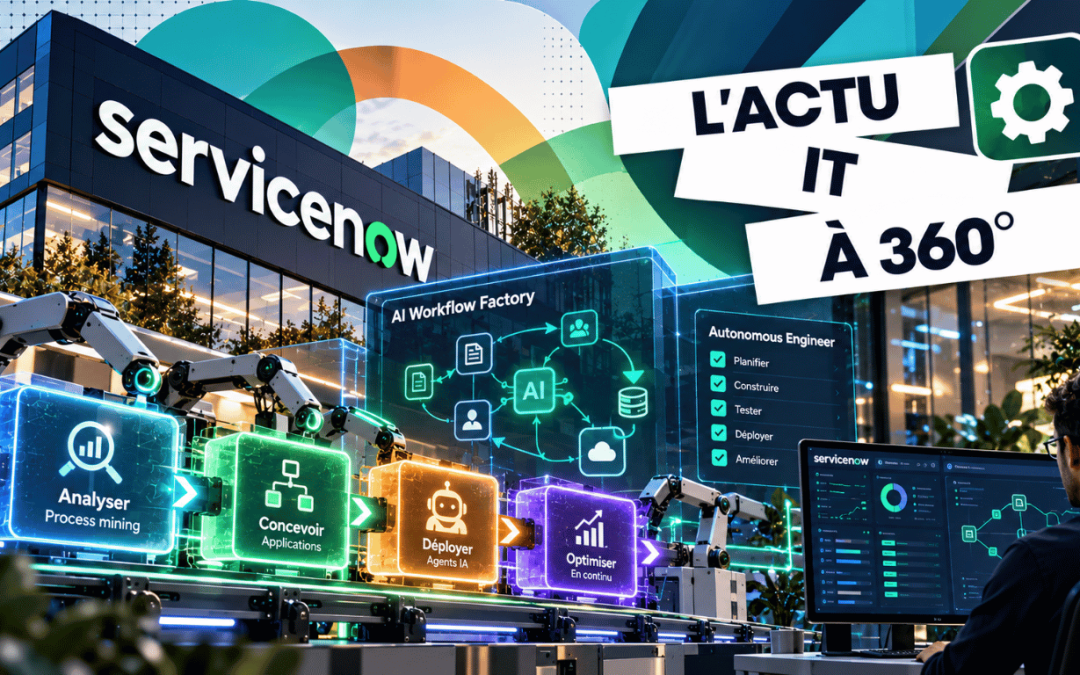
ServiceNow wants to turn process improvement into a continuous AI-driven loop
With AI Workflow Factory, ServiceNow aims to link the identification of inefficient processes with building and running their improvements. The announcement notably includes Autonomous Engineer, a tool designed to automate more of the implementation work.[1] For...