


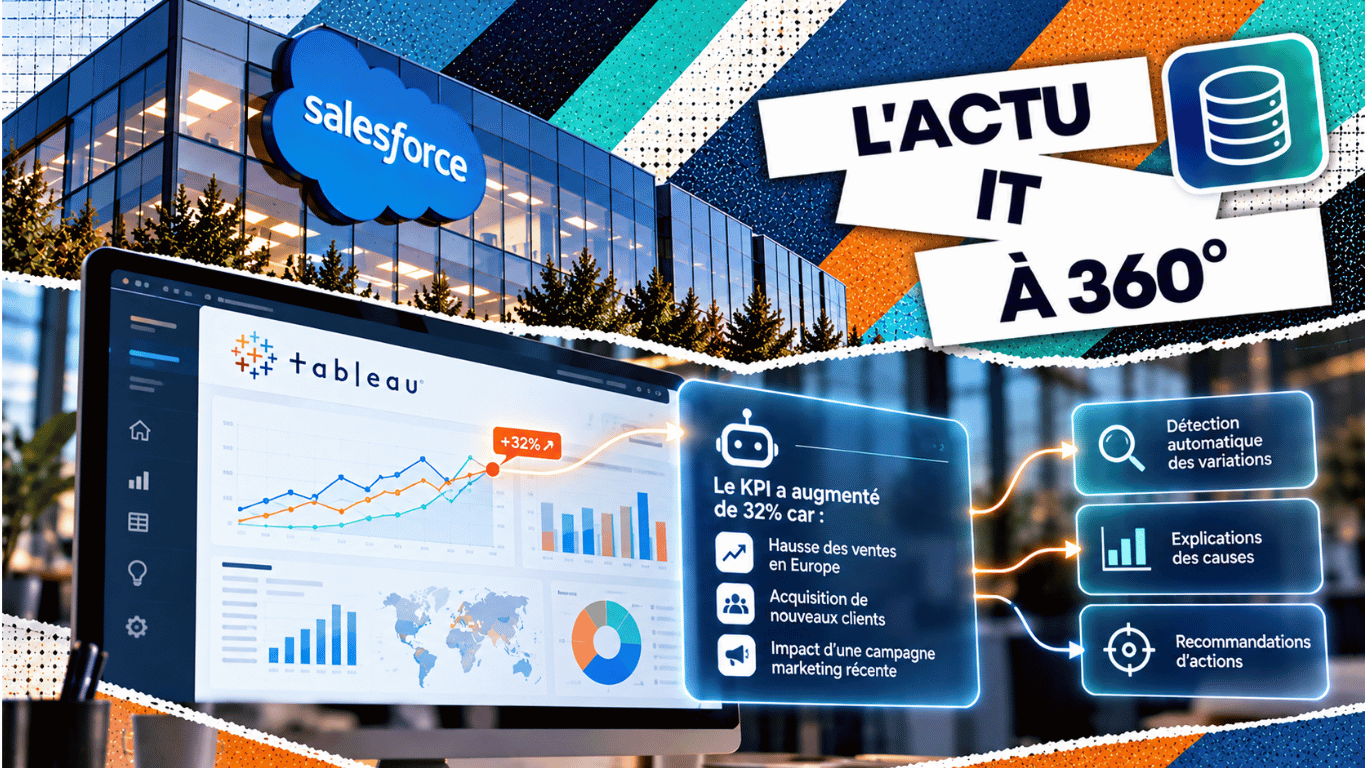
Salesforce has announced a definitive agreement to acquire Loops, an AI-based analytics platform, with the intention of integrating its technology into Tableau after closing.[1] The aim is to monitor metrics and bring out the factors associated with their changes. For businesses, the promise is to spot earlier what deserves analysis, provided they have reliable data and do not mistake a suggested explanation for a proven cause.
A deal announced before an integration that has yet to be built
The transaction is expected to close in early November, during Salesforce’s fiscal year 2027, subject to customary conditions. The press release gives no precise date for when Loops’ capabilities will be available in Tableau.[1] This is therefore an announced product direction, not a new feature already available to all users.
This distinction matters for a team preparing its budget or its analytics architecture. It can follow the project and identify its needs, but it should not base an operational deadline on an integration whose terms have yet to be specified.
Metrics become the starting point for an investigation
According to Salesforce, Loops monitors performance, detects trends and anomalies, and then brings out what contributes to changes. Its functions can be triggered from Slack or by email. The vendor wants to use them to strengthen Tableau’s agentic analytics and the prioritisation of actions.[1]
A key performance indicator, or KPI, summarises one dimension of the business: conversion, processing time or retention, for example. When it changes, the first need is often to work out where to look. Does the change concern all customers, or one particular region, product or channel? Proactive analysis can help organise this search.
Detecting a change is not enough to make a decision
This grid distinguishes three stages of analytical reasoning and the checks they require. It is an editorial reading of the business need.
| Stage | Question to address | Useful check |
|---|---|---|
| Detection | Which metric has changed and over what period? | Check data freshness and the comparison baseline. |
| Explanation | Which segments contribute to the change? | Examine volumes, changes in measurement and other factors. |
| Action | What intervention could improve the result? | Validate the hypothesis and measure the effects before rolling it out. |
A factor associated with a decline is not always its cause
A channel may account for a large share of a drop in sales because its traffic has changed, because a product is unavailable there or because data collection is incomplete. Breaking down a result helps locate the phenomenon; it does not automatically decide between all these explanations.
Before changing a campaign or a process, the analysis must be compared with business events. A controlled comparison or an experiment can then help test a hypothesis. The decision depends as much on this verification as on the clarity of the generated commentary.
Defining KPIs remains essential groundwork
Two departments may use the same word for different measures. A conversion rate calculated per visit does not match a rate calculated per user. Likewise, a cancelled order or a late-arriving event can change the result depending on the rules applied.
Continuous monitoring therefore requires a shared definition: formula, population, period, exclusions and reference source. The history of changes must also be kept. An alert triggered after a formula change does not necessarily describe a real change in activity.
An SME can test the value on a single metric
Take an illustrative scenario: an online shop notices a drop in its conversion rate. The team compares devices, channels and product categories. If the drop is concentrated on mobile, it then checks for payment incidents, stock shortages and recent changes to the customer journey. This scenario is not a customer result published by Salesforce.
The pilot should check that the tool surfaces useful observations without multiplying secondary alerts. The team can measure the time to a confirmed anomaly, the time needed to qualify the explanation and the share of alerts that are genuinely actionable. Nor does the absence of an alert prove the absence of a problem.
To assess a future integration, data access, costs and the scope of sources will need to be clarified. The press release provides no independent measure of accuracy or of generalisable time savings. These points remain to be verified on the company’s own data.
The IT skill to remember: Data Management
This development draws directly on Data Management. Professionals must know where information comes from, check its quality and ensure that transformations preserve the meaning of measures. A convincing explanation can still be misleading if the starting data is incomplete or poorly reconciled.
Their role includes documenting metrics and managing access rights. Users must understand what a KPI measures and what limits frame its interpretation. The details surfaced in an alert must also respect authorised access, particularly when they concern customers or employees.
The work continues in dialogue with business teams. Analysts must be able to verify the observations put forward, spell out uncertainties and track the effect of decisions taken. Automation can speed up investigation; the responsibility for giving results a reliable meaning remains.
Proactive analysis must steer a useful investigation
The value of proactive analysis is measured by its ability to steer a useful investigation. A dashboard that comments on its own changes does not thereby become an autonomous decision-maker: data quality, hypothesis testing and monitoring of results remain decisive.
Further reading
Four CCCLX reads to explore data quality, sharing and use in more depth.
Google Cloud Storage Intelligence Advisor detects storage anomalies
Talk to your database: Oracle improves its NL2SQL AI
Databricks extends Delta Sharing to AI and aims to break down data silos
Merck and Google Cloud commit one billion dollars to agentic AI
Sources
- 01
Salesforce (12 October 2026). “Salesforce Signs Definitive Agreement to Acquire Loops”. Announcement of the acquisition agreement and plans to integrate Loops technology into Tableau.

AI propels Nokia: data centres are reshaping the networking market
The AI explosion is transforming the infrastructure market Nokia is reaping the full benefits of the rise of artificial intelligence and the proliferation of data centres that comes with it. In the second quarter of 2026, the company’s Network Infrastructure business...

Gemini 3.5 Pro delayed: Google under pressure in the AI race
The race for AI models is speeding up Google is going through a difficult period in the competition over advanced artificial intelligence models. According to several reports in the specialist press, the launch of Gemini 3.5 Pro has reportedly been pushed back by...

Project Glasswing: Anthropic goes on the offensive against software vulnerabilities
A new step for AI applied to cybersecurity Anthropic is pressing ahead with Project Glasswing, an initiative that makes its Claude Mythos Preview model available to specialist cybersecurity players in order to identify and fix vulnerabilities in critical software. The...

Cloud, AI, defence: AWS steps up on every front
AWS makes artificial intelligence a pillar of critical infrastructure At the AWS Summit Washington, D.C. 2026, Amazon Web Services unveiled several developments aimed at government departments, public bodies and critical sectors. The company is strengthening its...

MDASH: the AI helping Microsoft secure Windows
Microsoft hands part of the bug hunt to artificial intelligence Cyberattacks are evolving ever faster, forcing software vendors to detect vulnerabilities before they can even be exploited. To meet this challenge, Microsoft has unveiled MDASH (Microsoft Detection and...

Microsoft speeds up its cybersecurity with AI: defence moves to machine scale
Microsoft wants to regain the upper hand against cyberattacks Cybercriminals are now using artificial intelligence to discover vulnerabilities, automate their attacks and speed up their malicious campaigns. In response, Microsoft is pressing ahead with its Secure...

Free access to Claude Fable 5 extended as Anthropic holds off
A new generation of AI designed for specific uses OpenAI is changing its strategy with the launch of GPT-5.6, a new family of models made up of Sol, Terra and Luna. Rather than offering a single model capable of meeting every need, the company is now betting on a...

OpenAI bets on modular AI with Sol, Terra and Luna
A new generation of AI designed for specific uses OpenAI is changing its strategy with the launch of GPT-5.6, a new family of models made up of Sol, Terra and Luna. Rather than offering a single model capable of meeting every need, the company is now betting on a...

Anthropic’s AI is advancing at a pace that worries cybersecurity specialists
AI models cross a new capability threshold Barely a month after its launch, Claude Mythos Preview is already improving its performance. According to the latest tests published by the UK’s AI Security Institute (AISI), Anthropic’s model now beats its own results from...
Lumo AI 2.0 speeds up without sacrificing data protection
Proton wants to prove that a high-performing AI can also be private The artificial intelligence race is no longer played out solely on model performance. User trust and data protection are now becoming major differentiators. With Lumo AI 2.0, Proton is upgrading its...