


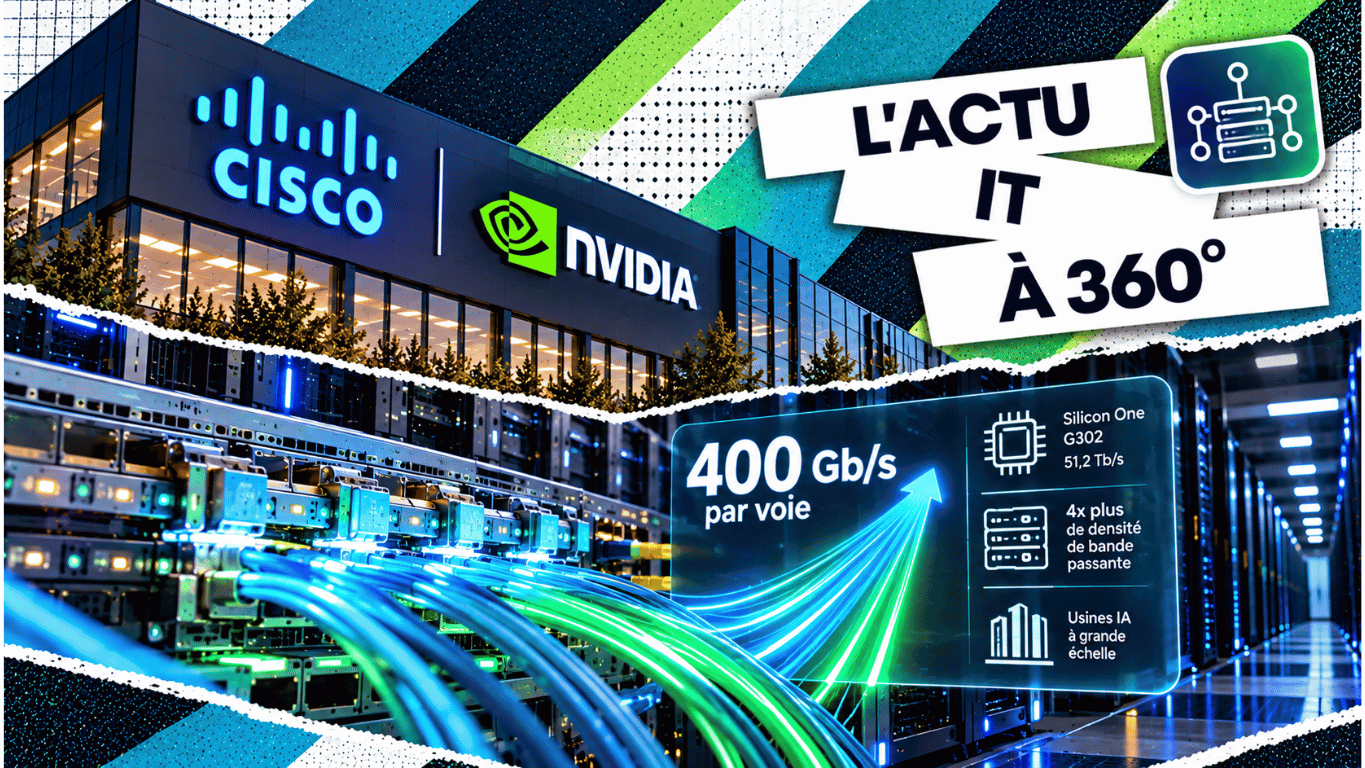
Cisco and NVIDIA have announced a project for a pluggable optical form factor, USFP, capable of supporting 400 Gb/s per lane. Cisco is also unveiling the Silicon One G302 switching chip, rated at 51.2 Tb/s.[1] These announcements address a key challenge for AI infrastructure: accelerators must exchange data quickly enough for the installed computing power to be genuinely usable. They do, however, concern separate components and timelines.
GPUs need to receive and share data
When processing is spread across several accelerators, part of the work depends on exchanges between machines. Waiting for data or for results from another node can slow down the entire computation. Adding GPUs is therefore not always enough to speed up a task if the network or storage is already limiting how fast they are fed.
The difficulty lies in locating the bottleneck. A saturated link, occasional congestion, poor traffic distribution or overly slow storage can all produce similar symptoms. The response must be based on measurements of the workload actually being run, before choosing faster equipment.
G302 powers the rack network while USFP prepares the optics
The G302 is aimed at top-of-rack switches, which connect servers to the data centre network. Cisco is announcing 200 Gb/s SerDes electrical interfaces and expects first shipments before the end of 2026.[1] The 51.2 Tb/s figure refers to aggregate switching capacity, not the throughput of an individual connection.
USFP, developed with NVIDIA, is a proposed optical module form factor. The partners plan an open specification.[1] A distinction must therefore be drawn between the chip being presented and this optical development, rather than attributing already available 400 Gb/s lanes to the G302.
Three figures that describe different things
Throughput is expressed here in bits per second. Aggregate capacity does not correspond to the usable throughput guaranteed to an application.
| Metric | What it describes | What it does not prove |
|---|---|---|
| 51.2 Tb/s | Switching capacity of the G302.[1] | The throughput available to each server. |
| 400 Gb/s per lane | Target per-lane capacity for USFP.[2] | The immediate availability of a complete link. |
| 6.4 Tb/s aggregate | 16 lanes at 400 Gb/s in the USFP project.[2] | An equivalent speed-up of AI applications. |
Density also depends on the number of lanes
The Cisco blog describes 16 lanes at 400 Gb/s, i.e. 6.4 Tb/s aggregate, with a possible evolution to 32 lanes and 12.8 Tb/s. It compares this proposal with 1.6 Tb/s pluggable modules to claim a fourfold increase in bandwidth density.[2] This factor therefore does not stem solely from doubling the per-lane throughput.
Maintenance matters as much as peak throughput
Cisco highlights the retention of field-replaceable modules and established operating practices for pluggable optics.[2] For an operator, the ability to service a module can weigh on the choice of architecture, just as much as throughput or footprint.
Higher density must nonetheless be assessed against cooling, cabling and spare-part availability constraints. The number of interventions, replacement lead times and compatibility conditions can change the real cost of an infrastructure over several years.
Energy gains have yet to be measured on the complete system
Cisco mentions energy efficiency potentially improved by around 1.3 times thanks to 400 Gb/s SerDes.[2] This indication does not mean that a data centre’s total consumption will fall in the same proportion. Higher capacity may also come with an increase in processing volumes.
A meaningful comparison must specify the load, the throughput actually carried and the scope measured. It should include network equipment, optics and cooling. The announcements reviewed do not present an independent benchmark that would allow the gain to be generalised to all environments.
SMEs can draw a sizing method from this
Most SMEs do not need to prepare a network for these speeds right away. However, an organisation that runs several GPU servers or buys remote computing capacity needs to understand what is limiting its workloads. The network is part of the service to be assessed, even when it is managed by a provider.
An illustrative scenario is to compare the same task on one and then several servers, observing duration, GPU utilisation and network traffic. If the time saving remains small, the team also examines storage and how the work is distributed. This test helps establish a diagnosis; it does not prove that the network is necessarily to blame.
The key IT skill: Systems and Network Administration
This development directly calls on Systems and Network Administration. Professionals must understand the paths data takes and distinguish theoretical throughput from observed performance. A capacity stated on a datasheet is not enough to size a service.
Their role includes analysing congestion, latency and dependencies on storage or compute. They must also check interfaces, optical modules and compatible software versions. These checks help avoid an investment that would simply move the bottleneck elsewhere.
Finally, network administration involves monitoring and incident recovery. Metrics must make degradations visible before they have a lasting impact on workloads. Having maintenance access and replacement procedures remains essential, even on a very high-performance infrastructure.
The value of USFP will therefore depend on performance measured on applications, equipment compatibility and operating conditions. To size an infrastructure, the real limits of compute, network and storage must first be identified.
Further reading
Four CCCLX reads on data centres, data and AI infrastructure.
AI powers Nokia: data centres reshape the networking market
Google Cloud Storage Intelligence Advisor detects storage anomalies
Databricks extends Delta Sharing to AI and aims to break down data silos
AI voice agents: Oracle details a LiveKit architecture on OCI
Sources
- 01
Cisco (12 October 2026). “Cisco Advances Scalability and Openness at OCP 2026”. Announcement of the Silicon One G302 switch and the USFP development project with NVIDIA.
- 02
Gartner, B. and Eatherton, W., Cisco Blogs (12 October 2026). “Cisco and NVIDIA Announce USFP: Expanding the Path to AI Connectivity”. Details on lanes, aggregate capacity and the gains announced for the USFP form factor.

With Stainless, Anthropic aims to put Claude at the heart of software development
The AI battle is shifting to developer tools Anthropic is continuing its rise in artificial intelligence with the acquisition of Stainless, a start-up specialising in development tools and API automation. Behind this acquisition lies a significant strategic...

Microsoft transforms Office with Fintool and autonomous AI
Office enters the age of intelligent agents Microsoft is stepping up its agentic artificial intelligence strategy with the acquisition of Fintool, a start-up specialising in automated financial analysis. Founded in San Francisco by Frenchmen Nicolas Bustamante and...

Googlebook: Google wants to reinvent the computer around AI
A new generation of PCs designed for artificial intelligence Google is preparing a new category of laptops called “Googlebook”, designed from the ground up around artificial intelligence. After AI-powered smartphones, the company now wants to turn the PC itself into a...

OpsMill: the start-up that wants to prepare IT systems for the AI shock
Artificial intelligence is moving faster than IT infrastructure Generative artificial intelligence is rapidly transforming businesses, but one reality is becoming increasingly clear: today’s IT infrastructure is not ready to absorb this revolution. This is...

What if your future cloud fitted in a drop of DNA?
Data storage is reaching its limits Every day, humanity produces a gigantic amount of data. In 2025, the volume generated worldwide each day is estimated at almost 300 exabytes, the equivalent of a century of European audiovisual archives created every 24 hours1. With...

+13.5% in 2026: corporate IT spending soars
A sharp acceleration in IT investment Worldwide IT spending is expected to reach 6.31 trillion dollars in 2026, a rise of 13.5% year on year, according to Gartner’s latest forecast1. This figure marks a clear acceleration compared with previous estimates (+10.8%),...

Microsoft builds legal AI into Word: contracts go automated
Word becomes an intelligent legal tool Microsoft is taking a new step by building artificial intelligence specialised in legal analysis directly into Word. The aim is clear: to automate contract review, detect risks and speed up document production. At a time when...

Merck and Google Cloud: a key partnership for agentic AI in the enterprise
A strategic investment to transform the company through AI Biopharmaceutical giant Merck has announced a 1-billion-dollar, 10-year partnership with Google Cloud, with a clear goal: to embed agentic artificial intelligence at the heart of its operations. This project...

Chrome Enterprise goes AI: Google automates browsing and workflows
The browser becomes a genuinely intelligent work tool Google is upgrading Chrome Enterprise with advanced artificial intelligence capabilities, turning the browser into an active platform able to carry out tasks. Autonomous browsing, workflow automation and...

$32 billion: Google launches a cyber army of AI agents
Cybersecurity enters a new dimension Google has made a major move by announcing an investment of $32 billion in developing a “cyber army” of artificial intelligence agents. Behind this term lies a technological reality: systems capable of automatically detecting,...