


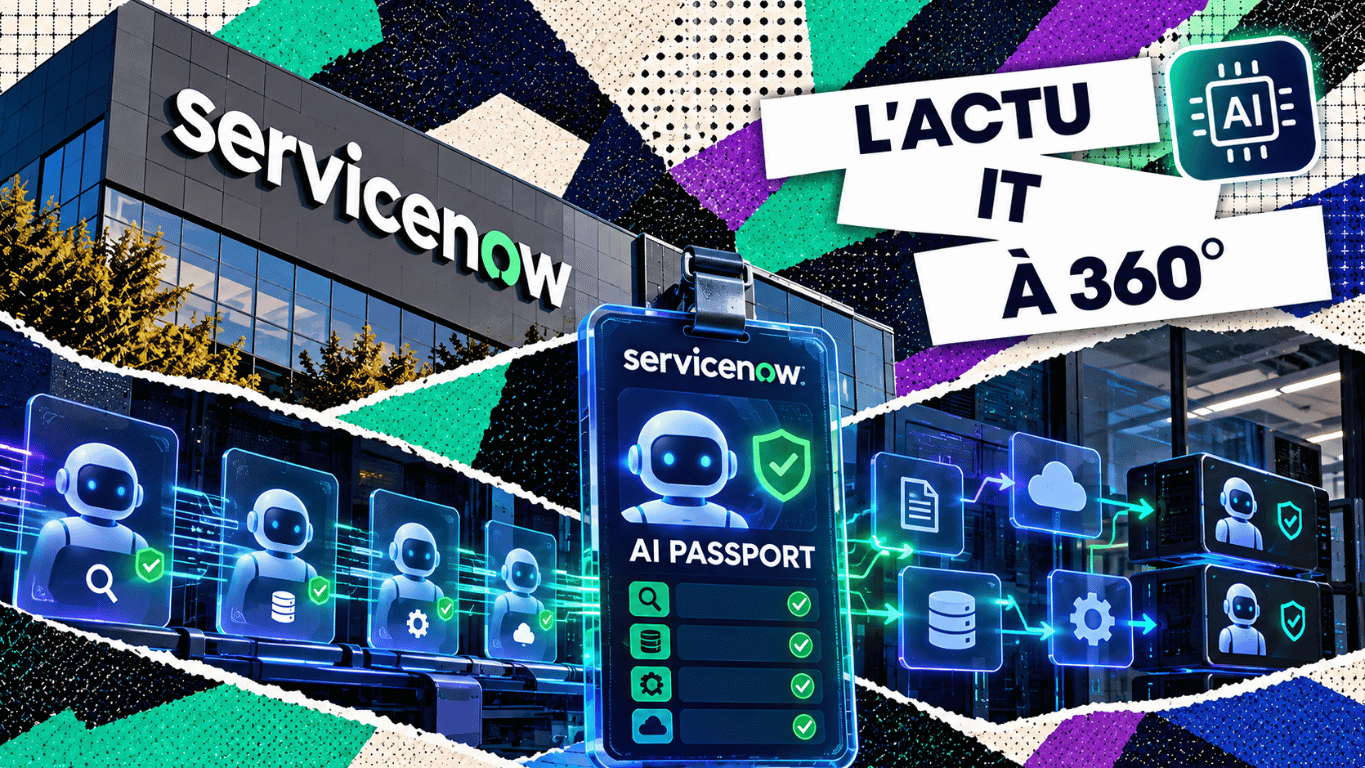
ServiceNow has announced AI Passport, a cryptographically signed authorisation credential designed to govern AI agents and MCP servers while workflows are running. It is scheduled to be available in the fourth quarter of 2026.[1] The image of a digital badge helps to explain the principle: an agent must be able to justify the resources it consults and the actions it takes, within a scope defined by the company.
An agent’s identity is not enough to define its rights
An assistant that answers a question and an agent that modifies a record do not have the same access needs. As soon as a system uses tools, it is necessary to determine what it can read, write or trigger, and in what circumstances additional approval becomes necessary.
According to ServiceNow, AI Passport makes it possible to check the authorised scope at each step of a workflow involving several agents. The system provides for delegation with progressively narrower rights, targeted revocation and graduated responses that can go as far as stopping the agent.[1]
The challenge is to make these limits effective at the moment of action. An instruction asking the agent to be careful is no substitute for a technical control capable of refusing an operation. Likewise, recording an action in a log does not, on its own, prevent it.
MCP connections are part of the scope to be secured
The MCP protocol connects AI applications to tools and resources. The official documentation points out that servers using authorisation must verify access tokens, in particular that the tokens are actually intended for them.[2] A technical connection to a tool is therefore not a general permission to use it.
For a company, verification must cover the whole chain: the agent, the server exposing a function and the application performing the operation. If any of these components has overly broad rights, the limits displayed in an interface may not match what is actually possible.
ServiceNow announces a collaboration with NVIDIA to enforce these controls in the infrastructure, notably with OpenShell. The Super Intelligence Control Tower is designed to keep actions traceable.[1] The actual coverage of tools and environments will need to be checked during deployment.
Four questions before giving an agent a badge
This editorial grid helps to translate authorisation management into concrete decisions.
| Component | Operational effect | Control question |
|---|---|---|
| Scope | Limit the data and tools that can be accessed. | Do the rights match the assigned task? |
| Delegation | Govern the handover of a task to another agent. | Do permissions remain limited at each step? |
| Revocation | Withdraw authorisations when the situation changes. | Is the withdrawal actually enforced by connected systems? |
| Traceability | Link an operation to its authorisation and its outcome. | Can we understand who allowed the action and what it changed? |
An authorised operation can still be wrong
Take a support agent authorised to consult tickets and draft a reply. This task does not automatically justify resetting an account or changing a network configuration. Those operations should have their own rules, with approval suited to their consequences.
Even within its scope, the agent may misinterpret a request or select the wrong record. Permission controls must therefore be complemented by testing, checking of the result and a recovery procedure. This example is a suggested framework, not a standard configuration announced for AI Passport.
Inventorying agents and matching costs to usage
ServiceNow is also announcing detection of unauthorised AI and AI Cost Management, expected in the fourth quarter of 2026. The aim is to link spending more closely to usage and results.[1] These functions should be distinguished from permission control itself.
For SMEs, start with one agent and one specific task
An SME could look at an agent already used for support or document processing. The pilot would involve identifying its access, removing unnecessary permissions and testing that an out-of-scope action is refused. It would also be necessary to check that rights are withdrawn and that the task can be taken over manually.
Agent security becomes an everyday administration job
This development gives Cybersecurity a central role. Professionals must apply the principle of least privilege: granting only the access needed for a task. They must understand the connections between agents, tools and applications in order to spot excessive permissions.
Their role also involves testing controls. An expected refusal must be checked in practice, as must the revocation of access or the stopping of a task. Logs must make it possible to explain actions without needlessly exposing sensitive information.
Oversight continues as usage evolves. A new connection or a change of task can alter the level of risk. The skill lies in adjusting authorisations, investigating incidents and organising the return to manual control with business teams and application owners.
Control will be judged at the moment of action
AI Passport highlights a key question for agentic AI: how can permissions be made verifiable and enforceable throughout a task? The answer will depend on integration with real systems. A badge will be useful if the associated controls work and if teams can understand, interrupt and correct operations.
Further reading
Four CCCLX reads to explore permissions, security and agent integration in more depth.
Azure Linux 4.0: is Microsoft preparing for life after Windows Server?
Open-source security scales up: IBM, Red Hat and Palo Alto join forces
GitHub Copilot bulks up for business: coding agents come under IT control
AI voice agents: Oracle details a LiveKit architecture on OCI
Sources
- 01
ServiceNow Newsroom (15 October 2026). “ServiceNow advances its operational harness for enterprise AI with AI Passport and expanded governance capabilities”. Announcement of AI Passport and the associated governance capabilities.
- 02
Model Context Protocol (accessed 16 October 2026). “Authorization”. Documentation on access token verification by MCP servers.
Editorial check of 16 October 2026. ServiceNow plans to make AI Passport, unauthorised AI detection and AI Cost Management available in the fourth quarter of 2026. The framework examples and the SME pilot are editorial suggestions, not standard configurations or announced customer results.

AI propels Nokia: data centres are reshaping the networking market
The AI explosion is transforming the infrastructure market Nokia is reaping the full benefits of the rise of artificial intelligence and the proliferation of data centres that comes with it. In the second quarter of 2026, the company’s Network Infrastructure business...

Gemini 3.5 Pro delayed: Google under pressure in the AI race
The race for AI models is speeding up Google is going through a difficult period in the competition over advanced artificial intelligence models. According to several reports in the specialist press, the launch of Gemini 3.5 Pro has reportedly been pushed back by...

Project Glasswing: Anthropic goes on the offensive against software vulnerabilities
A new step for AI applied to cybersecurity Anthropic is pressing ahead with Project Glasswing, an initiative that makes its Claude Mythos Preview model available to specialist cybersecurity players in order to identify and fix vulnerabilities in critical software. The...

Cloud, AI, defence: AWS steps up on every front
AWS makes artificial intelligence a pillar of critical infrastructure At the AWS Summit Washington, D.C. 2026, Amazon Web Services unveiled several developments aimed at government departments, public bodies and critical sectors. The company is strengthening its...

MDASH: the AI helping Microsoft secure Windows
Microsoft hands part of the bug hunt to artificial intelligence Cyberattacks are evolving ever faster, forcing software vendors to detect vulnerabilities before they can even be exploited. To meet this challenge, Microsoft has unveiled MDASH (Microsoft Detection and...

Microsoft speeds up its cybersecurity with AI: defence moves to machine scale
Microsoft wants to regain the upper hand against cyberattacks Cybercriminals are now using artificial intelligence to discover vulnerabilities, automate their attacks and speed up their malicious campaigns. In response, Microsoft is pressing ahead with its Secure...

Free access to Claude Fable 5 extended as Anthropic holds off
A new generation of AI designed for specific uses OpenAI is changing its strategy with the launch of GPT-5.6, a new family of models made up of Sol, Terra and Luna. Rather than offering a single model capable of meeting every need, the company is now betting on a...

OpenAI bets on modular AI with Sol, Terra and Luna
A new generation of AI designed for specific uses OpenAI is changing its strategy with the launch of GPT-5.6, a new family of models made up of Sol, Terra and Luna. Rather than offering a single model capable of meeting every need, the company is now betting on a...

Anthropic’s AI is advancing at a pace that worries cybersecurity specialists
AI models cross a new capability threshold Barely a month after its launch, Claude Mythos Preview is already improving its performance. According to the latest tests published by the UK’s AI Security Institute (AISI), Anthropic’s model now beats its own results from...

Lumo AI 2.0 speeds up without sacrificing data protection
Proton wants to prove that a high-performing AI can also be private The artificial intelligence race is no longer played out solely on model performance. User trust and data protection are now becoming major differentiators. With Lumo AI 2.0, Proton is upgrading its...