



Mistral has opened the public preview of Mistral Large 4, nicknamed “Le Chonk”, and plans to release its weights by the end of the month.[1] This European model targets agentic use cases in particular, as well as cybersecurity, finance and industry. For businesses, the issue goes beyond its size: which use cases could it improve, and under what conditions will it be possible to deploy and control it?
A preview available before the weights are released
Public access is currently via an API. Mistral also says it offers private access to selected partners, with additional cybersecurity capabilities and the preview weights.[1] Neither of these access modes should be confused with general availability of the weights.
This distinction changes how a project should be prepared. Testing a remote service makes it possible to evaluate its answers, but does not validate an installation within the company’s infrastructure. A future self-hosted deployment will have to be examined in light of the licence terms, compatible tools and resources required.
1.05 trillion parameters, but 49 billion active
The documentation describes a Mixture-of-Experts architecture, with 1.05 trillion parameters in total and 49 billion active. It also announces a one-million-token context window and a vision encoder.[2] Parameters are the values learnt during training; tokens are the units in which the model processes content.
In an expert-based architecture, a subset of components is selected for each token processed. The number of active parameters therefore sheds light on the compute involved, but does not sum up the system’s storage, memory or communication requirements. On its own, it does not allow the operating cost to be inferred.
Likewise, a large context window indicates how much content the model can take in. It does not guarantee that it will retrieve every relevant piece of information or correctly interpret every contradiction in a large file. These capabilities must be tested on the documents actually used.
Capabilities to translate into qualification criteria
This grid links the announced features to the checks worth carrying out before a business pilot.
| Component | Expected operational effect | Control question |
|---|---|---|
| Extended context | Analyse more documents in a single request. | Do the answers retrieve the right sources without omissions? |
| Multimodality | Cross-reference textual and visual elements. | Are errors on tables, diagrams or images detected? |
| Tool calling | Integrate the model into multi-step tasks.[2] | Which access rights and actions require validation? |
| Announced weights | Consider a deployment under the organisation’s control.[1] | Under what licence, on what infrastructure and at what total cost? |
Announced performance must match real-world use
Mistral claims top-tier results among open-weight models, notably in cybersecurity, finance and industrial manufacturing.[1] This positioning remains a vendor claim. It is not enough to demonstrate superiority on every task or to guarantee the results of a particular project.
A business must define its own criteria: accuracy of answers, quality of references, processing time and the ability to recognise missing information. For an agent, it is also necessary to observe the actions carried out, errors along the way and the situations in which human intervention becomes necessary.
For SMEs, start with a verifiable task
A first pilot could focus on analysing a set of technical procedures in order to prepare answers backed by their sources. The team would compare the proposals with the reference documents and measure the time saved after verification. This is an evaluation scenario, not an announced customer result.
API access can be used for this qualification, subject to internal rules on the data transmitted. Any later decision to host the model must factor in memory, compute, operations and available skills. A smaller model may still be preferable if it handles the task well enough at a lower cost and with less complexity.
Professionals must know how to evaluate before integrating
This announcement illustrates the importance of Artificial Intelligence as an operational skill. Understanding context, multimodal capabilities and tool use helps in choosing a suitable approach, instead of selecting a model solely on its size or ranking.
The work then consists of building a representative evaluation: common examples, ambiguous cases, expected errors and success criteria. Professionals must distinguish a convincing answer from an accurate one, then document the limitations observed before connecting the model to applications.
Finally, this skill involves linking AI to how the organisation operates. Access rights, cost tracking and human takeover must be defined with the teams concerned. The quality of the system depends as much on this integration as on the capabilities of the model itself.
A European alternative whose control has yet to be organised
The forthcoming release of the weights may broaden the scope for technical control. It does not automatically make a deployment sovereign: hosting, licences, dependencies and access remain decisive. The value of Large 4 will be measured in tasks successfully completed, at a sustainable cost and with clearly assigned responsibilities.
Further reading
Four CCCLX reads on model evaluation, cybersecurity and agent control.
Two months, 1.1 billion dollars: River AI already has investors in a frenzy
Project Glasswing: Anthropic goes on the offensive against software vulnerabilities
GitHub Copilot bulks up for business: code agents come under IT control
AI voice agents: Oracle details a LiveKit architecture on OCI
Sources
- 01
Mistral (6 October 2026). “Introducing Mistral Large 4”. Presentation of the public preview, the announced use cases and the release of the weights planned for the end of the month.
- 02
Mistral Docs (6 October 2026). “Mistral Large 4”. Public preview model card: architecture, parameters, context, vision encoder and features.
Editorial check as of 14 October 2026. Mistral has announced the release of the weights by the end of the month, without giving a precise date in its public presentation. The performance figures mentioned are vendor claims; the table and pilot criteria are editorial analysis.

Europe accuses Anthropic of discrimination after Fable 5 is blocked
A US decision that sparks an international crisis The sudden suspension of access to Anthropic’s Fable 5 and Mythos 5 models outside the United States now goes well beyond technology. What initially looked like a national security measure is taking on a major...

Mobi Fold and Spotlight 2: Logitech aims to simplify everyday hybrid working
The office is everywhere, but the tools do not always keep up Hybrid working has profoundly changed professional habits. Video-conference meetings, frequent travel, days split between home, the office and coworking spaces: employees now move between multiple...

+80%: agentic AI triggers a record surge in enterprise SSD prices
Artificial intelligence is putting new strain on infrastructure Artificial intelligence is often associated with graphics processors and massive computing centres. Yet another essential component of digital infrastructure is coming under unprecedented pressure:...
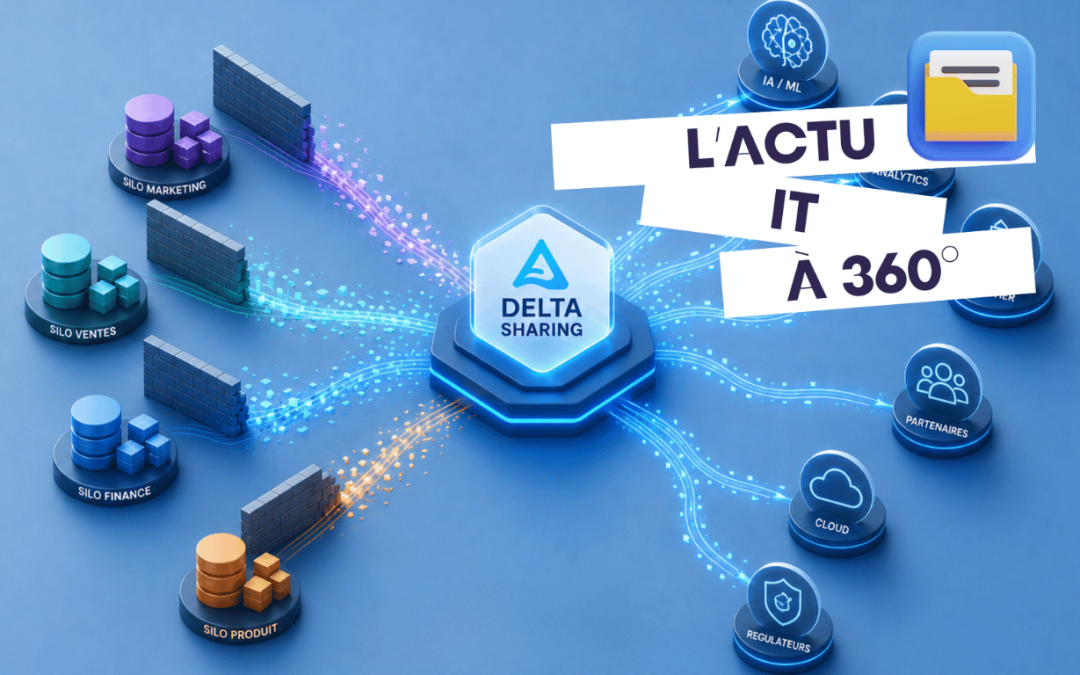
Databricks extends Delta Sharing to AI and aims to break down data silos
Data is no longer enough: intelligence must now be shared too Artificial intelligence is transforming the way companies use their data. Yet one major obstacle remains: the resources needed for AI projects are often scattered across different platforms, teams and...

RTX Spark: Nvidia accelerates the shift to AI-optimised PCs
Nvidia wants to redefine the PC for the age of artificial intelligence Unveiled at Computex 2026, the RTX Spark chip marks a new stage in the evolution of personal computers. With this Arm-based platform, Nvidia is not simply seeking to offer a more powerful...

WiFi 8 is arriving sooner than expected: what it means for businesses
A new generation of networking is already on the horizon While WiFi 7 is only just beginning to spread among businesses and consumers, the industry is already preparing the next step. TP-Link has just unveiled the first WiFi 8-compatible router, confirming that the...

Webedia-Elephant turns to Gemini Enterprise to industrialise generative AI
IT outages become a board-level issue Long regarded as mere technical incidents, service outages are now taking on a whole new dimension. According to a study by Oxford Economics for Splunk, Global 2000 companies suffer an average of 60 downtime incidents a year, at...

$600 billion lost: IT outages take on a new dimension
IT outages are becoming a boardroom issue Long regarded as mere technical incidents, service interruptions are now taking on a whole new dimension. According to a study conducted by Oxford Economics for Splunk, Global 2000 companies suffer an average of 60 downtime...

Lightwell: IBM and Red Hat tackle the open source patching headache
AI finds flaws faster than companies can fix them Artificial intelligence is profoundly transforming cybersecurity. While it makes it possible to detect vulnerabilities more quickly, it also creates a new challenge: the ability to fix a growing number of flaws within...

AWS strengthens OpenSearch to connect AI to enterprise data
AI agents are forcing the cloud to evolve The rise of agentic AI is profoundly transforming cloud infrastructure. Unlike traditional conversational assistants, intelligent agents must access data, interact with several systems and carry out tasks autonomously. To meet...