


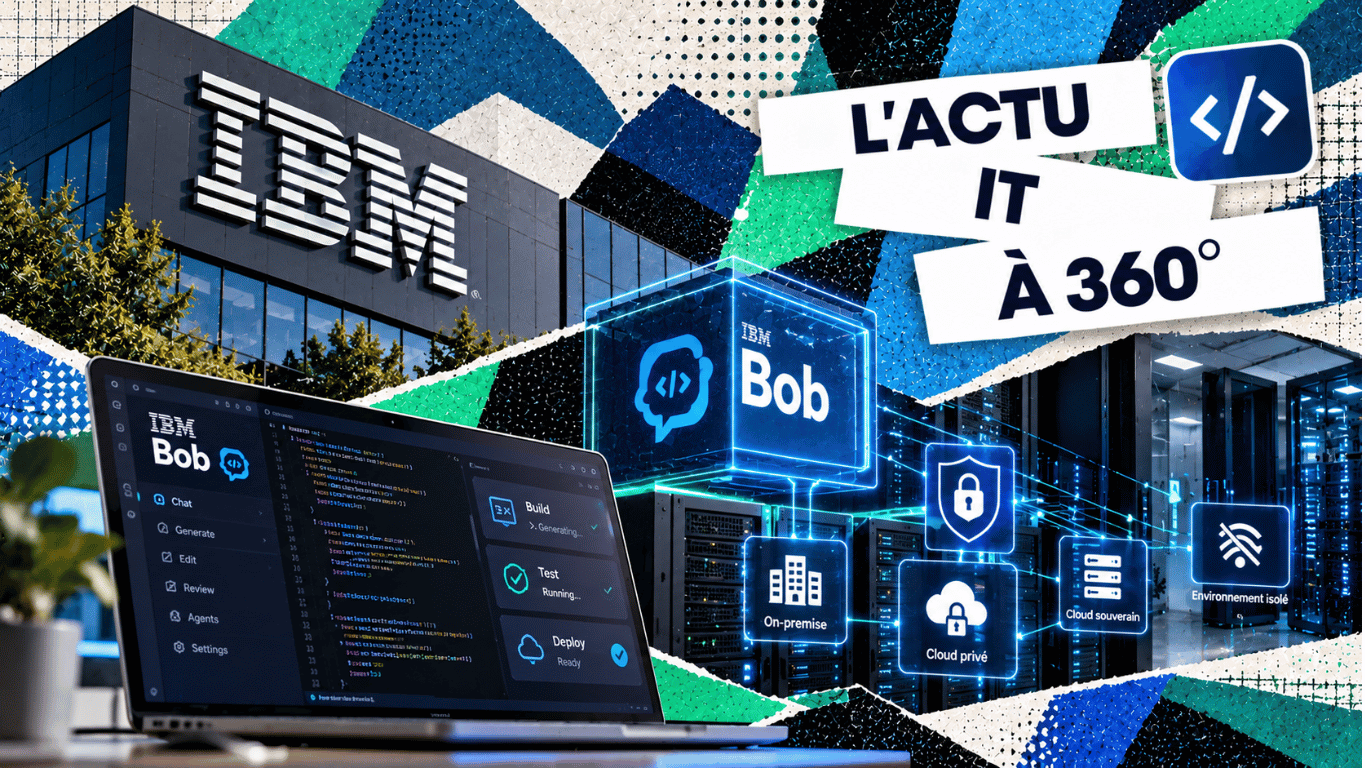
IIBM has announced a self-hosted version of Bob, its agentic development platform, for internal infrastructure, private or sovereign clouds and environments isolated from the internet.[1] This option addresses a concrete obstacle: some applications contain code, data or business logic that a company wants to keep within its own environment. It still needs to be checked where the models actually do their processing.
The assistant moves into the company’s working environment
According to IBM, Bob helps with understanding applications, planning tasks, carrying out changes and validating them. The self-hosted offering notably retains an experience within the development environment and the BobShell tool.[2] The ambition therefore goes beyond suggesting a few lines of code.
For a team maintaining legacy software, the potential benefit would be to prepare changes while taking the existing behaviour into account. Billing rules, interfaces with other systems or specific processing routines often make up a large part of the software’s value. Their confidentiality can matter as much as that of the code itself.
Self-hosting Bob does not always mean running the model locally
IBM distinguishes between models installed and administered by the customer and hybrid configurations using a compatible external service. In a supported local configuration, the code, development context and build artefacts can remain within the customer’s environment.[2]
The decisive choice concerns inference, that is, running the model when it processes a request. Hosting the assistant on your own infrastructure is therefore not enough to establish that all the data stays there. You also need to examine the models used and the connections required by the chosen setup.
IBM cites NVIDIA Nemotron and Poolside Laguna among the self-hosted models supported at launch. Customers must provide access to a supported model; some existing licences can be reused under certain conditions.[2] Compatibility and usage rights are therefore part of the project.
Four decisions that determine real control
This grid sets out the questions to examine before a deployment. It does not constitute a security certification of Bob.
| Component | Operational effect | Control question |
|---|---|---|
| Hosting | Place the service in an environment administered by the company. | Who runs the components and applies updates? |
| Model | Determine where code and instructions are processed. | Is inference local or entrusted to an external service? |
| Tool access | Allow the agent to consult or modify resources. | Which repositories, secrets and environments are accessible? |
| Validation | Check changes before they are integrated. | Which tests and what human review are required before going into production? |
Keeping data inside does not eliminate errors
An environment isolated from the internet, often called “air-gapped”, can meet a network separation requirement. IBM has announced support for this type of deployment with compatible models.[1] This property relates to the architecture; on its own, it does not prove the quality of the code produced.
The team must still check the changes, the dependencies added and the consequences for applications. An agent allowed to act across too wide a scope can cause unwanted changes even without an external connection. Permissions, tests and rollback options remain operational decisions.
For SMEs, assessing the value on a well-defined project
An SME developing proprietary software could start with a limited task, such as documenting a module or preparing its modernisation in a dedicated branch. This scenario is a suggested pilot, not a customer result published by IBM.
The assessment should measure the time saved after review and correction, the relevance of the tests proposed and the defects detected before integration. The budget should also include licences, computing resources, administration and maintenance. The two announcements consulted provide neither a typical total cost nor an independent performance comparison across configurations.
The developer stays in control of changes
This development reinforces the importance of Web Programming and Management. Understanding the code, its dependencies and business needs makes it possible to frame a task the agent can handle, and then to judge whether its proposal truly meets the project’s requirements.
Code review remains central. The developer must spot an incorrect assumption, an unsuitable library or a test that merely confirms the behaviour the agent imagined. It is up to them to compare the changes against real-world use and maintenance constraints.
Their role also includes organising delegated work: defining the scope, selecting the relevant context, monitoring actions and deciding on integration. In-house hosting brings the tool closer to the software estate, but responsibility for evolving that estate remains human.
Sovereignty is verified in the chosen configuration
The announcement opens up an option for organisations whose constraints limit the use of external assistants. Its value will depend on the whole set-up: compatible models, data flows, authorised access and the ability to operate the service. The decision should be based on a documented pilot, with measured gains and clearly assigned responsibilities.
Further reading
Four CCCLX reads to explore the control of agents and their infrastructure in more depth.
Azure Linux 4.0: is Microsoft preparing for life after Windows Server?
Open-source security scales up: IBM, Red Hat and Palo Alto join forces
GitHub Copilot bulks up for business: coding agents come under IT control
AI voice agents: Oracle details a LiveKit architecture on OCI
Sources
- 01
IBM Newsroom (1 October 2026). “IBM Introduces Self-Hosted Deployment for IBM Bob to Help Enterprises Advance AI Sovereignty and Governance”. Announcement of Bob’s self-hosted deployment and the target environments.
- 02
Mishra, P. and Sundaresan, N., IBM (30 September 2026). “IBM Bob expands to self-hosted environments for sensitive and mission-critical enterprise software”. Product details on compatible models and local and hybrid configurations.
Checked on 6 October 2026. The date used is that of the press release; the product presentation is dated 30 September. Features and configurations are as described by IBM. The table, the SME scenario and the qualification criteria are editorial analysis. The four internal links were checked during research for this series.

AI propels Nokia: data centres are reshaping the networking market
The AI explosion is transforming the infrastructure market Nokia is reaping the full benefits of the rise of artificial intelligence and the proliferation of data centres that comes with it. In the second quarter of 2026, the company’s Network Infrastructure business...

Gemini 3.5 Pro delayed: Google under pressure in the AI race
The race for AI models is speeding up Google is going through a difficult period in the competition over advanced artificial intelligence models. According to several reports in the specialist press, the launch of Gemini 3.5 Pro has reportedly been pushed back by...

Project Glasswing: Anthropic goes on the offensive against software vulnerabilities
A new step for AI applied to cybersecurity Anthropic is pressing ahead with Project Glasswing, an initiative that makes its Claude Mythos Preview model available to specialist cybersecurity players in order to identify and fix vulnerabilities in critical software. The...

Cloud, AI, defence: AWS steps up on every front
AWS makes artificial intelligence a pillar of critical infrastructure At the AWS Summit Washington, D.C. 2026, Amazon Web Services unveiled several developments aimed at government departments, public bodies and critical sectors. The company is strengthening its...

MDASH: the AI helping Microsoft secure Windows
Microsoft hands part of the bug hunt to artificial intelligence Cyberattacks are evolving ever faster, forcing software vendors to detect vulnerabilities before they can even be exploited. To meet this challenge, Microsoft has unveiled MDASH (Microsoft Detection and...

Microsoft speeds up its cybersecurity with AI: defence moves to machine scale
Microsoft wants to regain the upper hand against cyberattacks Cybercriminals are now using artificial intelligence to discover vulnerabilities, automate their attacks and speed up their malicious campaigns. In response, Microsoft is pressing ahead with its Secure...

Free access to Claude Fable 5 extended as Anthropic holds off
A new generation of AI designed for specific uses OpenAI is changing its strategy with the launch of GPT-5.6, a new family of models made up of Sol, Terra and Luna. Rather than offering a single model capable of meeting every need, the company is now betting on a...

OpenAI bets on modular AI with Sol, Terra and Luna
A new generation of AI designed for specific uses OpenAI is changing its strategy with the launch of GPT-5.6, a new family of models made up of Sol, Terra and Luna. Rather than offering a single model capable of meeting every need, the company is now betting on a...

Anthropic’s AI is advancing at a pace that worries cybersecurity specialists
AI models cross a new capability threshold Barely a month after its launch, Claude Mythos Preview is already improving its performance. According to the latest tests published by the UK’s AI Security Institute (AISI), Anthropic’s model now beats its own results from...

Lumo AI 2.0 speeds up without sacrificing data protection
Proton wants to prove that a high-performing AI can also be private The artificial intelligence race is no longer played out solely on model performance. User trust and data protection are now becoming major differentiators. With Lumo AI 2.0, Proton is upgrading its...