



HPE plans to deploy a Self-Driving Network for the 2027 Ryder Cup, with Wi-Fi 7 and an operations centre bringing together data and AI tools.[1] The stated aim is to monitor usage, adapt the network and move towards autonomous interventions. For businesses, the project raises a practical question: which decisions can be delegated without losing control of the service?
A deployment planned for a demanding event
Announced on 5 October, the project concerns the competition to be held at Adare Manor, Ireland, from 17 to 19 September 2027. HPE plans to connect the tournament areas and extend its Connected Intelligence Center, introduced at the 2025 edition. The centre will run on HPE Private Cloud AI and will be developed by HPE Services.[1]
The diversity of users and spaces makes this an interesting case for observing how a network is operated under pressure. The press release, however, describes a system yet to come. It does not yet provide any results on interruptions avoided, quality achieved or the cost of this edition.
Wi-Fi 7 and automation meet different needs
Radio connectivity allows devices to access the network. Automation concerns the way this network is monitored, anomalies are interpreted and an intervention is chosen. Installing a new generation of Wi-Fi is therefore not enough to make an infrastructure autonomous.
AIOps refers to the use of AI to help operate IT systems. In a network, the benefit is to link scattered signals to a problem the user can observe. A slow connection may require several checks before a configuration change is justified.
Targeted actions already exist in HPE’s strategy
In May 2026, HPE announced autonomous capabilities on its Mist and Aruba Central platforms: optimisation of radio parameters, correction of missing VLAN configurations and handling of rogue DHCP servers.[2] A VLAN logically segments the network; DHCP notably provides devices with the parameters they need to connect.
These examples make the promise more concrete, but they do not constitute the list of functions that will be enabled at the Ryder Cup. The October press release details neither this scope nor the planned human approvals. A capability in the catalogue must be distinguished from its actual use in a project.
Four stages for understanding the level of autonomy
This editorial grid distinguishes the functions to be assessed. It does not describe the tournament’s final configuration.
| Stage | Operational effect | Control question |
|---|---|---|
| Monitoring | Spot a degradation in service. | Do the measurements cover critical uses? |
| Diagnosis | Link symptoms to a probable cause. | What evidence can be used to verify the cause? |
| Recommendation | Propose an appropriate change. | What effect is expected, and who approves it? |
| Correction | Carry out an action within an authorised scope. | How can the result be checked and rolled back? |
A shared view does not replace responsibilities
According to HPE, the Connected Intelligence Center will bring together the tournament’s data, AI models and tools in a unified operational view.[1] For teams, this kind of organisation can make it easier to link a technical problem to its impact on operations.
Decision-making still needs to be organised: who authorises a change, who receives a persistent alert and who takes back control? A useful recommendation must be open to review by those responsible for the network, the applications and the operations concerned.
For an SME, start with a limited intervention
A pilot could focus on one site and one family of recurring incidents, observing the recommendations before any automatic execution. The team would compare resolution time, diagnostic errors and the number of human interventions required. This scenario is a suggested evaluation, not a result announced by HPE.
The full cost should include equipment, licences, integration and the monitoring of automations. The case of an international event is not enough to demonstrate a return on investment for an SME. Relevance will depend on the existing estate, the expected service and the operational resources available.
The administrator defines the conditions under which the network acts
This development reinforces Systems and Network Administration. Professionals must understand the dependencies between radio access, network services and applications in order to verify a diagnosis. Reading metrics remains essential when the tool proposes a fix.
Their work also involves defining the automation’s rights, the authorised changes and the conditions for reverting to a known configuration. An action that is appropriate on one device can become risky if it is extended to several sites without verification.
The value of this skill is thus shifting towards designing and controlling procedures. The administrator must be able to explain what changed, why and with what effect on the service, and then adjust the rules as usage evolves.
Autonomy will have to be measured by service continuity
Our reading of the project is that network operations are evolving towards a more integrated loop between observation and action. Its success will have to be verified after deployment: incidents actually avoided, appropriate fixes and the ability to take back control. A more autonomous network will be useful if its interventions remain understandable and improve the service delivered.
READ ALSO
These four CCCLX analyses explore further the issues of monitoring, permissions and infrastructure administration.
Cloud Storage: Google automates anomaly detection
GitHub Copilot bulks up for business: coding agents come under IT control
Azure Linux 4.0: is Microsoft preparing for life after Windows Server?
AI propels Nokia: data centres are reshaping the networking market
Sources
- 01
HPE (5 October 2026). “HPE chosen to deliver intelligent connectivity and autonomous IT operations at the 2027 Ryder Cup”. Announcement of the deployment planned for the 2027 tournament.
- 02
HPE (6 May 2026). “HPE moves self-driving networks from vision to reality with autonomous networking capabilities”. Autonomous capabilities announced on the Mist and Aruba Central platforms.
Checked on 6 October 2026. Both sources are vendor press releases. The 2027 project remains forward-looking; the functions announced in May are not treated as its final configuration. Four CCCLX links found: three pages opened directly, the Cloud Storage article verified via its indexed content after it failed to open.

Europe accuses Anthropic of discrimination after Fable 5 is blocked
A US decision that sparks an international crisis The sudden suspension of access to Anthropic’s Fable 5 and Mythos 5 models outside the United States now goes well beyond technology. What initially looked like a national security measure is taking on a major...

Mobi Fold and Spotlight 2: Logitech aims to simplify everyday hybrid working
The office is everywhere, but the tools do not always keep up Hybrid working has profoundly changed professional habits. Video-conference meetings, frequent travel, days split between home, the office and coworking spaces: employees now move between multiple...
+80%: agentic AI triggers a record surge in enterprise SSD prices
Artificial intelligence is putting new strain on infrastructure Artificial intelligence is often associated with graphics processors and massive computing centres. Yet another essential component of digital infrastructure is coming under unprecedented pressure:...
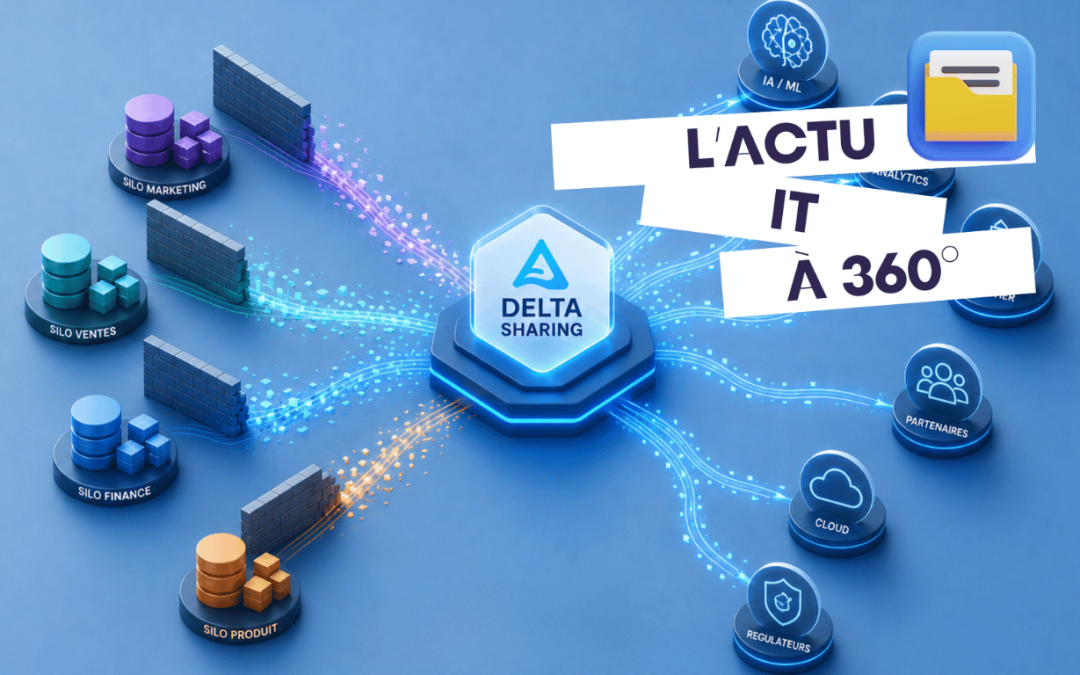
Databricks extends Delta Sharing to AI and aims to break down data silos
Data is no longer enough: intelligence must now be shared too Artificial intelligence is transforming the way companies use their data. Yet one major obstacle remains: the resources needed for AI projects are often scattered across different platforms, teams and...

RTX Spark: Nvidia accelerates the shift to AI-optimised PCs
Nvidia wants to redefine the PC for the age of artificial intelligence Unveiled at Computex 2026, the RTX Spark chip marks a new stage in the evolution of personal computers. With this Arm-based platform, Nvidia is not simply seeking to offer a more powerful...

WiFi 8 is arriving sooner than expected: what it means for businesses
A new generation of networking is already on the horizon While WiFi 7 is only just beginning to spread among businesses and consumers, the industry is already preparing the next step. TP-Link has just unveiled the first WiFi 8-compatible router, confirming that the...

Webedia-Elephant turns to Gemini Enterprise to industrialise generative AI
IT outages become a board-level issue Long regarded as mere technical incidents, service outages are now taking on a whole new dimension. According to a study by Oxford Economics for Splunk, Global 2000 companies suffer an average of 60 downtime incidents a year, at...

$600 billion lost: IT outages take on a new dimension
IT outages are becoming a boardroom issue Long regarded as mere technical incidents, service interruptions are now taking on a whole new dimension. According to a study conducted by Oxford Economics for Splunk, Global 2000 companies suffer an average of 60 downtime...

Lightwell: IBM and Red Hat tackle the open source patching headache
AI finds flaws faster than companies can fix them Artificial intelligence is profoundly transforming cybersecurity. While it makes it possible to detect vulnerabilities more quickly, it also creates a new challenge: the ability to fix a growing number of flaws within...

AWS strengthens OpenSearch to connect AI to enterprise data
AI agents are forcing the cloud to evolve The rise of agentic AI is profoundly transforming cloud infrastructure. Unlike traditional conversational assistants, intelligent agents must access data, interact with several systems and carry out tasks autonomously. To meet...