


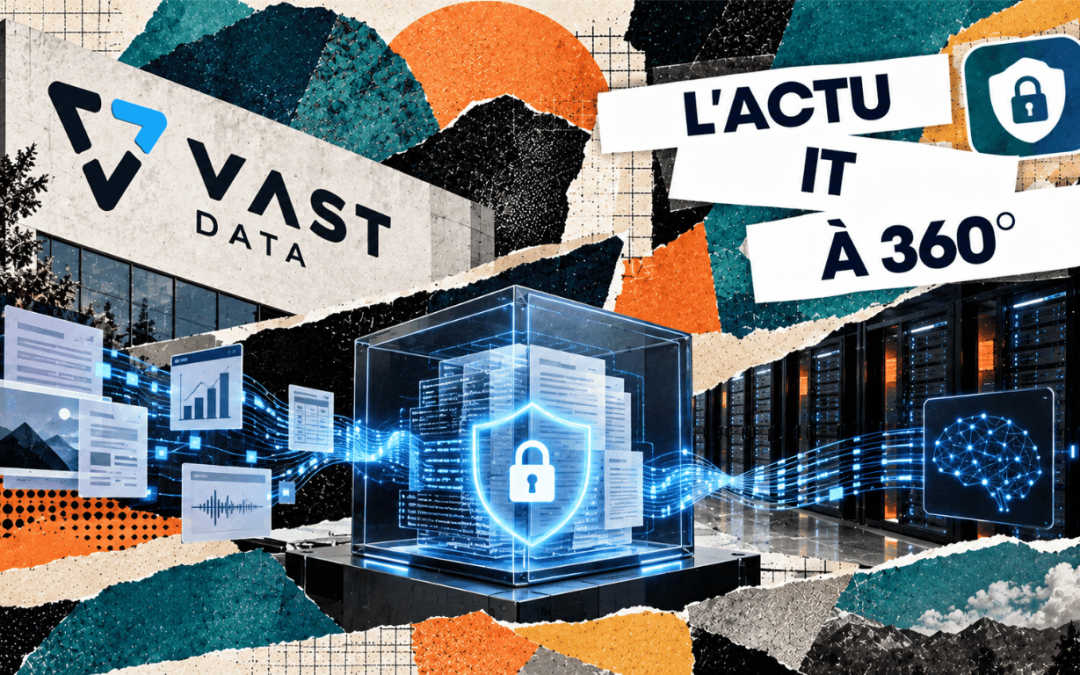
VAST Data has unveiled DataEnclave, a confidential execution capability designed to bring artificial intelligence models closer to companies’ sensitive data. Presented as a preview, it is due to go on sale in the first quarter of 2027.[1] The aim is to make certain processing possible without giving infrastructure administrators direct access to the information used during computation.
An announcement that tackles a deployment hurdle
A company may want to run a proprietary model on its internal documents while limiting how widely they circulate. The model provider, for its part, wants to protect its parameters, which represent part of its intellectual property. The project therefore requires each party to spell out what it is prepared to entrust to the other and to the host.
DataEnclave is part of VAST DataEngine and builds on NVIDIA Confidential Computing. VAST is announcing deployments in customers’ data centres or on trusted cloud infrastructure, with Cohere, Deepgram and TwelveLabs among the partners in its ecosystem. Cisco and Supermicro are among the partners lined up for distribution.[1]
This timeline should be kept in mind: the announcement does not mean that a company can already deploy every combination of models and hardware mentioned. Supported configurations and commercial terms will need to be confirmed for each project.
Protection extends into computation
Confidential computing aims to protect data while it is in use. NVIDIA describes hardware-based trusted execution environments, with isolation, memory encryption and integrity verification. Attestation makes it possible to check the state of this environment cryptographically before handing it any secrets.[3]
In DataEnclave, VAST describes confidential virtual machines covering both CPU and GPU. Models and data are decrypted there in protected memory. Keys are only released after hardware evidence has been checked against the policies set by their owner.[2]
The model must therefore be able to process the information within this authorised space. Talking about data that would never be exposed to any processing would be misleading. The useful question is which parties cannot access its content, and under what conditions this separation holds.
Key control becomes an operational decision
VAST says that the company and the model provider each keep control of their keys in separate trust domains. The vendor also plans records of attestation, key release and environment lifecycle.[1]
For the IT team, this set-up means assigning precise responsibilities. Who approves a new version of the model? Who can change the verification policy? What happens if the key management service becomes unavailable? These questions also determine the continuity of the business service.
The technical blog post explains that a provider can withdraw a deployment’s right to receive the keys needed to start new confidential machines.[2] This option calls for planning the consequences of a contract ending or a change of provider, beyond the initial installation alone.
The enclave does not cover the whole application chain
VAST points out that developers remain responsible for what goes in and out through their applications’ APIs. The vendor also distinguishes confidentiality from availability: the operator can interrupt a workload.[2] NVIDIA notes, regarding its confidential containers architecture, that this technology does not fix vulnerabilities in the application running inside.[3]
An assistant authorised to read contracts could thus produce an answer containing a confidential clause. Protecting its memory is not enough to decide who should receive that answer. User rights, selected documents and download options remain issues to be handled within the application.
This example is illustrative. It shows why the assessment must follow the full journey of the information, from its selection to its display. Strong protection of computation can coexist with overly broad permissions or poor retention of results.
Four dimensions to examine before a project
This grid offers preparatory questions. It is neither an audit of DataEnclave nor a validation of its performance.
| Dimension | Expected benefit | Point to check |
|---|---|---|
| Protected execution | Limit reading by host administrators. | Hardware and software scope covered by the protection. |
| Attestation and keys | Reserve secrets for approved environments. | Policy owner and procedure in case of refusal. |
| Application access | Restrict the data and responses that can be accessed. | User rights and export controls. |
| Operations | Keep a usable service over time. | Total cost, performance, updates and recovery. |
For SMEs, the value depends on the real need
Our reading of this announcement is that the security of computation is becoming part of choosing an AI infrastructure. This may appeal to an organisation whose use cases remain blocked by the sensitivity of its information. Buying such an architecture must nonetheless address an identified problem, with a defined data scope and an expected business outcome.
An SME could start with a limited case, for example analysing a document collection reserved for a few employees. The assessment should compare response time, quality of results and operating workload with the solutions already available. It would also be necessary to check that the team or service provider can maintain the components and handle incidents.
The sources consulted describe an architecture and vendor commitments. They are not enough to establish a productivity gain, a cost advantage or a level of security independently validated in production. These points will need to be documented before any wider roll-out.[1][2]
Professionals must know how to define the boundaries of protection
This development gives concrete meaning to Cybersecurity. Professionals must be able to identify sensitive information, understand the boundaries of a protected environment and check the conditions under which keys are released. It is up to them to translate a technical promise into understandable operating rules.
Their role continues into the application: reviewing permissions, controlling exchanges with other services and defining the logs needed for an investigation. They must be able to explain why a piece of data can be processed in a given context and which operations remain forbidden.
This skill also requires working with business teams and service providers. The quality of protection is measured by the ability to demonstrate its scope, spot the risks still open and maintain controls as models and uses evolve.
Trust will have to be proven in deployment
DataEnclave offers a way to bring proprietary models together with information that companies hesitate to use with AI. The next step will be to test this architecture against operational constraints once it becomes available as announced. The question to ask will remain a practical one: who can access which information, when, and what evidence makes it possible to verify this?
SEE ALSO
These four CCCLX articles explore further the issues of confidentiality, data governance and the security of software used with AI.
Lumo AI 2.0 speeds up without sacrificing data protection
Agentic Data Cloud: Google rethinks data for the era of AI agents
Databricks extends Delta Sharing to AI and aims to break down data silos
Project Glasswing: Anthropic goes on the offensive against software vulnerabilities
Sources
- 01
VAST Data (24 September 2026). “VAST Data Introduces DataEnclave to Bring Leading AI Models and Enterprise Data Together on Trusted Infrastructure”. Press release distributed on GlobeNewswire. Presentation of DataEnclave and its commercial release announced for the first quarter of 2027.
- 02
Lockwood, G. K. and Quinn, C. (22 September 2026, date shown). “Introducing VAST DataEnclave: Confidential AI for Sensitive Data and Proprietary Models”. Technical article published by VAST Data on the confidential architecture and the key lifecycle.
- 03
NVIDIA. “NVIDIA Confidential Containers Reference Architecture”. Technical documentation, Background and Security Considerations sections.
Editorial check and opening of the four internal links: 30 September 2026. The news date corresponds to the press release of 24 September; the technical blog post shows 22 September. Commercial release announced for the first quarter of 2027.
Djinn Stealer: the malware targeting companies’ cloud and AI credentials
Cybercriminals are changing targets Cyberattacks are no longer aimed solely at data or workstations. The credentials used to access cloud platforms, artificial intelligence environments and development tools have become highly sought-after assets. It is against this...
Claude Tag turns Slack into a genuine agentic workspace
AI agents settle at the heart of collaborative work Artificial intelligence is no longer limited to assistants accessed in a chat window. With Claude Tag, Anthropic is taking a new step by building an AI agent directly into Slack. Available in beta for Claude...
IBM and OpenAI want to arm businesses against machine-speed cyberattacks
Defenders must now fight AI with AI Cyberattacks are evolving at unprecedented speed. Thanks to artificial intelligence models, attackers can automate the search for vulnerabilities, analyse code in seconds and quickly identify the most exposed systems. To respond to...
Open-source security scales up: IBM, Red Hat and Palo Alto join forces
Cyberattacks push IT giants to join forces Open-source components are present in virtually all modern applications, from cloud platforms to business software. This dependence, however, comes with a growing risk: vulnerabilities are now discovered and exploited much...
With Lambda, AWS prepares cloud infrastructure for autonomous AI agents
Serverless enters a new phase The cloud is evolving to meet the needs of a new generation of applications based on agentic artificial intelligence. As AI agents become capable of carrying out complex tasks for hours at a time, traditional serverless architectures are...
With Code Layers, Figma brings design and development together for good
A new step towards building apps without boundaries Design and software development have long followed two separate paths. Designers imagined the interfaces, developers then translated them into code, with many back-and-forth exchanges and sometimes discrepancies...
Google Chrome sees what you see: Gemini can now analyse your screen
Chrome takes a new step towards the intelligent browser Web browsers no longer simply display web pages. They are gradually becoming genuine assistants capable of understanding the context in which users are working. With the new “Select from screen” feature, Google...
SpaceX buys Cursor: agentic AI becomes the new standard in software development
An acquisition that reaches far beyond the software world SpaceX’s acquisition of Anysphere, the company behind Cursor, for an estimated $60 billion marks a major turning point in the tech industry. Behind this spectacular deal lies a much deeper transformation: the...
Europe’s AI takes shape: OVHcloud is developing its own LLMs
OVHcloud wants to move from cloud to artificial intelligence Long recognised as a major player in European cloud, OVHcloud now aims to play a much bigger role in the artificial intelligence ecosystem. At the VivaTech trade show, Octave Klaba, the group’s founder and...
F5 strengthens its WAF to tackle the cyber threats of the AI era
Cyberattacks are evolving faster than patches Artificial intelligence is transforming corporate cybersecurity, but it is also benefiting attackers. New models capable of rapidly identifying vulnerabilities or automating certain exploitation phases are dramatically...