


Proton wants to prove that a high-performing AI can also be private
The artificial intelligence race is no longer played out solely on model performance. User trust and data protection are now becoming major differentiators. With Lumo AI 2.0, Proton is upgrading its intelligent assistant by improving its speed, reasoning capabilities and multimodal features, while maintaining a strong commitment to privacy. The Swiss company thus intends to show that it is possible to use advanced artificial intelligence without giving up control of one’s personal information.1
A more comprehensive artificial intelligence
This new version is no longer limited to text exchanges. Lumo AI 2.0 can now analyse images, generate them from descriptions and draw on web results to enrich its answers with up-to-date information such as news, weather or financial data. Proton is also announcing improved reasoning capabilities for the model, enabling it to better understand complex requests and provide more relevant answers. Users can also choose what information the assistant remembers or forgets in order to personalise their future interactions.1
Privacy becomes a technological selling point
Whereas most players emphasise above all the performance of their models, Proton is focusing on data protection. The company states that its users’ conversations are never used to train future artificial intelligence models. Exchanges are encrypted so that they cannot be viewed, including by Proton itself. This approach is in keeping with the company’s long-standing strategy, already known for its secure email and storage services, in which privacy is central to its offering.2
Europe as a guarantee of digital sovereignty
Another distinctive feature of Lumo AI 2.0 is that its infrastructure relies on servers located in Europe. This choice allows Proton to limit its services’ exposure to certain extraterritorial laws and to meet the requirements of many organisations concerned about where their data is located. The company also offers a dedicated business plan enabling companies to analyse internal documents or use artificial intelligence on sensitive information while maintaining a high level of data protection.2
Companies are now looking for trustworthy AI
The evolution of Lumo AI illustrates an underlying market trend. Organisations no longer choose an artificial intelligence assistant solely on the basis of its speed or the quality of its answers. They also assess how their data is stored, used and protected. Questions of digital sovereignty, regulatory compliance and privacy are gradually becoming as important as the technical performance of models, particularly in sectors that handle sensitive information.3
Ethics becomes a criterion for choosing AI technologies
The development of solutions such as Lumo AI 2.0 shows that ethical and data protection issues are taking on a growing role in artificial intelligence. Understanding data governance mechanisms, privacy principles, applicable regulations and the technology choices that protect users’ information is becoming essential for deploying responsible AI solutions in companies.
The future of AI will also depend on trust
With Lumo AI 2.0, Proton is a reminder that competition between intelligent assistants no longer rests solely on model capabilities. The trust placed in platforms, transparency about how data is used and the ability to protect personal information are becoming decisive factors. As artificial intelligence becomes part of the everyday lives of individuals and businesses alike, privacy could become a competitive advantage as important as performance.
360° IT News — decoding technology to understand the jobs of tomorrow.
Further reading
The evolution of Azure Linux illustrates the rapid transformation of IT infrastructure, which is increasingly geared towards the cloud, distributed environments and artificial intelligence. On a related topic, read our article “The cloud gets ready for autonomous agents: AWS evolves Lambda”, which shows how cloud platforms are also adapting their architectures to new generations of applications driven by AI agents.
References
1. Proton. (2026). Introducing Lumo AI 2.0.
https://proton.me
2. Proton. (2026). Privacy and Security at Proton AI.
https://proton.me
3. European Commission. (2024). AI Act.
https://artificial-intelligence-act.eu
Europe accuses Anthropic of discrimination after Fable 5 is blocked
A US decision that sparks an international crisis The sudden suspension of access to Anthropic’s Fable 5 and Mythos 5 models outside the United States now goes well beyond technology. What initially looked like a national security measure is taking on a major...
Mobi Fold and Spotlight 2: Logitech aims to simplify everyday hybrid working
The office is everywhere, but the tools do not always keep up Hybrid working has profoundly changed professional habits. Video-conference meetings, frequent travel, days split between home, the office and coworking spaces: employees now move between multiple...
+80%: agentic AI triggers a record surge in enterprise SSD prices
Artificial intelligence is putting new strain on infrastructure Artificial intelligence is often associated with graphics processors and massive computing centres. Yet another essential component of digital infrastructure is coming under unprecedented pressure:...
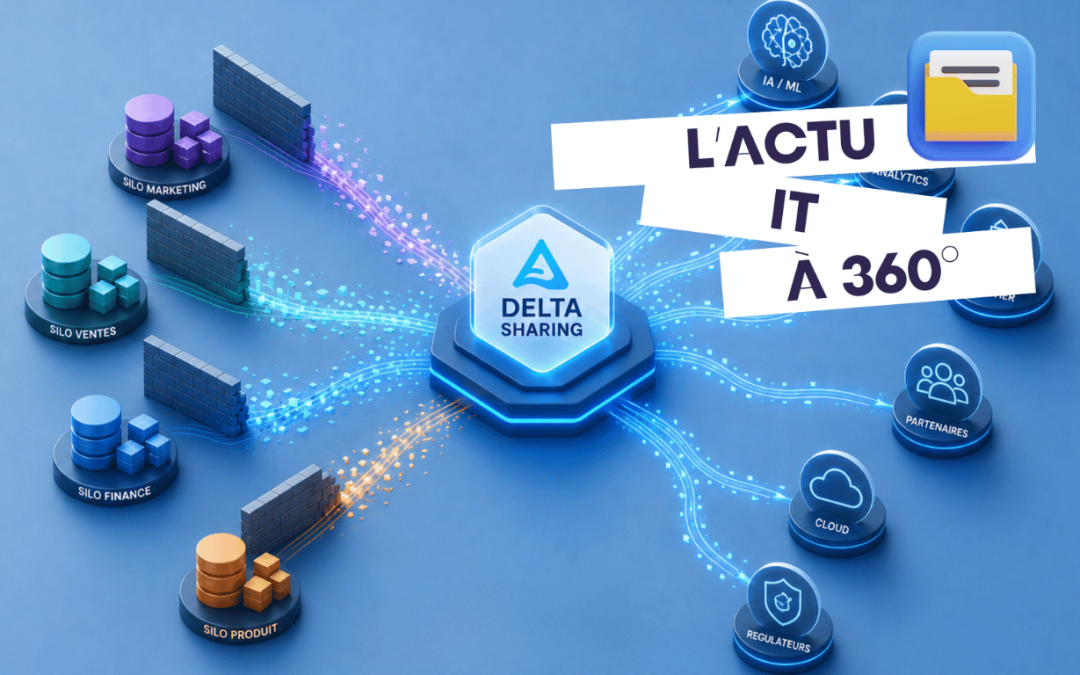
Databricks extends Delta Sharing to AI and aims to break down data silos
Data is no longer enough: intelligence must now be shared too Artificial intelligence is transforming the way companies use their data. Yet one major obstacle remains: the resources needed for AI projects are often scattered across different platforms, teams and...

RTX Spark: Nvidia accelerates the shift to AI-optimised PCs
Nvidia wants to redefine the PC for the age of artificial intelligence Unveiled at Computex 2026, the RTX Spark chip marks a new stage in the evolution of personal computers. With this Arm-based platform, Nvidia is not simply seeking to offer a more powerful...

WiFi 8 is arriving sooner than expected: what it means for businesses
A new generation of networking is already on the horizon While WiFi 7 is only just beginning to spread among businesses and consumers, the industry is already preparing the next step. TP-Link has just unveiled the first WiFi 8-compatible router, confirming that the...

Webedia-Elephant turns to Gemini Enterprise to industrialise generative AI
IT outages become a board-level issue Long regarded as mere technical incidents, service outages are now taking on a whole new dimension. According to a study by Oxford Economics for Splunk, Global 2000 companies suffer an average of 60 downtime incidents a year, at...

$600 billion lost: IT outages take on a new dimension
IT outages are becoming a boardroom issue Long regarded as mere technical incidents, service interruptions are now taking on a whole new dimension. According to a study conducted by Oxford Economics for Splunk, Global 2000 companies suffer an average of 60 downtime...

Lightwell: IBM and Red Hat tackle the open source patching headache
AI finds flaws faster than companies can fix them Artificial intelligence is profoundly transforming cybersecurity. While it makes it possible to detect vulnerabilities more quickly, it also creates a new challenge: the ability to fix a growing number of flaws within...

AWS strengthens OpenSearch to connect AI to enterprise data
AI agents are forcing the cloud to evolve The rise of agentic AI is profoundly transforming cloud infrastructure. Unlike traditional conversational assistants, intelligent agents must access data, interact with several systems and carry out tasks autonomously. To meet...