


Serverless enters a new phase
The cloud is evolving to meet the needs of a new generation of applications based on agentic artificial intelligence. As AI agents become capable of carrying out complex tasks for hours at a time, traditional serverless architectures are showing their limits. To support this shift, AWS is upgrading Lambda with a new offering based on Firecracker microVMs, the same technology that already powers AgentCore Runtime. This announcement illustrates a deeper transformation of cloud infrastructure, now designed to host intelligent, autonomous and always-available applications.1
MicroVMs push back Lambda’s limits
The new microVMs profoundly change the way Lambda works. Unlike conventional functions limited to fifteen minutes of execution, they can run for up to eight hours and offer a far more complete environment. Developers have shell access, can install packages, mount file systems and run their applications directly from a Dockerfile. Each microVM also has its own secure endpoint compatible with HTTP, WebSockets, gRPC and Server-Sent Events. Combined with SnapStart, which captures a snapshot of the environment to eliminate start-up times, this architecture brings Lambda closer to a true execution platform for persistent applications.1
Infrastructure designed for agentic AI
Although AWS does not officially present this development as an extension of AgentCore, the similarities are numerous. The microVMs use Firecracker, the technology already employed by AWS’s AI agent services, and address the same technical constraints: running third-party code, preserving session state, isolating users and delivering high performance while retaining the flexibility of serverless. AWS also offers a reference architecture for Anthropic’s Claude Managed Agents, in which each conversation runs in its own microVM while orchestration remains in Claude’s hands, illustrating the direction taken by future artificial intelligence platforms.2
Much more than a simple Lambda upgrade
The use cases presented by AWS show that these microVMs are not reserved for AI agents. They can also host data analytics platforms, vulnerability scanners, CI/CD environments, game servers or sandboxes designed to reproduce software bugs. Among the first users is ClickHouse, which uses the technology to run its chDB analytics engine, launch federated queries, create on-demand test environments or provide dedicated memory for each agentic session. This diversity shows that microVMs represent a major development in serverless execution well beyond the field of artificial intelligence alone.1
The cloud becomes an intelligent execution platform
The introduction of microVMs confirms an underlying trend: cloud providers no longer seek merely to host applications, but to offer environments that can adapt dynamically to the needs of intelligent workloads. The new microVMs can be suspended when idle while retaining their memory state and storage, then restart instantly when a new request arrives. This capability reduces operating costs while giving AI agents a persistent environment, an essential feature for applications that alternate between periods of inactivity and intensive computing phases.1
Cloud Computing becomes an essential skill
This development shows that cloud infrastructure is becoming ever more sophisticated and demands advanced technical skills. Understanding serverless architectures, virtualisation technologies, containers, microVMs and orchestration mechanisms is becoming indispensable for designing the platforms that will host tomorrow’s applications. This is precisely what the Cloud Computing skill taught at CCCLX develops. It enables future professionals to master modern cloud services, understand how they work and help companies design infrastructure capable of supporting new generations of AI-based applications.
AWS is already preparing the infrastructure for tomorrow’s applications
With this upgrade to Lambda, AWS is not just seeking to improve its serverless offering. The provider is laying the technical foundations that will allow future autonomous agents to run in secure, scalable and economically viable environments. As intelligent applications gain autonomy, cloud infrastructure will need to offer greater persistence, flexibility and isolation. MicroVMs are a first response to this transformation and herald a new generation of platforms designed to support the rise of agentic AI.
360° IT News — decoding technology to understand the jobs of tomorrow.
Further reading
Lambda’s microVMs illustrate how cloud infrastructure is evolving into platforms designed specifically for intelligent agents. This transformation also affects the services responsible for connecting these agents to company data. On a related topic, read our article “AWS strengthens OpenSearch to connect AI to enterprise data”, which explains how AWS is adapting its search engine to make it easier for AI agents to access information spread across information systems.
References
1. AWS. (2026). AWS Lambda MicroVMs Preview.
https://aws.amazon.com/
2. AWS. (2026). Firecracker MicroVM Documentation.
https://firecracker-microvm.github.io/

Europe accuses Anthropic of discrimination after Fable 5 is blocked
A US decision that sparks an international crisis The sudden suspension of access to Anthropic’s Fable 5 and Mythos 5 models outside the United States now goes well beyond technology. What initially looked like a national security measure is taking on a major...

Mobi Fold and Spotlight 2: Logitech aims to simplify everyday hybrid working
The office is everywhere, but the tools do not always keep up Hybrid working has profoundly changed professional habits. Video-conference meetings, frequent travel, days split between home, the office and coworking spaces: employees now move between multiple...
+80%: agentic AI triggers a record surge in enterprise SSD prices
Artificial intelligence is putting new strain on infrastructure Artificial intelligence is often associated with graphics processors and massive computing centres. Yet another essential component of digital infrastructure is coming under unprecedented pressure:...
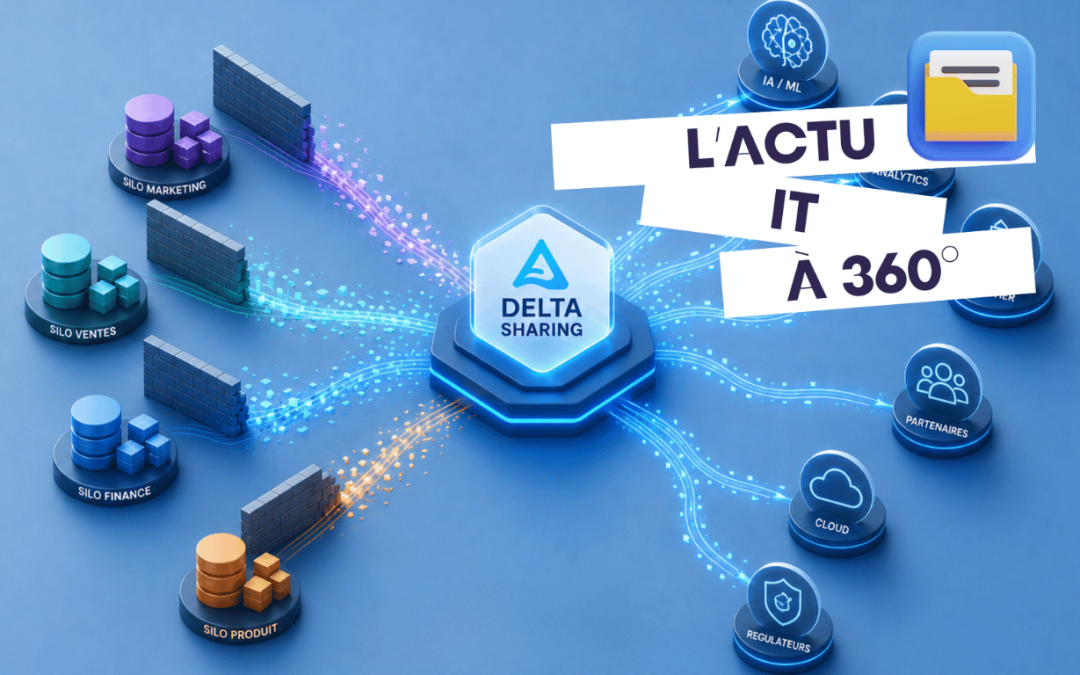
Databricks extends Delta Sharing to AI and aims to break down data silos
Data is no longer enough: intelligence must now be shared too Artificial intelligence is transforming the way companies use their data. Yet one major obstacle remains: the resources needed for AI projects are often scattered across different platforms, teams and...

RTX Spark: Nvidia accelerates the shift to AI-optimised PCs
Nvidia wants to redefine the PC for the age of artificial intelligence Unveiled at Computex 2026, the RTX Spark chip marks a new stage in the evolution of personal computers. With this Arm-based platform, Nvidia is not simply seeking to offer a more powerful...

WiFi 8 is arriving sooner than expected: what it means for businesses
A new generation of networking is already on the horizon While WiFi 7 is only just beginning to spread among businesses and consumers, the industry is already preparing the next step. TP-Link has just unveiled the first WiFi 8-compatible router, confirming that the...

Webedia-Elephant turns to Gemini Enterprise to industrialise generative AI
IT outages become a board-level issue Long regarded as mere technical incidents, service outages are now taking on a whole new dimension. According to a study by Oxford Economics for Splunk, Global 2000 companies suffer an average of 60 downtime incidents a year, at...

$600 billion lost: IT outages take on a new dimension
IT outages are becoming a boardroom issue Long regarded as mere technical incidents, service interruptions are now taking on a whole new dimension. According to a study conducted by Oxford Economics for Splunk, Global 2000 companies suffer an average of 60 downtime...

Lightwell: IBM and Red Hat tackle the open source patching headache
AI finds flaws faster than companies can fix them Artificial intelligence is profoundly transforming cybersecurity. While it makes it possible to detect vulnerabilities more quickly, it also creates a new challenge: the ability to fix a growing number of flaws within...

AWS strengthens OpenSearch to connect AI to enterprise data
AI agents are forcing the cloud to evolve The rise of agentic AI is profoundly transforming cloud infrastructure. Unlike traditional conversational assistants, intelligent agents must access data, interact with several systems and carry out tasks autonomously. To meet...