


Nvidia wants to redefine the PC for the age of artificial intelligence
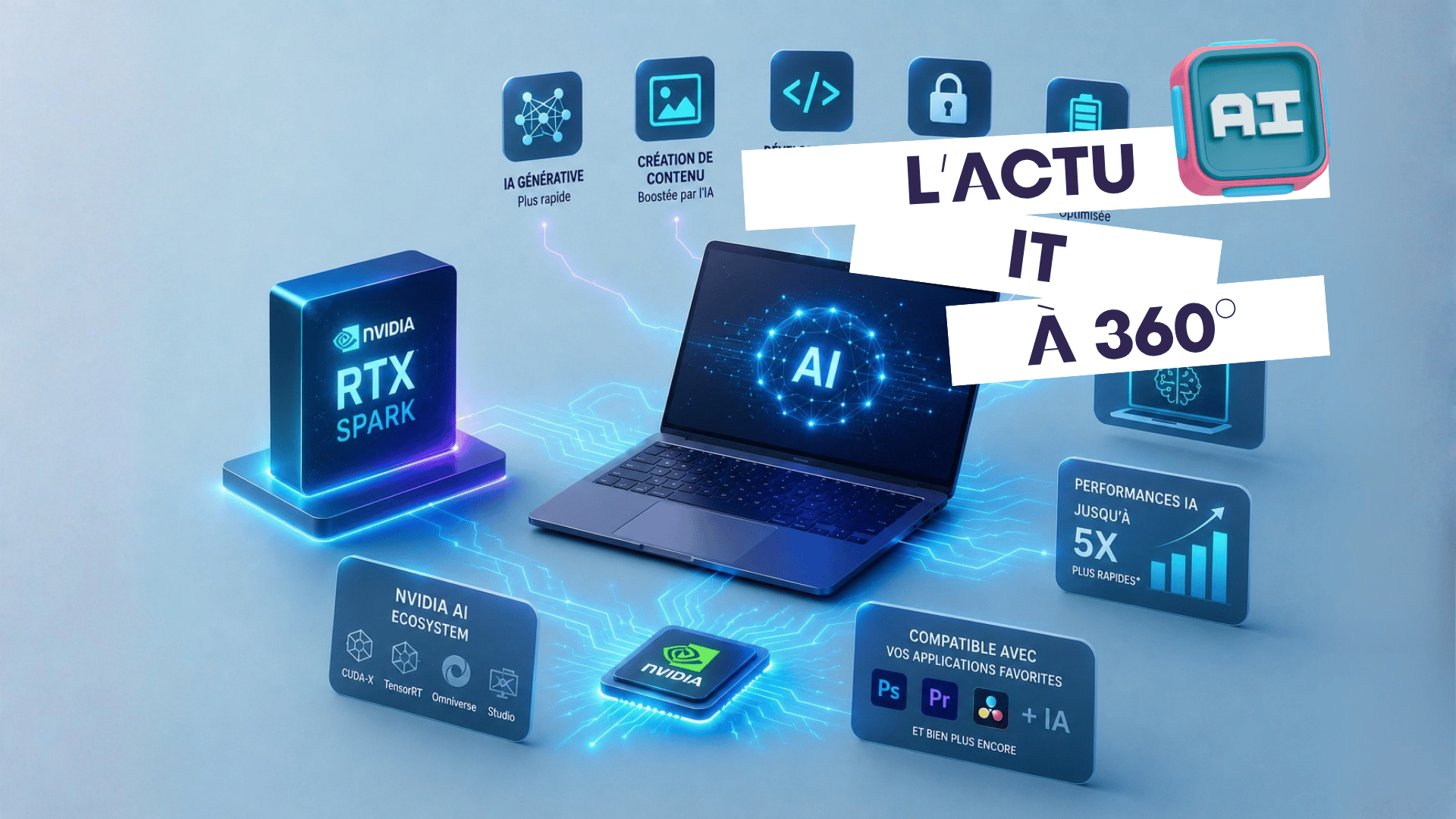
Unveiled at Computex 2026, the RTX Spark chip marks a new stage in the evolution of personal computers. With this Arm-based platform, Nvidia is not simply seeking to offer a more powerful processor. The company aims to create a new category of PCs designed from the ground up to run artificial intelligence workloads locally. This initiative could upset the balance of a market dominated for decades by Intel and AMD, while accelerating the adoption of AI PCs in business.
Unprecedented computing power for AI use cases
The RTX Spark platform combines a 20-core Grace Arm processor with a graphics unit featuring 6,144 CUDA cores based on the Blackwell architecture. Nvidia claims performance of up to 1 petaflop at FP4 precision, a level until now reserved for certain specialised infrastructures. The platform can also include up to 128 GB of LPDDR5X memory, making it possible to run language models of up to 120 billion parameters1 locally. This capability paves the way for advanced AI use directly on the workstation, without permanent reliance on the cloud.
Major manufacturers are getting on board
To speed up adoption, Nvidia is relying on a broad ecosystem of manufacturers. Asus, Dell, HP, Lenovo, Microsoft and MSI have already announced products based on RTX Spark. Dell notably plans to integrate the chip into a version of its XPS 16 Creator Edition, while Microsoft is preparing a Surface RTX Spark Dev Box aimed at developers. This mobilisation shows that the industry now regards AI PCs as a strategic segment set to grow rapidly.
A new segment between the standard PC and the workstation
According to several analysts, RTX Spark could create a new category of computers sitting between traditional business PCs and high-end workstations2. These machines target users who need to run complex AI models, simulations or advanced data processing locally. Prices should logically reflect this premium positioning, with configurations likely to exceed 2,000 dollars. By contrast, consumer AI PCs equipped with Intel, AMD or Qualcomm processors remain mainly intended for office use and Copilot+ features.
Local AI becomes a strategic selling point
One of RTX Spark’s main strengths lies in its ability to run AI directly on the device. This approach offers businesses several advantages: lower cloud inference costs, reduced latency and better control over sensitive data. For certain sectors handling confidential information, such as finance, healthcare or cybersecurity, running models locally can be a decisive advantage.
Developers and data scientists on the front line
Not every business will need such power, however. Analysts believe the first users will mainly be developers, AI engineers, data scientists and cybersecurity teams. These profiles work with complex models and large volumes of data on a daily basis. For standard office use, current AI PCs remain more than sufficient. RTX Spark therefore looks more like a specialised platform than a future universal standard in the short term.
Growing pressure on Intel, AMD and Qualcomm
Nvidia’s arrival in the AI PC market could also intensify competition. Until now, Intel, AMD and Qualcomm have occupied most of the ground in AI-capable computers3. By introducing a solution capable of running very large models locally, Nvidia is pushing the whole sector to step up investment in AI-dedicated architectures. This competition should foster innovation and reshape market standards over the coming years.
Understanding AI architectures is becoming essential
This development highlights a strategic skill: mastering hardware architectures dedicated to artificial intelligence. Future IT professionals will need to understand the differences between CPUs, GPUs, NPUs and new hybrid platforms capable of running complex models locally. As AI moves closer to users, hardware is once again becoming a key factor in performance and innovation.
AI PCs enter a new phase
With RTX Spark, Nvidia is not just launching a new chip. The company is helping to build a new generation of computers capable of running advanced artificial intelligence models locally. For students and future IT professionals, this development deserves particular attention. It could herald the emergence of a new computing segment in which AI capabilities become as important as traditional computing power.
360° IT News — decoding technology to understand the jobs of tomorrow.
Further reading
The arrival of RTX Spark illustrates a broader transformation of computer hardware, now designed to run artificial intelligence workloads directly on devices. This shift also affects high-performance computing infrastructure, which must adapt to the explosion in AI-related needs. On a related topic, read our article “Pangea 5: TotalEnergies’ 100-million bet on AI and simulation”, which analyses how new computing infrastructures are becoming strategic for innovation and competitiveness.
References
1. Nvidia. (2026). RTX Spark Platform Specifications.
https://www.nvidia.com
2. Futurum Research. (2026). AI PC Market Forecast 2025–2030.
https://www.futurumgroup.com
3. Counterpoint Research. (2026). The Future of AI PCs and Edge Computing.
https://www.counterpointresearch.com

With Stainless, Anthropic aims to put Claude at the heart of software development
The AI battle is shifting to developer tools Anthropic is continuing its rise in artificial intelligence with the acquisition of Stainless, a start-up specialising in development tools and API automation. Behind this acquisition lies a significant strategic...

Microsoft transforms Office with Fintool and autonomous AI
Office enters the age of intelligent agents Microsoft is stepping up its agentic artificial intelligence strategy with the acquisition of Fintool, a start-up specialising in automated financial analysis. Founded in San Francisco by Frenchmen Nicolas Bustamante and...

Googlebook: Google wants to reinvent the computer around AI
A new generation of PCs designed for artificial intelligence Google is preparing a new category of laptops called “Googlebook”, designed from the ground up around artificial intelligence. After AI-powered smartphones, the company now wants to turn the PC itself into a...

OpsMill: the start-up that wants to prepare IT systems for the AI shock
Artificial intelligence is moving faster than IT infrastructure Generative artificial intelligence is rapidly transforming businesses, but one reality is becoming increasingly clear: today’s IT infrastructure is not ready to absorb this revolution. This is...

What if your future cloud fitted in a drop of DNA?
Data storage is reaching its limits Every day, humanity produces a gigantic amount of data. In 2025, the volume generated worldwide each day is estimated at almost 300 exabytes, the equivalent of a century of European audiovisual archives created every 24 hours1. With...

+13.5% in 2026: corporate IT spending soars
A sharp acceleration in IT investment Worldwide IT spending is expected to reach 6.31 trillion dollars in 2026, a rise of 13.5% year on year, according to Gartner’s latest forecast1. This figure marks a clear acceleration compared with previous estimates (+10.8%),...

Microsoft builds legal AI into Word: contracts go automated
Word becomes an intelligent legal tool Microsoft is taking a new step by building artificial intelligence specialised in legal analysis directly into Word. The aim is clear: to automate contract review, detect risks and speed up document production. At a time when...

Merck and Google Cloud: a key partnership for agentic AI in the enterprise
A strategic investment to transform the company through AI Biopharmaceutical giant Merck has announced a 1-billion-dollar, 10-year partnership with Google Cloud, with a clear goal: to embed agentic artificial intelligence at the heart of its operations. This project...

Chrome Enterprise goes AI: Google automates browsing and workflows
The browser becomes a genuinely intelligent work tool Google is upgrading Chrome Enterprise with advanced artificial intelligence capabilities, turning the browser into an active platform able to carry out tasks. Autonomous browsing, workflow automation and...

$32 billion: Google launches a cyber army of AI agents
Cybersecurity enters a new dimension Google has made a major move by announcing an investment of $32 billion in developing a “cyber army” of artificial intelligence agents. Behind this term lies a technological reality: systems capable of automatically detecting,...