


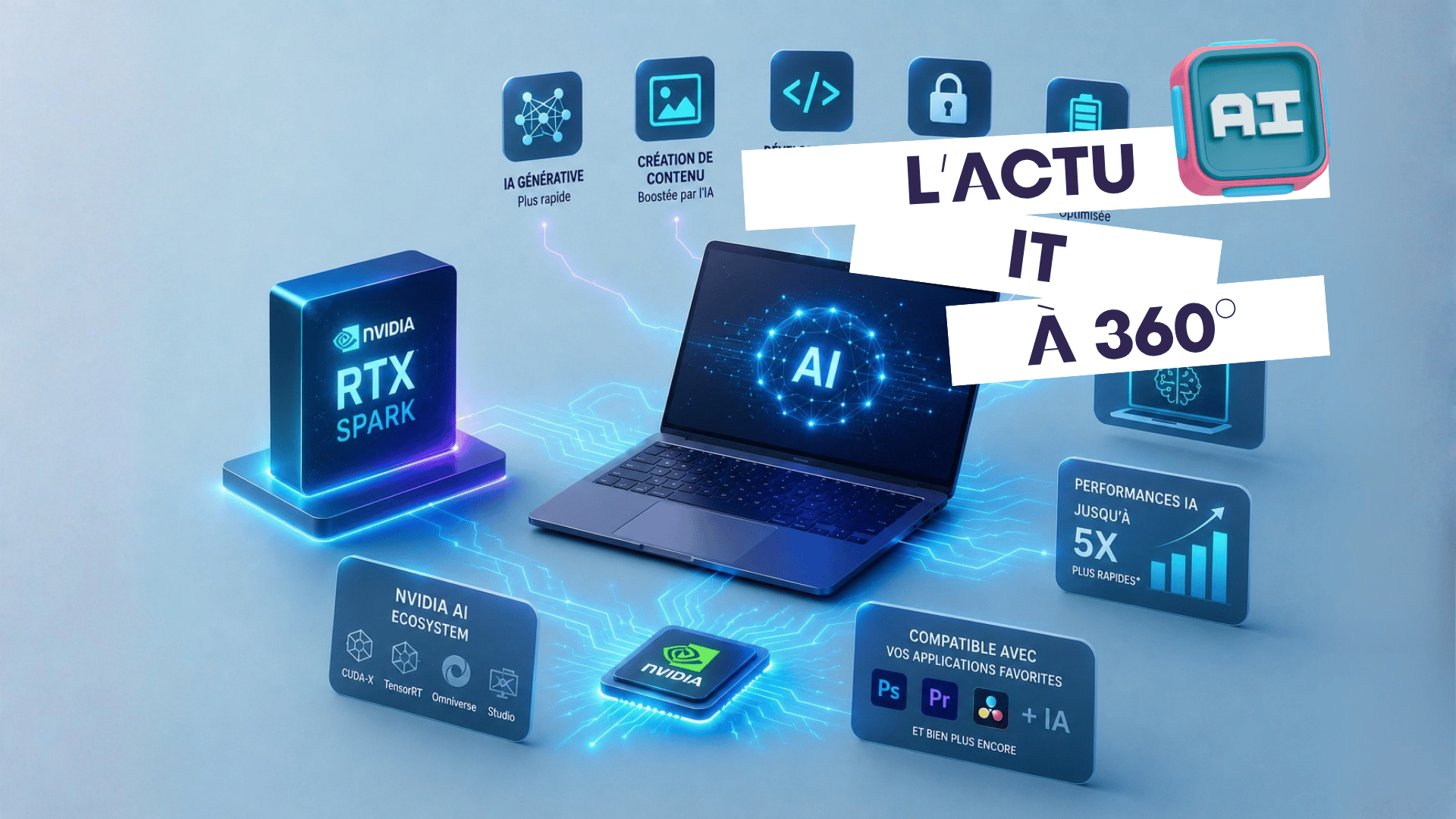
Nvidia wants to redefine the PC for the age of artificial intelligence
Unveiled at Computex 2026, the RTX Spark chip marks a new stage in the evolution of personal computers. With this Arm-based platform, Nvidia is not simply seeking to offer a more powerful processor. The company aims to create a new category of PCs designed from the ground up to run artificial intelligence workloads locally. This initiative could upset the balance of a market dominated for decades by Intel and AMD, while accelerating the adoption of AI PCs in business.
Unprecedented computing power for AI use cases
The RTX Spark platform combines a 20-core Grace Arm processor with a graphics unit featuring 6,144 CUDA cores based on the Blackwell architecture. Nvidia claims performance of up to 1 petaflop at FP4 precision, a level until now reserved for certain specialised infrastructures. The platform can also include up to 128 GB of LPDDR5X memory, making it possible to run language models of up to 120 billion parameters1 locally. This capability paves the way for advanced AI use directly on the workstation, without permanent reliance on the cloud.
Major manufacturers are getting on board
To speed up adoption, Nvidia is relying on a broad ecosystem of manufacturers. Asus, Dell, HP, Lenovo, Microsoft and MSI have already announced products based on RTX Spark. Dell notably plans to integrate the chip into a version of its XPS 16 Creator Edition, while Microsoft is preparing a Surface RTX Spark Dev Box aimed at developers. This mobilisation shows that the industry now regards AI PCs as a strategic segment set to grow rapidly.
A new segment between the standard PC and the workstation
According to several analysts, RTX Spark could create a new category of computers sitting between traditional business PCs and high-end workstations2. These machines target users who need to run complex AI models, simulations or advanced data processing locally. Prices should logically reflect this premium positioning, with configurations likely to exceed 2,000 dollars. By contrast, consumer AI PCs equipped with Intel, AMD or Qualcomm processors remain mainly intended for office use and Copilot+ features.
Local AI becomes a strategic selling point
One of RTX Spark’s main strengths lies in its ability to run AI directly on the device. This approach offers businesses several advantages: lower cloud inference costs, reduced latency and better control over sensitive data. For certain sectors handling confidential information, such as finance, healthcare or cybersecurity, running models locally can be a decisive advantage.
Developers and data scientists on the front line
Not every business will need such power, however. Analysts believe the first users will mainly be developers, AI engineers, data scientists and cybersecurity teams. These profiles work with complex models and large volumes of data on a daily basis. For standard office use, current AI PCs remain more than sufficient. RTX Spark therefore looks more like a specialised platform than a future universal standard in the short term.
Growing pressure on Intel, AMD and Qualcomm
Nvidia’s arrival in the AI PC market could also intensify competition. Until now, Intel, AMD and Qualcomm have occupied most of the ground in AI-capable computers3. By introducing a solution capable of running very large models locally, Nvidia is pushing the whole sector to step up investment in AI-dedicated architectures. This competition should foster innovation and reshape market standards over the coming years.
Understanding AI architectures is becoming essential
This development highlights a strategic skill: mastering hardware architectures dedicated to artificial intelligence. Future IT professionals will need to understand the differences between CPUs, GPUs, NPUs and new hybrid platforms capable of running complex models locally. As AI moves closer to users, hardware is once again becoming a key factor in performance and innovation.
AI PCs enter a new phase
With RTX Spark, Nvidia is not just launching a new chip. The company is helping to build a new generation of computers capable of running advanced artificial intelligence models locally. For students and future IT professionals, this development deserves particular attention. It could herald the emergence of a new computing segment in which AI capabilities become as important as traditional computing power.
360° IT News — decoding technology to understand the jobs of tomorrow.
Further reading
The arrival of RTX Spark illustrates a broader transformation of computer hardware, now designed to run artificial intelligence workloads directly on devices. This shift also affects high-performance computing infrastructure, which must adapt to the explosion in AI-related needs. On a related topic, read our article “Pangea 5: TotalEnergies’ 100-million bet on AI and simulation”, which analyses how new computing infrastructures are becoming strategic for innovation and competitiveness.
References
1. Nvidia. (2026). RTX Spark Platform Specifications.
https://www.nvidia.com
2. Futurum Research. (2026). AI PC Market Forecast 2025–2030.
https://www.futurumgroup.com
3. Counterpoint Research. (2026). The Future of AI PCs and Edge Computing.
https://www.counterpointresearch.com

Lumo AI 2.0 speeds up without sacrificing data protection
Proton wants to prove that a high-performing AI can also be private The artificial intelligence race is no longer played out solely on model performance. User trust and data protection are now becoming major differentiators. With Lumo AI 2.0, Proton is upgrading its...

Djinn Stealer: the malware targeting companies’ cloud and AI credentials
Cybercriminals are changing targets Cyberattacks are no longer aimed solely at data or workstations. The credentials used to access cloud platforms, artificial intelligence environments and development tools have become highly sought-after assets. It is against this...

Claude Tag turns Slack into a genuine agentic workspace
AI agents settle at the heart of collaborative work Artificial intelligence is no longer limited to assistants accessed in a chat window. With Claude Tag, Anthropic is taking a new step by building an AI agent directly into Slack. Available in beta for Claude...

IBM and OpenAI want to arm businesses against machine-speed cyberattacks
Defenders must now fight AI with AI Cyberattacks are evolving at unprecedented speed. Thanks to artificial intelligence models, attackers can automate the search for vulnerabilities, analyse code in seconds and quickly identify the most exposed systems. To respond to...

Open-source security scales up: IBM, Red Hat and Palo Alto join forces
Cyberattacks push IT giants to join forces Open-source components are present in virtually all modern applications, from cloud platforms to business software. This dependence, however, comes with a growing risk: vulnerabilities are now discovered and exploited much...
With Lambda, AWS prepares cloud infrastructure for autonomous AI agents
Serverless enters a new phase The cloud is evolving to meet the needs of a new generation of applications based on agentic artificial intelligence. As AI agents become capable of carrying out complex tasks for hours at a time, traditional serverless architectures are...
With Code Layers, Figma brings design and development together for good
A new step towards building apps without boundaries Design and software development have long followed two separate paths. Designers imagined the interfaces, developers then translated them into code, with many back-and-forth exchanges and sometimes discrepancies...
Google Chrome sees what you see: Gemini can now analyse your screen
Chrome takes a new step towards the intelligent browser Web browsers no longer simply display web pages. They are gradually becoming genuine assistants capable of understanding the context in which users are working. With the new “Select from screen” feature, Google...
SpaceX buys Cursor: agentic AI becomes the new standard in software development
An acquisition that reaches far beyond the software world SpaceX’s acquisition of Anysphere, the company behind Cursor, for an estimated $60 billion marks a major turning point in the tech industry. Behind this spectacular deal lies a much deeper transformation: the...

Europe’s AI takes shape: OVHcloud is developing its own LLMs
OVHcloud wants to move from cloud to artificial intelligence Long recognised as a major player in European cloud, OVHcloud now aims to play a much bigger role in the artificial intelligence ecosystem. At the VivaTech trade show, Octave Klaba, the group’s founder and...