


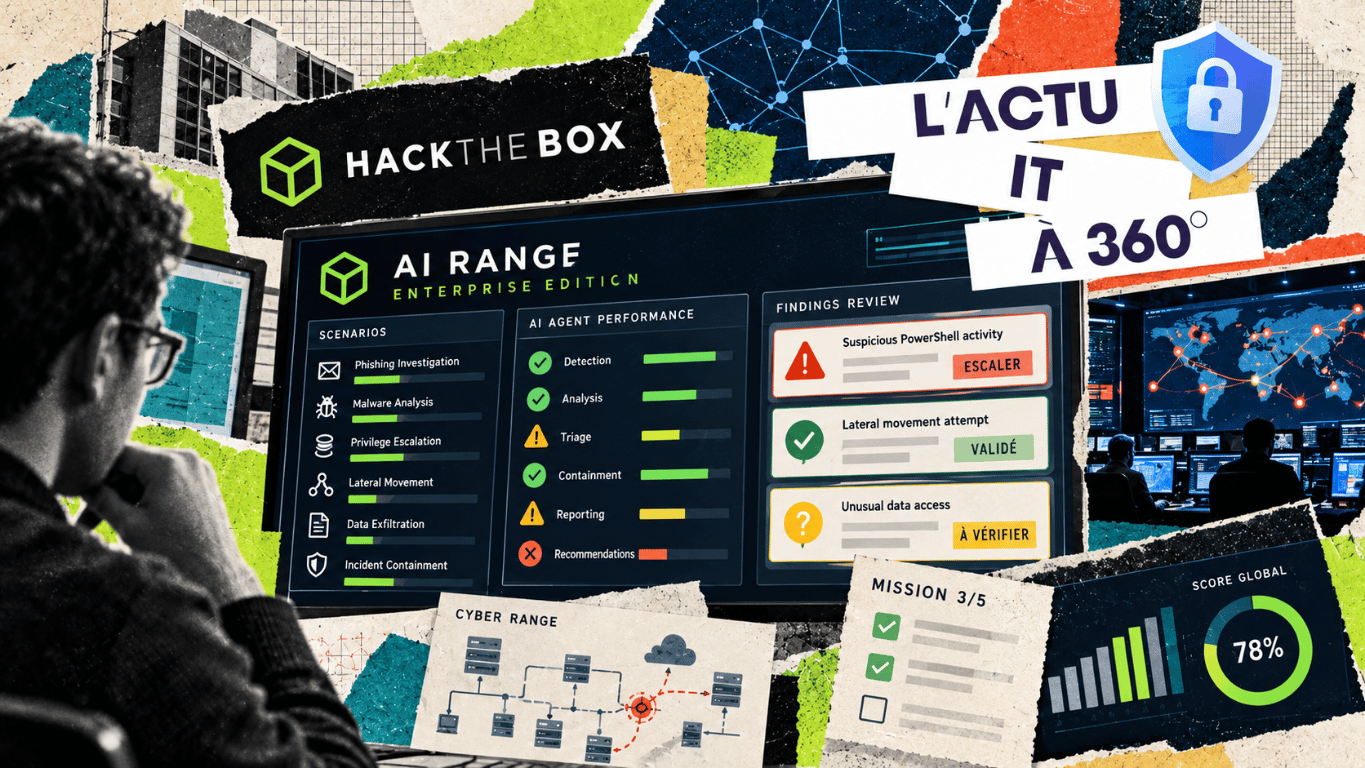
Hack The Box is launching AI Range Enterprise Edition to let security teams assess their own AI agents on the roles assigned to them.[1] For businesses, the stakes are concrete: having evidence before delegating a task, then checking that this evidence remains valid as tools evolve.
An enterprise edition to assess defined missions
AI Range has existed since December 2025. The novelty announced on 6 October 2026 is an edition aimed at corporate security teams, with role-based assessment. Hack The Box presents this approach as a way of regularly measuring an agent’s ability to do the work expected of it.[1][3]
A cyber range is a controlled training environment. It allows tools or professionals to be confronted with representative situations without a real incident being the first test. Passing these exercises provides evidence for assessment, the scope of which depends on the scenario and the conditions chosen.
An overall score is not enough to assign responsibility
An agent may recognise suspicious activity without knowing how to build a complete investigation. For a company, defining its mission therefore means specifying the information it can access, the decisions it is allowed to make and the situations that require human validation.
Take an illustrative case: an assistant triages login alerts. The assessment should check the incidents identified, but also the legitimate alerts dismissed and the cases left unanswered. A quick result loses its value if an analyst then has to redo the whole investigation.
Tests must keep pace with changes to the agent
Hack The Box recommends reassessing agents whenever the models, the components that drive their actions, the environments or the threats change.[2] Otherwise, a one-off validation risks describing a configuration that is no longer the one used day to day.
In practice, the team should keep a record of the version tested, the tools available, the permissions and the results. This makes it possible to compare two assessments and determine whether a change genuinely improves the service.
Four criteria for examining the work delegated
This grid is an editorial proposal for preparing an assessment, not Hack The Box’s scoring scheme.
| Criterion | Result to observe | Control question |
|---|---|---|
| Relevance | Incidents detected and false alarms. | Which important cases are missed? |
| Justification | Sources and evidence supporting the analysis. | Can an analyst verify the conclusion? |
| Permissions | Actions carried out within the intended scope. | When must the agent ask for validation? |
| Cooperation | Handing uncertain cases over to a human. | Does the escalation contain the useful information? |
The analyst’s judgement is also put to the test
The announcement also introduces Agentic Operator Competence Scoring, a proprietary system separate from agent assessment. It aims to measure professionals’ ability to understand a recommendation, spot an error and decide when to step in. The AI-augmented SOC Analyst role uses AI-assisted alert analysis and investigation scenarios.[1]
This distinction avoids reducing oversight to systematic approval. A professional must be able to challenge a conclusion, but also to let an authorised operation continue when the available evidence justifies it.
For SMEs, start with a measurable task
An SME could assess an agent on preparing alert files before considering letting it act on its systems. The pilot should compare the quality of the files and the total time spent by the team, including corrections. Pricing, integrations and access conditions for the offering remain to be confirmed with the vendor.
The press release describes a method and announced capabilities. It does not demonstrate a reduction in incidents for every customer. A laboratory result must be complemented by validation in the company’s own context, with limited rights and defined stop criteria.[1]
Professionals become responsible for the quality of delegation
This development gives concrete form to Cybersecurity. Professionals must be able to design a relevant test, examine the traces produced and recognise a poorly supported conclusion. Understanding threats remains necessary to judge the agent’s work.
Their role also involves setting the limits of delegation. They must distinguish a recommendation from an authorised action and organise a handover to humans when information is missing or the risk goes beyond the intended scope.
The value of this skill is then measured in the quality of the decisions made with the tool. Being able to explain why a result is acceptable, or why it must be rejected, becomes part of the defence work.
Trust that must be renewed with use
Our reading of this announcement is that agent assessment could become a regular operational activity. The challenge will be to link each result to a specific mission and a deployment decision. The useful question remains simple: what evidence currently justifies the autonomy granted to this agent?
ALSO READ
These four CCCLX analyses explore further the issues of permissions, protection and system verification.
GitHub Copilot bulks up for business: coding agents come under IT control
VAST Data wants to let AI use sensitive data in a protected environment
Project Glasswing: Anthropic goes on the offensive against software vulnerabilities
ShinyHunters bypasses WAF rules and revives attacks on PeopleSoft
Sources
- 01
Hack The Box (6 October 2026). “Hack The Box Launches AI Range Enterprise Edition to Set a New Standard for AI Agent Competence in Cybersecurity”. Presentation of the enterprise edition and role-based agent assessment.
- 02
Hack The Box. “Cyber Workforce Development for Human & Agentic Teams”. Presentation of the offerings and continuous agent reassessment.
- 03
Hack The Box (3 December 2025). “Hack The Box launches the world’s first AI cyber range to benchmark AI agents and accelerate human-AI teaming across offensive and defensive cyber operations”. Initial announcement of AI Range.
Checked on 6 October 2026: the Hack The Box sources were consulted via their indexed content, as direct access was unavailable. The four CCCLX links were found; the VAST and PeopleSoft pages were checked in their indexed content after direct access failed. The criteria in the table are editorial and do not reproduce the proprietary scoring scheme.

AI propels Nokia: data centres are reshaping the networking market
The AI explosion is transforming the infrastructure market Nokia is reaping the full benefits of the rise of artificial intelligence and the proliferation of data centres that comes with it. In the second quarter of 2026, the company’s Network Infrastructure business...

Gemini 3.5 Pro delayed: Google under pressure in the AI race
The race for AI models is speeding up Google is going through a difficult period in the competition over advanced artificial intelligence models. According to several reports in the specialist press, the launch of Gemini 3.5 Pro has reportedly been pushed back by...

Project Glasswing: Anthropic goes on the offensive against software vulnerabilities
A new step for AI applied to cybersecurity Anthropic is pressing ahead with Project Glasswing, an initiative that makes its Claude Mythos Preview model available to specialist cybersecurity players in order to identify and fix vulnerabilities in critical software. The...

Cloud, AI, defence: AWS steps up on every front
AWS makes artificial intelligence a pillar of critical infrastructure At the AWS Summit Washington, D.C. 2026, Amazon Web Services unveiled several developments aimed at government departments, public bodies and critical sectors. The company is strengthening its...

MDASH: the AI helping Microsoft secure Windows
Microsoft hands part of the bug hunt to artificial intelligence Cyberattacks are evolving ever faster, forcing software vendors to detect vulnerabilities before they can even be exploited. To meet this challenge, Microsoft has unveiled MDASH (Microsoft Detection and...

Microsoft speeds up its cybersecurity with AI: defence moves to machine scale
Microsoft wants to regain the upper hand against cyberattacks Cybercriminals are now using artificial intelligence to discover vulnerabilities, automate their attacks and speed up their malicious campaigns. In response, Microsoft is pressing ahead with its Secure...

Free access to Claude Fable 5 extended as Anthropic holds off
A new generation of AI designed for specific uses OpenAI is changing its strategy with the launch of GPT-5.6, a new family of models made up of Sol, Terra and Luna. Rather than offering a single model capable of meeting every need, the company is now betting on a...

OpenAI bets on modular AI with Sol, Terra and Luna
A new generation of AI designed for specific uses OpenAI is changing its strategy with the launch of GPT-5.6, a new family of models made up of Sol, Terra and Luna. Rather than offering a single model capable of meeting every need, the company is now betting on a...

Anthropic’s AI is advancing at a pace that worries cybersecurity specialists
AI models cross a new capability threshold Barely a month after its launch, Claude Mythos Preview is already improving its performance. According to the latest tests published by the UK’s AI Security Institute (AISI), Anthropic’s model now beats its own results from...
Lumo AI 2.0 speeds up without sacrificing data protection
Proton wants to prove that a high-performing AI can also be private The artificial intelligence race is no longer played out solely on model performance. User trust and data protection are now becoming major differentiators. With Lumo AI 2.0, Proton is upgrading its...