


ChatGPT Work is gradually leaving the chat window
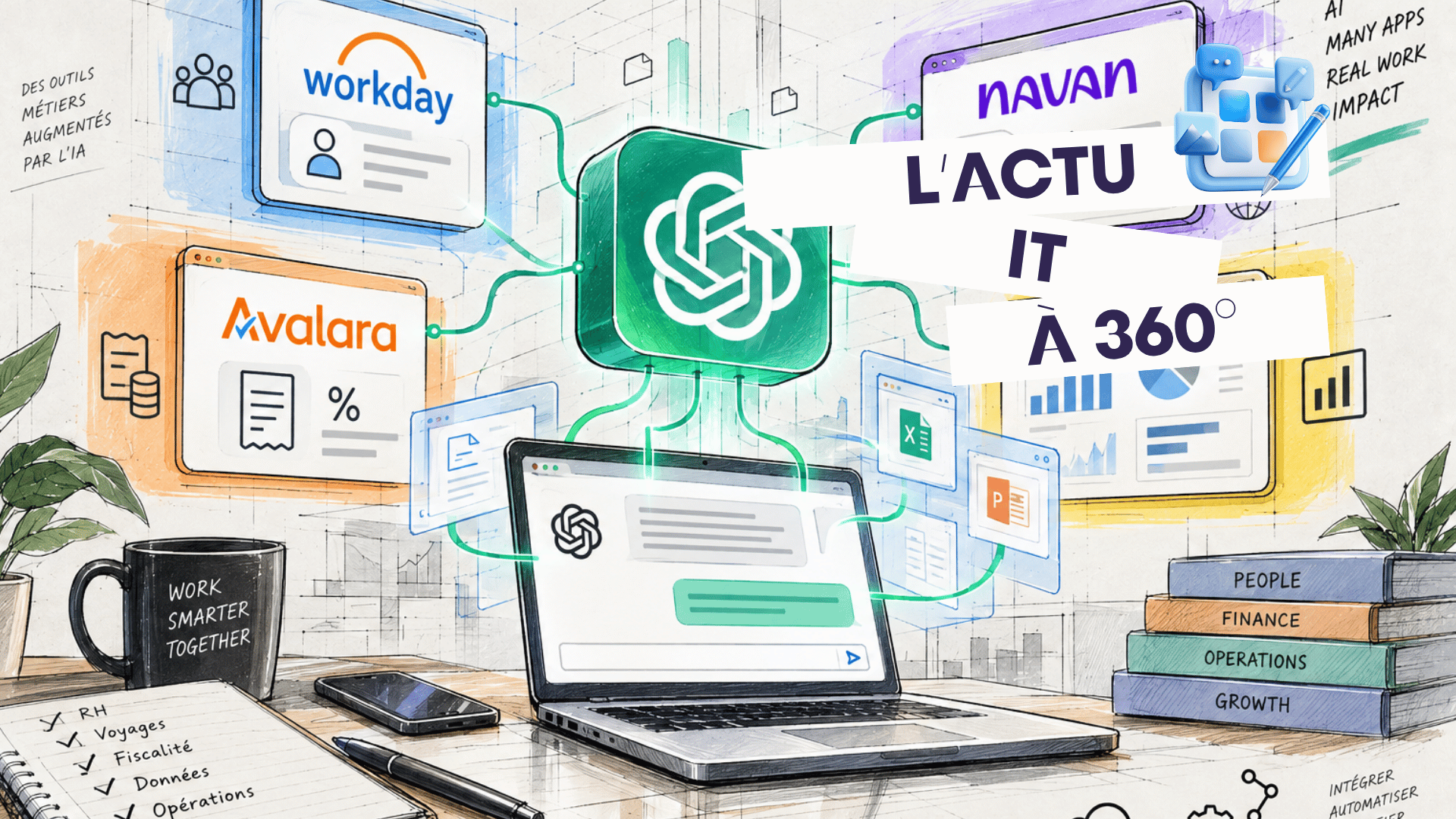
With GPT-6 Astra, OpenAI is no longer simply trying to improve the quality of ChatGPT’s answers. The company wants to bring its AI closer to the applications in which employees actually work. With the arrival of GPT-6 Astra on Amazon Bedrock, new enterprise plugins for ChatGPT Work extend its browser-use capabilities to business intelligence tools as well as to Workday, Navan and Avalara, with use cases focused on data analysis, operations and finance.¹ This is a significant change: ChatGPT Work can already gather information from applications and files, use the web and turn complex work into deliverables such as documents, spreadsheets, presentations or websites. With these additional connections, the AI is now moving directly closer to the software that structures a company’s day-to-day processes.
HR, travel, tax: AI moves closer to business processes
The choice of the first applications illustrates this shift well. Workday plays a central role in the HR and finance systems of many organisations, Navan handles business travel and expense management, while Avalara automates processes related to tax and compliance in particular. AWS has not yet provided an exhaustive list of actions specific to each of these plugins, so it would be premature to claim that ChatGPT Work can carry out any operation on these platforms. The announcement nonetheless confirms that their environments can now be used in workflows driven by Astra, alongside business intelligence tools.¹ The line between conversational assistant and business software is therefore becoming thinner: users can hand an objective to the AI, let it look for the information it needs in authorised environments and supervise the progress of the work rather than manually moving data from one application to another.
The browser becomes a gateway between AI and applications
This integration relies in particular on the advanced computer use and browser use capabilities of GPT-6 Astra. OpenAI presents its new model as particularly strong at complex, multi-step professional tasks, able to work across software interfaces and produce structured deliverables directly.² This approach is strategic because not all business software necessarily offers the APIs, connectors or automations that would let an agent carry out every step of a process. An AI capable of using a web interface can potentially pursue certain tasks by interacting with software in a way closer to that of a human user, which considerably widens the number of workflows that can be assisted or automated.
Automation does not mean handing AI the keys to the company
Connecting an agent to HR, financial or operational applications immediately raises the question of access rights. On this point, AWS specifies that the new plugins work through the user’s existing account and the permissions set by administrators, so they do not automatically give GPT-6 Astra additional privileges.¹ ChatGPT Work also makes it possible to control which applications and sites the agent can access, manage file transfers and require human confirmation before certain actions. Users can follow the progress of the work, change their instructions and approve important steps. This human-in-the-loop approach becomes essential as agents move beyond purely informational tasks to take part in processes that may affect the organisation’s data, spending or operations.
AI becomes a new layer of business software
This transformation brings Software and Application Management back to the fore. For a long time, administering business tools mainly meant deploying solutions, managing accounts, configuring access, keeping software up to date and supporting users. The arrival of agents able to move between several applications now adds an extra layer: deciding which data can be consulted, which actions can be carried out, which plugins should be authorised and when human validation remains mandatory. IT teams will also need to understand how these agents interact with ERPs, HR tools, financial solutions and collaboration platforms, so that a productivity gain does not turn into a proliferation of hard-to-control access. This development is therefore gradually bringing application administration closer to AI agent governance.
From copilot to workflow, enterprise software changes its logic
Above all, ChatGPT Work’s plugins illustrate a change of model. The first generation of generative AI mainly helped people write, summarise or search for information; the new generation seeks to complete an entire sequence of work by drawing on several sources and applications. GPT-6 Astra was specifically trained for multi-step professional tasks, and OpenAI says it can produce documents, presentations, spreadsheets and analyses tailored to an organisation’s templates and standards.² In this context, business software is no longer necessarily the place where users carry out each operation manually: it can become one of the resources an agent draws on to achieve a broader goal. The value of AI is thus gradually shifting from the answer it produces to the process it is able to orchestrate.
Companies will have to learn to govern digital co-workers
The arrival of Workday, Navan, Avalara and BI tools in the ChatGPT Work ecosystem ultimately offers a glimpse of what the agentic workstation could become. Instead of opening several pieces of software in turn, extracting information and then assembling it manually, employees will be able to entrust more cross-functional tasks to an AI capable of working across these environments. But the more agents can act, the more strategic their supervision becomes: permissions, identity, traceability, validation of operations and accountability in the event of error will need to be considered as carefully as their performance. The real change, then, is not simply that ChatGPT can connect to more applications; it is that AI is beginning to become an orchestration layer between the software that keeps the business running.
360° IT News — decoding technology to understand the jobs of tomorrow.
Further reading
This shift had already begun in collaboration tools. Read our CCCLX article “ Claude Tag turns Slack into a genuine agentic workspace ”, which looks at how Anthropic is building an agent directly into Slack to track projects, find information and support teams without leaving their working environment.
References
1. Amazon Web Services. (2026). Take on your most ambitious work with GPT-6 Astra on Amazon Bedrock.
https://aws.amazon.com/blogs/machine-learning/take-on-your-most-ambitious-work-with-gpt-6-astra-on-amazon-bedrock/
2. OpenAI. (2026). GPT-6 Astra: A new generation of intelligence.
https://openai.com/index/gpt-6-astra/
3. OpenAI. (2026). ChatGPT Release Notes.
https://help.openai.com/en/articles/6825453-chatgpt-release-notes
Europe accuses Anthropic of discrimination after Fable 5 is blocked
A US decision that sparks an international crisis The sudden suspension of access to Anthropic’s Fable 5 and Mythos 5 models outside the United States now goes well beyond technology. What initially looked like a national security measure is taking on a major...

Mobi Fold and Spotlight 2: Logitech aims to simplify everyday hybrid working
The office is everywhere, but the tools do not always keep up Hybrid working has profoundly changed professional habits. Video-conference meetings, frequent travel, days split between home, the office and coworking spaces: employees now move between multiple...

+80%: agentic AI triggers a record surge in enterprise SSD prices
Artificial intelligence is putting new strain on infrastructure Artificial intelligence is often associated with graphics processors and massive computing centres. Yet another essential component of digital infrastructure is coming under unprecedented pressure:...
Databricks extends Delta Sharing to AI and aims to break down data silos
Data is no longer enough: intelligence must now be shared too Artificial intelligence is transforming the way companies use their data. Yet one major obstacle remains: the resources needed for AI projects are often scattered across different platforms, teams and...

RTX Spark: Nvidia accelerates the shift to AI-optimised PCs
Nvidia wants to redefine the PC for the age of artificial intelligence Unveiled at Computex 2026, the RTX Spark chip marks a new stage in the evolution of personal computers. With this Arm-based platform, Nvidia is not simply seeking to offer a more powerful...

WiFi 8 is arriving sooner than expected: what it means for businesses
A new generation of networking is already on the horizon While WiFi 7 is only just beginning to spread among businesses and consumers, the industry is already preparing the next step. TP-Link has just unveiled the first WiFi 8-compatible router, confirming that the...

Webedia-Elephant turns to Gemini Enterprise to industrialise generative AI
IT outages become a board-level issue Long regarded as mere technical incidents, service outages are now taking on a whole new dimension. According to a study by Oxford Economics for Splunk, Global 2000 companies suffer an average of 60 downtime incidents a year, at...

$600 billion lost: IT outages take on a new dimension
IT outages are becoming a boardroom issue Long regarded as mere technical incidents, service interruptions are now taking on a whole new dimension. According to a study conducted by Oxford Economics for Splunk, Global 2000 companies suffer an average of 60 downtime...

Lightwell: IBM and Red Hat tackle the open source patching headache
AI finds flaws faster than companies can fix them Artificial intelligence is profoundly transforming cybersecurity. While it makes it possible to detect vulnerabilities more quickly, it also creates a new challenge: the ability to fix a growing number of flaws within...

AWS strengthens OpenSearch to connect AI to enterprise data
AI agents are forcing the cloud to evolve The rise of agentic AI is profoundly transforming cloud infrastructure. Unlike traditional conversational assistants, intelligent agents must access data, interact with several systems and carry out tasks autonomously. To meet...