


Data storage is reaching its limits
Every day, humanity produces a gigantic amount of data. In 2025, the volume generated worldwide each day is estimated at almost 300 exabytes, the equivalent of a century of European audiovisual archives created every 24 hours1. With the rise of artificial intelligence, the cloud and connected devices, this growth is becoming exponential. Behind this explosion lies a major problem: today’s storage infrastructure is gradually approaching its technical, energy and environmental limits.
PearCode wants to turn DNA into digital infrastructure
Against this backdrop, the French deeptech company PearCode, a spin-off from the I3S laboratory in Sophia Antipolis, has just launched a first archiving solution based on synthetic DNA. Long regarded as a futuristic technology, DNA storage is now starting to leave the laboratory and enter the market. The principle is to encode digital data as genetic sequences that can be preserved for decades, or even centuries, without significant degradation.
A gram of DNA could hold an entire data centre
One of the most spectacular arguments for DNA storage lies in its density. According to several studies, a single gram of DNA could theoretically hold the equivalent of an entire data centre’s data2. On top of this comes a major advantage: unlike traditional infrastructure, DNA does not require a continuous power supply to retain data. At a time when data centres already account for 1 to 2% of global electricity consumption, this prospect is attracting strong interest from the technology industry3.
The real challenge: automating data writing and reading
While the promise is immense, the main obstacle remains automation. Today, writing and reading data on DNA is still slow and expensive. The challenge for companies like PearCode is therefore to industrialise these processes in order to reduce costs and access times. This is precisely where the global competition is being played out. The players able to make this technology fast, reliable and accessible could redefine digital storage infrastructure in the coming decades.
A potential revolution for businesses and critical archives
The first target uses concern sensitive data and long-term archives: administrative documents, scientific data, digital heritage or medical records. For businesses, this approach could sharply reduce cold storage costs while improving data durability. SMEs could also benefit indirectly from this development through more efficient, less energy-hungry cloud services.
Between science, cloud and digital sovereignty
DNA storage is not just about technology; it also raises strategic issues. Controlling the storage infrastructure of the future could become a major digital sovereignty issue. While traditional data centres require massive amounts of energy and materials, DNA paves the way for a new, more compact and potentially more sustainable approach to the cloud. This transition could transform the way states and companies manage their critical data.
Understanding tomorrow’s infrastructure becomes essential
This development highlights a key skill: data and digital infrastructure. Future IT professionals will need to understand new storage architectures, their constraints and their uses. It is no longer just a matter of managing servers or conventional cloud, but of anticipating technologies capable of completely redefining the digital ecosystem.
Towards a biological cloud?
Even though DNA storage is still emerging, PearCode shows that the technology is gradually entering an industrial phase. The idea of storing data in a biological molecule may seem futuristic, but it addresses a very concrete problem: the saturation of digital infrastructure. For students and future IT professionals, this is a fascinating development. It shows that the future of the cloud may no longer rest solely on giant servers, but also on technologies directly inspired by living organisms.
360° IT News — decoding technology to understand the jobs of tomorrow.
Further reading
The emergence of DNA storage illustrates a profound transformation of digital infrastructure in the face of the explosion in data volumes generated by artificial intelligence and the cloud. This development is part of a worldwide search for more compact, durable solutions capable of overcoming the limits of traditional data centres. On a related topic, read our article “Data centre boom: Legrand goes on the offensive in China and the United Kingdom”, which analyses how storage and computing infrastructure is becoming a major strategic issue for the digital economy.
References
1. Statista. (2025). Global data creation forecast.
https://www.statista.com
2. Nature. (2021). DNA data storage density research.
https://www.nature.com
3. International Energy Agency. (2024). Data centres and electricity consumption.
https://www.iea.org
AWS strengthens OpenSearch to connect AI to enterprise data
AI agents are forcing the cloud to evolve The rise of agentic AI is profoundly transforming cloud infrastructure. Unlike traditional conversational assistants, intelligent agents must access data, interact with several systems and carry out tasks autonomously. To meet...
With Stainless, Anthropic aims to put Claude at the heart of software development
The AI battle is shifting to developer tools Anthropic is continuing its rise in artificial intelligence with the acquisition of Stainless, a start-up specialising in development tools and API automation. Behind this acquisition lies a significant strategic...
Microsoft transforms Office with Fintool and autonomous AI
Office enters the age of intelligent agents Microsoft is stepping up its agentic artificial intelligence strategy with the acquisition of Fintool, a start-up specialising in automated financial analysis. Founded in San Francisco by Frenchmen Nicolas Bustamante and...
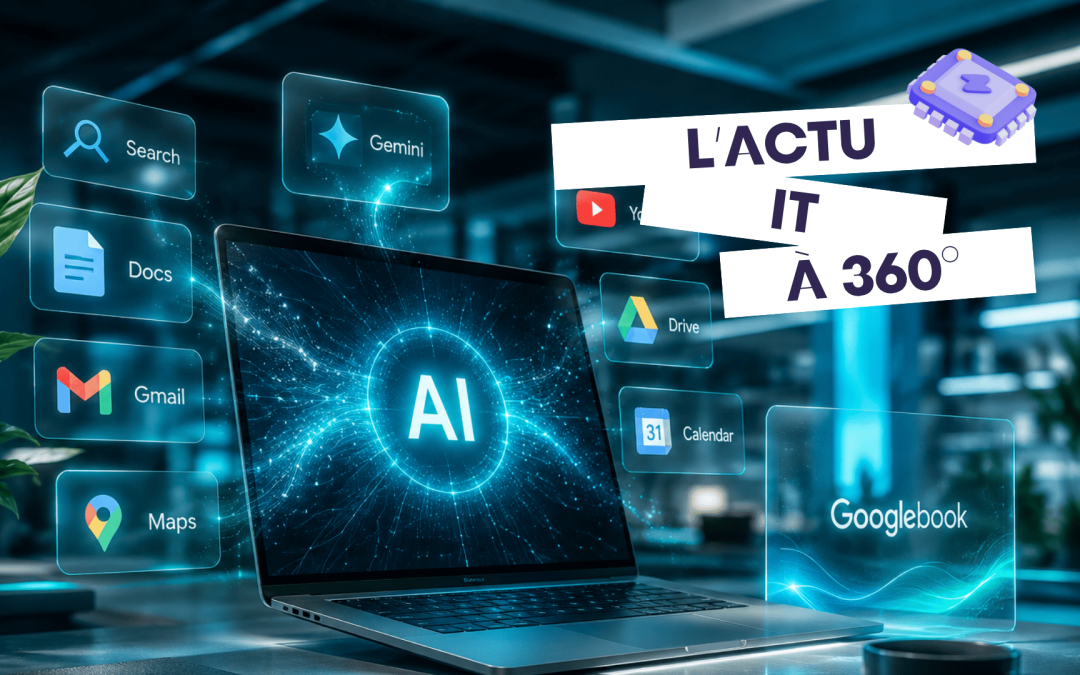
Googlebook: Google wants to reinvent the computer around AI
A new generation of PCs designed for artificial intelligence Google is preparing a new category of laptops called “Googlebook”, designed from the ground up around artificial intelligence. After AI-powered smartphones, the company now wants to turn the PC itself into a...

OpsMill: the start-up that wants to prepare IT systems for the AI shock
Artificial intelligence is moving faster than IT infrastructure Generative artificial intelligence is rapidly transforming businesses, but one reality is becoming increasingly clear: today’s IT infrastructure is not ready to absorb this revolution. This is...

+13.5% in 2026: corporate IT spending soars
A sharp acceleration in IT investment Worldwide IT spending is expected to reach 6.31 trillion dollars in 2026, a rise of 13.5% year on year, according to Gartner’s latest forecast1. This figure marks a clear acceleration compared with previous estimates (+10.8%),...

Microsoft builds legal AI into Word: contracts go automated
Word becomes an intelligent legal tool Microsoft is taking a new step by building artificial intelligence specialised in legal analysis directly into Word. The aim is clear: to automate contract review, detect risks and speed up document production. At a time when...

Merck and Google Cloud: a key partnership for agentic AI in the enterprise
A strategic investment to transform the company through AI Biopharmaceutical giant Merck has announced a 1-billion-dollar, 10-year partnership with Google Cloud, with a clear goal: to embed agentic artificial intelligence at the heart of its operations. This project...
Chrome Enterprise goes AI: Google automates browsing and workflows
The browser becomes a genuinely intelligent work tool Google is upgrading Chrome Enterprise with advanced artificial intelligence capabilities, turning the browser into an active platform able to carry out tasks. Autonomous browsing, workflow automation and...
$32 billion: Google launches a cyber army of AI agents
Cybersecurity enters a new dimension Google has made a major move by announcing an investment of $32 billion in developing a “cyber army” of artificial intelligence agents. Behind this term lies a technological reality: systems capable of automatically detecting,...