


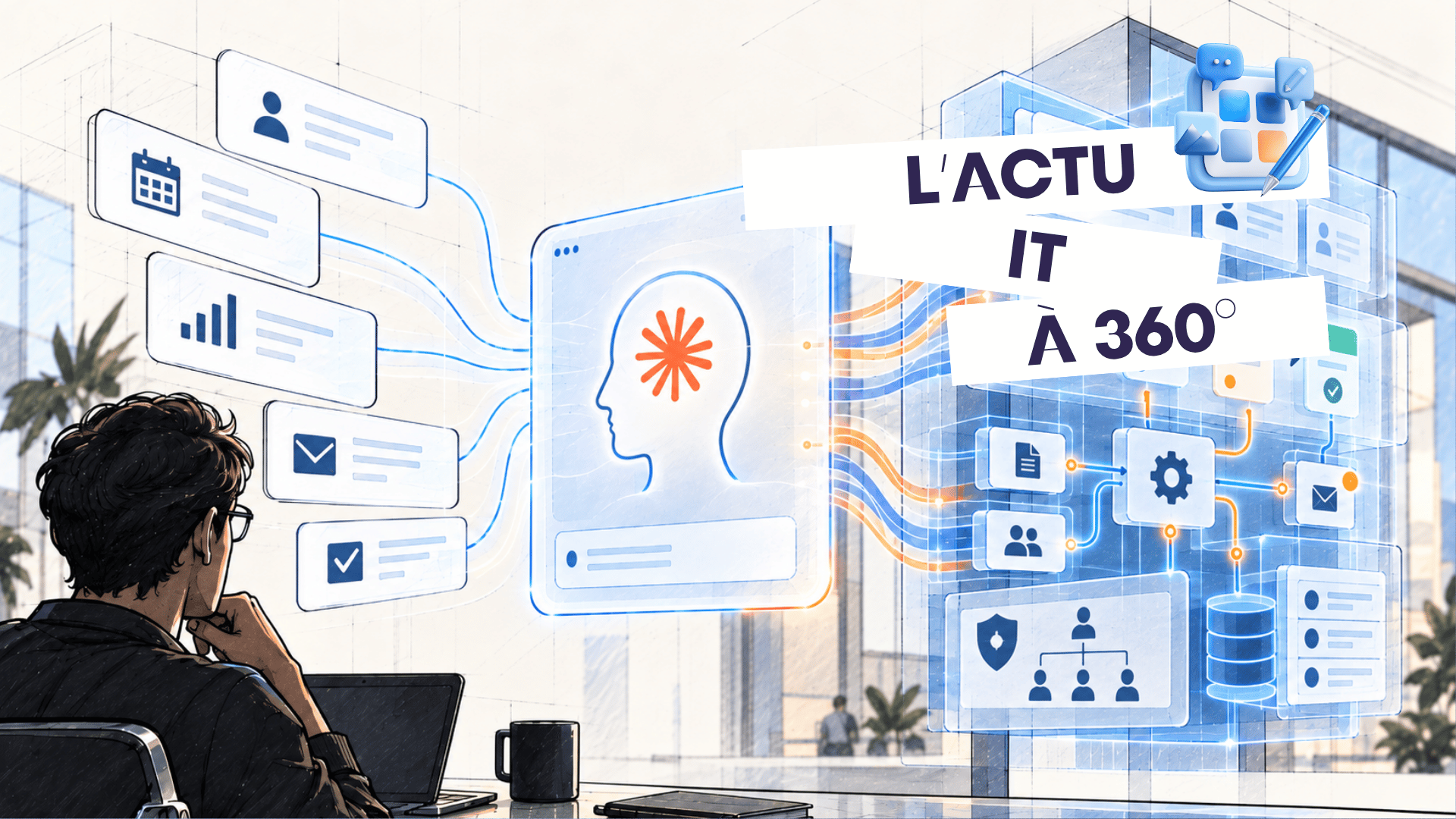
What if the CRM soon no longer needed to be opened?
For decades, using a CRM meant navigating between customer records, dashboards, menus and forms. With Claudeforce, Salesforce and Anthropic want to change this logic: rather than forcing users to go into Salesforce to find information or carry out an action, Claude could become the interface itself, giving direct access to the CRM’s data, workflows and business rules. Announced at the end of August and placed at the heart of the topics expected at Dreamforce 2026, which opens on 15 September, the partnership combines Claude’s reasoning capabilities with Salesforce’s data, business logic, actions and governance.¹ The first concrete product, Salesforce in Claude, allows pilot users to interact with their sales context directly from Claude, without having to keep going back to the Salesforce interface.
Salesforce in Claude starts with sales teams
The first version of Claudeforce targets sales. Salesforce in Claude takes the form of a plugin with 37 preconfigured sales skills, for example to prepare a meeting, review the health of an opportunity or analyse a pipeline.¹ Claude can reason from real-time sales context and carry out governed actions in Salesforce. The integration can also draw on context from Salesforce, Slack and other connectors available in Claude to generate views tailored to the salesperson. The goal is therefore more ambitious than a chatbot able to answer a few questions about a customer: Salesforce and Anthropic want to make Claude an environment from which part of the sales work can be analysed and then carried out. Salesforce points out, however, that Salesforce in Claude is still offered to pilot customers, with a beta announced for September 2026.
Headless 360 gradually separates software from its interface
This integration rests on a major architectural shift at Salesforce: Headless 360. This architecture exposes the platform’s capabilities, including data, workflows, business rules and permissions, so that agents can use them directly through secure connections relying in particular on MCP (Model Context Protocol).² Business software is then no longer necessarily the same thing as its graphical interface. Salesforce can continue to store customer data, apply rules and run processes in the background, while users interact with these capabilities from Claude, Slack or another interface. Salesforce itself sums up this shift as moving from software as an interface to software capable of powering multiple interfaces.
The CRM could become less visible, but much smarter
This shift directly transforms Software and Application Management. In a traditional environment, professionals learn to use an application: they know its menus, fields, screens and procedures. In an agentic environment, they could instead state an objective, such as preparing a meeting with a customer, identifying at-risk opportunities or updating a pipeline, and then let the agent determine which data to consult and which functions to call. The application does not disappear: it becomes a layer of services, data and rules sitting behind the agent. For IT teams, administering business software could therefore gradually mean governing APIs, permissions, agents and MCP connections as much as configuring the interfaces used by employees.
Claude also enters Salesforce, not just the other way round
Claudeforce works in both directions. Salesforce is not simply opening its data to Claude: Claude is also integrated into its own agentic environment. Salesforce states that Claude is available in Agentforce as a reasoning model, that it powers certain experiences by default such as Agentforce Vibes and Agentforce Coworker, and that it is accessible in Agent Builder.¹ The company also states that Claude is the first LLM provider fully integrated within the Salesforce Trust Boundary, notably via Amazon Bedrock. This architecture allows Salesforce to retain its security and governance mechanisms while providing access to the capabilities of Anthropic’s model, a particularly important point for organisations handling sensitive data or operating in regulated sectors.
Slack becomes the other cornerstone of Claudeforce
The partnership takes on another dimension with Slack. Salesforce wants to make its collaboration platform the space where humans and agents work together, and Claude is becoming a central part of this strategy. According to Salesforce, Claude is now the default model for several Slack experiences: it powers Slackbot, takes part in collaboration through Claude Tag and is one of the founding partners of Slack Code.¹ The idea is to allow a team to discuss a situation in Slack, ask Claude to analyse it using the available context and then, where permissions allow, trigger an action in Salesforce without interrupting the workflow. The CRM could then gradually move from being an application you open to becoming business infrastructure accessible from the space where employees already work.
Salesforce permissions follow the user all the way into Claude
Connecting an AI model to a CRM immediately raises a question: what can it actually see and change? Salesforce says that Salesforce in Claude reuses existing permissions and business rules. Claude should only see the information the logged-in user is authorised to access and can only perform actions matching that user’s rights.² This is crucial: a conversational interface must not become a shortcut for bypassing the information system’s security mechanisms. The more agents are able to operate business software directly, the more companies will have to treat identities, permissions, action logs and execution rules as fundamental components of their agentic architecture.
Dreamforce now needs to show how far Salesforce wants to go
The timing is strategic. Dreamforce 2026 takes place from 15 to 17 September in San Francisco, and Salesforce is already announcing demonstrations of Salesforce in Claude as well as new information on what the two companies are building together.³ It is therefore important to distinguish what has already been announced from what is still to come: Claudeforce and Salesforce in Claude do exist, the 37 sales skills have been announced and some customers are taking part in the pilot, but several extensions of the integration have yet to be detailed. Above all, Dreamforce should reveal how far Salesforce intends to push this strategy, in which Claude, Agentforce, Slack, Headless 360 and CRM data function as the different layers of a single agentic environment.
After the graphical interface, the interface could become an intention
Ultimately, Claudeforce illustrates a much broader shift in enterprise software. For a long time, innovation consisted of improving the graphical interface so that users could find a function more quickly. Agentic AI is gradually reversing this logic: the user states what they want to achieve and the agent itself looks for the data, functions and workflows needed to complete the task. Salesforce is therefore not necessarily planning the disappearance of its traditional interfaces, but is preparing for a world in which they would no longer be the only way to access the CRM’s capabilities. If this approach becomes widespread, the next battle in business software may be fought less over the quality of menus than over the ability to expose data and actions securely to AI agents.
360° IT News — decoding technology to understand the jobs of tomorrow.
Further reading
This strategy is a direct extension of a transformation already visible in collaboration tools. Read our CCCLX article “Claude Tag turns Slack into a true agentic workspace”, which analyses how Anthropic is making Slack an environment in which AI can follow teams’ context, join their conversations and take a direct part in their workflows.
References
1. Salesforce. (2026). Salesforce and Anthropic Announce Claudeforce: The #1 AI Meets the #1 AI CRM.
https://www.salesforce.com/news/press-releases/2026/08/27/salesforce-and-anthropic-announce-claudeforce/
2. Salesforce. (2026). Claudeforce: The #1 AI Meets the #1 CRM.
https://www.salesforce.com/claudeforce/
3. Salesforce. (2026). Dreamforce 2026 Official Media Resources & News.
https://www.salesforce.com/news/dreamforce-26-media-resources/
4. ITPro. (2026). What to expect at Dreamforce 2026.
https://www.itpro.com/business/business-strategy/what-to-expect-at-dreamforce-2026

AI propels Nokia: data centres are reshaping the networking market
The AI explosion is transforming the infrastructure market Nokia is reaping the full benefits of the rise of artificial intelligence and the proliferation of data centres that comes with it. In the second quarter of 2026, the company’s Network Infrastructure business...

Gemini 3.5 Pro delayed: Google under pressure in the AI race
The race for AI models is speeding up Google is going through a difficult period in the competition over advanced artificial intelligence models. According to several reports in the specialist press, the launch of Gemini 3.5 Pro has reportedly been pushed back by...

Project Glasswing: Anthropic goes on the offensive against software vulnerabilities
A new step for AI applied to cybersecurity Anthropic is pressing ahead with Project Glasswing, an initiative that makes its Claude Mythos Preview model available to specialist cybersecurity players in order to identify and fix vulnerabilities in critical software. The...

Cloud, AI, defence: AWS steps up on every front
AWS makes artificial intelligence a pillar of critical infrastructure At the AWS Summit Washington, D.C. 2026, Amazon Web Services unveiled several developments aimed at government departments, public bodies and critical sectors. The company is strengthening its...

MDASH: the AI helping Microsoft secure Windows
Microsoft hands part of the bug hunt to artificial intelligence Cyberattacks are evolving ever faster, forcing software vendors to detect vulnerabilities before they can even be exploited. To meet this challenge, Microsoft has unveiled MDASH (Microsoft Detection and...

Microsoft speeds up its cybersecurity with AI: defence moves to machine scale
Microsoft wants to regain the upper hand against cyberattacks Cybercriminals are now using artificial intelligence to discover vulnerabilities, automate their attacks and speed up their malicious campaigns. In response, Microsoft is pressing ahead with its Secure...

Free access to Claude Fable 5 extended as Anthropic holds off
A new generation of AI designed for specific uses OpenAI is changing its strategy with the launch of GPT-5.6, a new family of models made up of Sol, Terra and Luna. Rather than offering a single model capable of meeting every need, the company is now betting on a...

OpenAI bets on modular AI with Sol, Terra and Luna
A new generation of AI designed for specific uses OpenAI is changing its strategy with the launch of GPT-5.6, a new family of models made up of Sol, Terra and Luna. Rather than offering a single model capable of meeting every need, the company is now betting on a...

Anthropic’s AI is advancing at a pace that worries cybersecurity specialists
AI models cross a new capability threshold Barely a month after its launch, Claude Mythos Preview is already improving its performance. According to the latest tests published by the UK’s AI Security Institute (AISI), Anthropic’s model now beats its own results from...
Lumo AI 2.0 speeds up without sacrificing data protection
Proton wants to prove that a high-performing AI can also be private The artificial intelligence race is no longer played out solely on model performance. User trust and data protection are now becoming major differentiators. With Lumo AI 2.0, Proton is upgrading its...