



Oracle wants to make OCI a one-stop shop for AI
Oracle is stepping up its efforts in the AI cloud battle by significantly expanding the catalogue of models available in OCI Enterprise AI. On 4 September 2026, the group announced in particular the integration of Kimi K3, Moonshot AI’s model, as well as new capabilities allowing businesses to deploy models from Mistral, Google, Alibaba, NVIDIA, DeepSeek, Z.ai and Xiaomi through Model Import.¹ Behind this growing list lies a clear strategy: Oracle does not want to push its customers towards a single model, but to provide them with an infrastructure in which different families of AI can be evaluated, deployed and operated as needed. For CIOs, this development matters because choosing a model now depends as much on its performance as on its cost, language capabilities, specialisation, multimodality or the governance constraints imposed by the company.
Kimi K3 joins the OCI ecosystem directly
The arrival of Kimi K3 is particularly revealing of this strategy. Developed by Moonshot AI, the model is based on a Mixture of Experts (MoE) architecture that aims to combine very large capacity with more selective activation of parameters during inference. Oracle is making Kimi K3 available in OCI Enterprise AI so that businesses can use it in their applications and workflows without having to build all the infrastructure required to deploy it themselves.¹ Above all, this integration allows Oracle to broaden its offering beyond the American and European players that have traditionally dominated enterprise cloud, at a time when Chinese models are taking a growing place in the open-source and open-weight ecosystem. For international organisations, this diversification opens up new opportunities for experimentation, particularly in software development, reasoning, agentic use cases and multilingual applications.
Model Import opens OCI to a wave of models
Oracle’s strategy, however, goes well beyond Kimi K3. With Model Import, OCI Enterprise AI allows businesses to import and deploy compatible models from different ecosystems, including Mistral, Google, Alibaba, NVIDIA, DeepSeek, Z.ai and Xiaomi.² The principle is significant: instead of waiting for a model to be systematically integrated as a service fully managed by the cloud provider, teams can bring certain models into OCI and run them on Oracle’s infrastructure. This approach is gradually turning the AI cloud into a universal execution platform in which the model becomes an interchangeable component of the architecture. An organisation can thus test several solutions, compare their performance on its own data and select different AIs for different applications, rather than making its entire strategy dependent on a single provider.
The best model is no longer necessarily the same for every task
This proliferation of options reflects an increasingly obvious reality: there is not necessarily one universally superior model. A company may want a highly capable coding AI for its developers, a cheaper model for processing large volumes of documents, a solution that is particularly effective in certain languages or a multimodal model to analyse text and images at the same time. On top of this come constraints of latency, resource consumption, licensing and compliance. The choice is therefore gradually becoming an architectural decision. Companies may end up building a portfolio in which several models coexist and are called on dynamically depending on the nature of the task, a logic that makes platforms capable of hosting and orchestrating different families of AI particularly strategic.
Open source also reduces dependence on model providers
Opening OCI to more open-source or open-weight models also responds to some organisations’ desire to limit vendor lock-in. Relying exclusively on a model accessed through a proprietary API can create significant dependence in terms of pricing, availability, technical evolution or commercial policy. Models whose weights can be deployed on infrastructure chosen by the company offer greater control over their execution environment, even though running them in return requires greater technical and operational skills.³ With Model Import, Oracle is seeking precisely to capture this demand by allowing businesses to keep their OCI infrastructure while changing the models they use. The cloud then becomes the stable layer of the architecture, while AIs can be replaced, specialised or combined much more quickly.
The AI cloud is becoming an à la carte model marketplace
This development is directly transforming Cloud Computing. Architects no longer just have to choose a region, a machine type or a storage architecture: they must also decide where to run each model, what resources to allocate to it, how to manage its autoscaling, security and observability, and then measure its performance-to-cost ratio. In a multi-model architecture, these trade-offs become even more important, since several AIs may use different infrastructures and be subject to different constraints. Cloud skills are thus moving ever closer to ModelOps and LLMOps, with the need to manage models as evolving components of the information system rather than as isolated services.
For CIOs, the choice is also a matter of governance
The diversification of models does, however, bring additional complexity. Adding several AIs to the information system means multiplying the licences, technical characteristics, security levels and behaviours to be monitored. Teams will therefore need to establish criteria to determine which models are authorised for which data and which uses, and also to track their versions and performance over time. A particularly cost-effective model may be suited to certain internal tasks while being inadequate for a critical process; conversely, systematically using the most powerful model can lead to disproportionate costs. The challenge for CIOs will therefore be less about finding “the best LLM” than about building governance capable of directing each workload to the appropriate model.
Oracle is betting on a future in which businesses will use several AIs
With Kimi K3 and the expansion of Model Import, Oracle is ultimately betting that the enterprise AI market will become durably multi-model. The extremely rapid progress of Moonshot AI, Mistral, DeepSeek, Alibaba and other labs makes it hard to imagine an organisation selecting a provider today and keeping the same model for several years. Cloud architectures must therefore be flexible enough to accommodate the next generations of AI without requiring a complete rebuild of applications. By turning OCI into an environment capable of hosting a growing range of models, Oracle is seeking precisely to become this lasting infrastructure layer, while the models running on top of it can continue to evolve at a much faster pace.
360° IT News — decoding technology to understand the jobs of tomorrow.
Further reading
Read our CCCLX article “AWS strengthens OpenSearch to connect AI to enterprise data”, which looks at another central challenge of professional AI: enabling models and intelligent applications to find and make effective use of information scattered across the organisation’s systems.
References
1. Oracle. (2026). Oracle expands OCI Enterprise AI with new frontier and open models.
https://www.oracle.com/news/
2. Oracle Cloud Infrastructure. (2026). Model Import in OCI Enterprise AI.
https://docs.oracle.com/en-us/iaas/
3. Oracle. (2026). OCI Generative AI and Enterprise AI.
https://www.oracle.com/artificial-intelligence/generative-ai/
GitHub Copilot bulks up for business: coding agents come under IT control
Copilot is no longer just there to suggest the next line GitHub Copilot is continuing its transformation. Originally known mainly for completing code in the editor, the tool is now evolving towards agents capable of exploring a project, modifying files, using tools...
PDFs, presentations, audio: Adobe wants to turn Acrobat into a content factory
Acrobat no longer just wants to open your documents For more than thirty years, Acrobat has mainly been used to read, create, edit, sign and share PDFs. Adobe now wants to give it a much broader role. On 9 September 2026, the company announced new capabilities based...
Salesforce plugs Claude into its CRM: Claudeforce prepares for life after the interface
What if the CRM soon no longer needed to be opened? For decades, using a CRM meant navigating between customer records, dashboards, menus and forms. With Claudeforce, Salesforce and Anthropic want to change this logic: rather than forcing users to go into Salesforce...
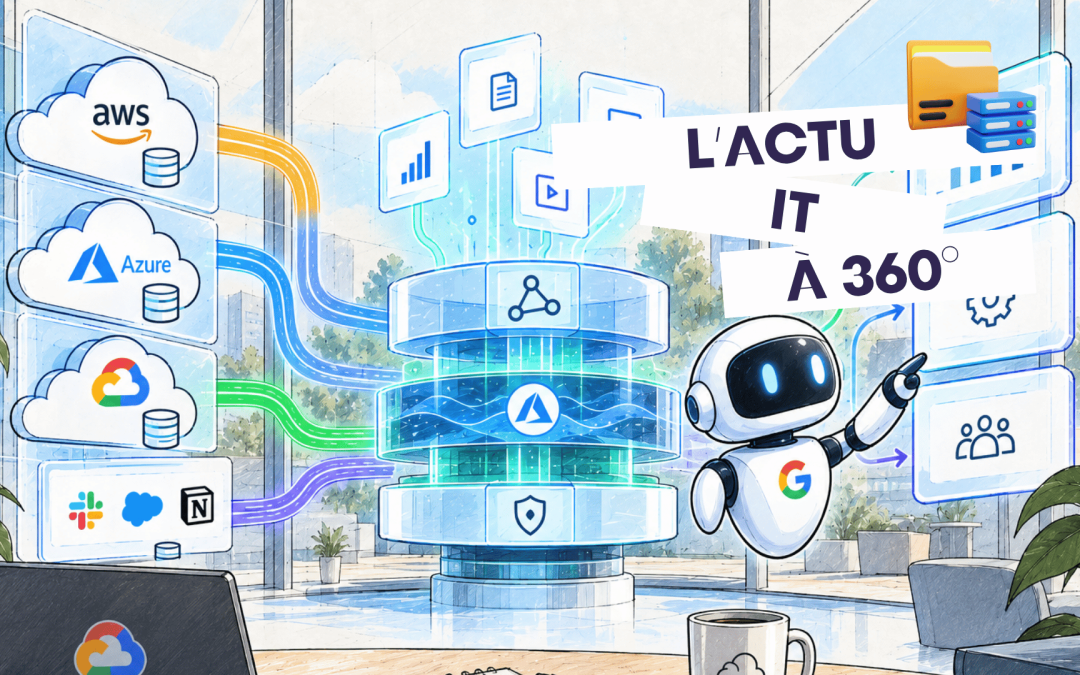
Agentic Data Cloud: Google rethinks data for the age of AI agents
AI agents are forcing Google to rethink data architecture AI agents promise to search for information, make decisions and act directly within company systems, but this autonomy depends on one essential condition: accessing the right data and, above all, understanding...
Google Cloud tackles the hidden bill of AI agents
AI agents raise a new problem: how much does a task really cost? As companies move from chatbots to AI agents able to work through multiple steps, the question of cost becomes much more complex. A chatbot generally handles a request and generates an answer, whereas an...
Workday, Navan, Avalara: ChatGPT Work moves into business software
ChatGPT Work is gradually leaving the chat window With GPT-6 Astra, OpenAI is no longer simply trying to improve the quality of ChatGPT’s answers. The company wants to bring its AI closer to the applications in which employees actually work. With the arrival of GPT-6...

From chip to cloud: Groq raises 350 million to scale up
Groq now wants to sell cloud rather than just chips Groq is pursuing a major strategic transformation. Long seen as one of Nvidia’s challengers thanks to its LPUs (Language Processing Units) specialised in artificial intelligence model inference, the group is now...
Muse Code: Meta launches its AI agent to tackle giant codebases
Meta wants to bring AI agents into complex software projects Meta is stepping up its efforts in AI-assisted software development with Muse Code, a new agent designed to work on large codebases, where traditional assistants can quickly lose the context needed to...
Qwen3.8-Max reportedly coded for 16 days without human intervention
Alibaba tests how far an autonomous AI developer can go Alibaba claims to have reached a new milestone in agentic software development with Qwen3.8-Max, its new flagship model launched in early August 2026. In an internal test, the model reportedly worked fully...
Two months, $1.1 billion: River AI is already exciting investors
A spectacular raise for a start-up barely out of the shadows Two months after emerging from stealth mode, River AI has just completed one of the most spectacular funding rounds of the year in artificial intelligence. The start-up founded by Igor Babuschkin, a former...