


ChatGPT Work is gradually leaving the chat window
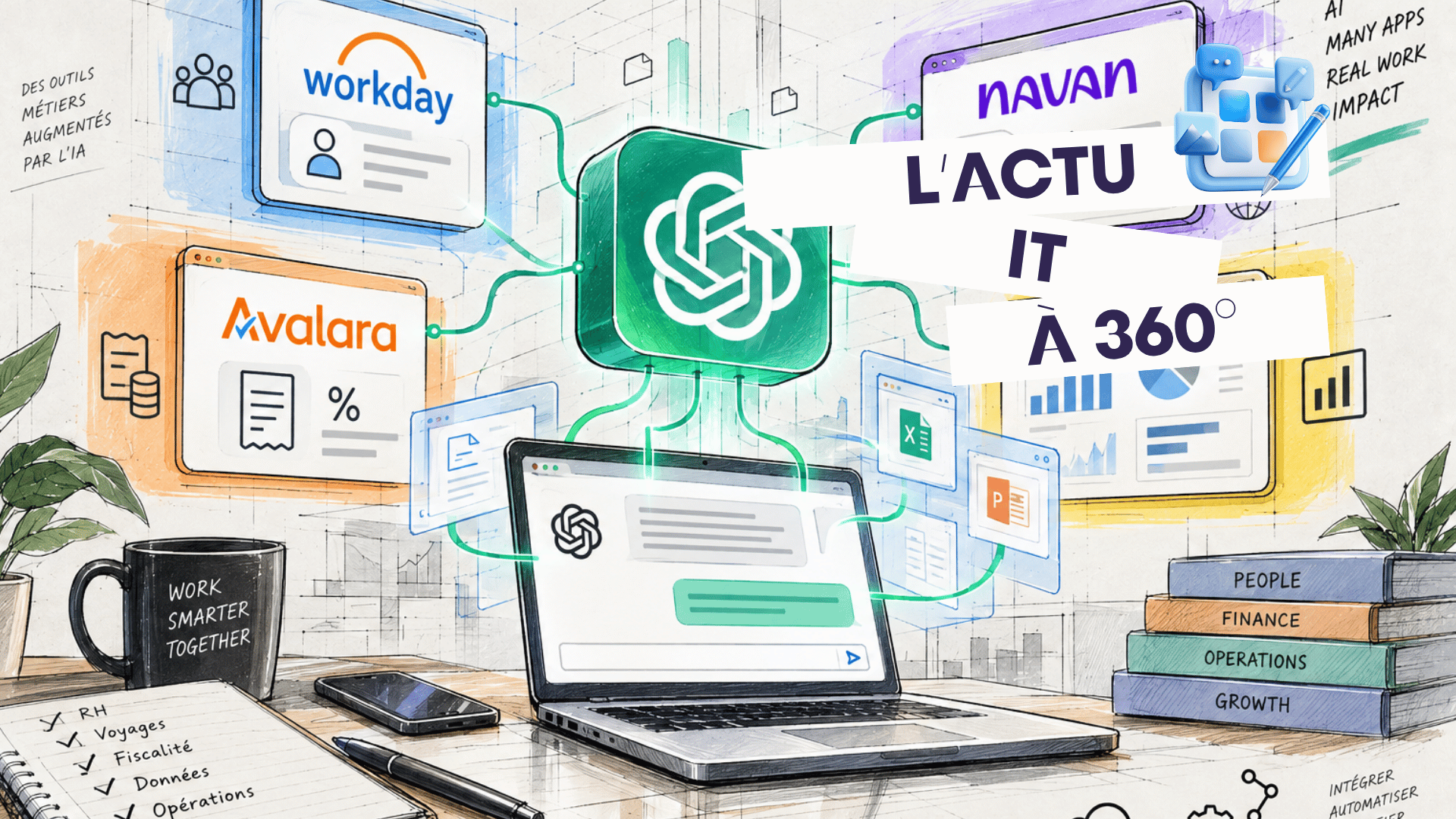
With GPT-6 Astra, OpenAI is no longer simply trying to improve the quality of ChatGPT’s answers. The company wants to bring its AI closer to the applications in which employees actually work. With the arrival of GPT-6 Astra on Amazon Bedrock, new enterprise plugins for ChatGPT Work extend its browser-use capabilities to business intelligence tools as well as to Workday, Navan and Avalara, with use cases focused on data analysis, operations and finance.¹ This is a significant change: ChatGPT Work can already gather information from applications and files, use the web and turn complex work into deliverables such as documents, spreadsheets, presentations or websites. With these additional connections, the AI is now moving directly closer to the software that structures a company’s day-to-day processes.
HR, travel, tax: AI moves closer to business processes
The choice of the first applications illustrates this shift well. Workday plays a central role in the HR and finance systems of many organisations, Navan handles business travel and expense management, while Avalara automates processes related to tax and compliance in particular. AWS has not yet provided an exhaustive list of actions specific to each of these plugins, so it would be premature to claim that ChatGPT Work can carry out any operation on these platforms. The announcement nonetheless confirms that their environments can now be used in workflows driven by Astra, alongside business intelligence tools.¹ The line between conversational assistant and business software is therefore becoming thinner: users can hand an objective to the AI, let it look for the information it needs in authorised environments and supervise the progress of the work rather than manually moving data from one application to another.
The browser becomes a gateway between AI and applications
This integration relies in particular on the advanced computer use and browser use capabilities of GPT-6 Astra. OpenAI presents its new model as particularly strong at complex, multi-step professional tasks, able to work across software interfaces and produce structured deliverables directly.² This approach is strategic because not all business software necessarily offers the APIs, connectors or automations that would let an agent carry out every step of a process. An AI capable of using a web interface can potentially pursue certain tasks by interacting with software in a way closer to that of a human user, which considerably widens the number of workflows that can be assisted or automated.
Automation does not mean handing AI the keys to the company
Connecting an agent to HR, financial or operational applications immediately raises the question of access rights. On this point, AWS specifies that the new plugins work through the user’s existing account and the permissions set by administrators, so they do not automatically give GPT-6 Astra additional privileges.¹ ChatGPT Work also makes it possible to control which applications and sites the agent can access, manage file transfers and require human confirmation before certain actions. Users can follow the progress of the work, change their instructions and approve important steps. This human-in-the-loop approach becomes essential as agents move beyond purely informational tasks to take part in processes that may affect the organisation’s data, spending or operations.
AI becomes a new layer of business software
This transformation brings Software and Application Management back to the fore. For a long time, administering business tools mainly meant deploying solutions, managing accounts, configuring access, keeping software up to date and supporting users. The arrival of agents able to move between several applications now adds an extra layer: deciding which data can be consulted, which actions can be carried out, which plugins should be authorised and when human validation remains mandatory. IT teams will also need to understand how these agents interact with ERPs, HR tools, financial solutions and collaboration platforms, so that a productivity gain does not turn into a proliferation of hard-to-control access. This development is therefore gradually bringing application administration closer to AI agent governance.
From copilot to workflow, enterprise software changes its logic
Above all, ChatGPT Work’s plugins illustrate a change of model. The first generation of generative AI mainly helped people write, summarise or search for information; the new generation seeks to complete an entire sequence of work by drawing on several sources and applications. GPT-6 Astra was specifically trained for multi-step professional tasks, and OpenAI says it can produce documents, presentations, spreadsheets and analyses tailored to an organisation’s templates and standards.² In this context, business software is no longer necessarily the place where users carry out each operation manually: it can become one of the resources an agent draws on to achieve a broader goal. The value of AI is thus gradually shifting from the answer it produces to the process it is able to orchestrate.
Companies will have to learn to govern digital co-workers
The arrival of Workday, Navan, Avalara and BI tools in the ChatGPT Work ecosystem ultimately offers a glimpse of what the agentic workstation could become. Instead of opening several pieces of software in turn, extracting information and then assembling it manually, employees will be able to entrust more cross-functional tasks to an AI capable of working across these environments. But the more agents can act, the more strategic their supervision becomes: permissions, identity, traceability, validation of operations and accountability in the event of error will need to be considered as carefully as their performance. The real change, then, is not simply that ChatGPT can connect to more applications; it is that AI is beginning to become an orchestration layer between the software that keeps the business running.
360° IT News — decoding technology to understand the jobs of tomorrow.
Further reading
This shift had already begun in collaboration tools. Read our CCCLX article “ Claude Tag turns Slack into a genuine agentic workspace ”, which looks at how Anthropic is building an agent directly into Slack to track projects, find information and support teams without leaving their working environment.
References
1. Amazon Web Services. (2026). Take on your most ambitious work with GPT-6 Astra on Amazon Bedrock.
https://aws.amazon.com/blogs/machine-learning/take-on-your-most-ambitious-work-with-gpt-6-astra-on-amazon-bedrock/
2. OpenAI. (2026). GPT-6 Astra: A new generation of intelligence.
https://openai.com/index/gpt-6-astra/
3. OpenAI. (2026). ChatGPT Release Notes.
https://help.openai.com/en/articles/6825453-chatgpt-release-notes

AI propels Nokia: data centres are reshaping the networking market
The AI explosion is transforming the infrastructure market Nokia is reaping the full benefits of the rise of artificial intelligence and the proliferation of data centres that comes with it. In the second quarter of 2026, the company’s Network Infrastructure business...

Gemini 3.5 Pro delayed: Google under pressure in the AI race
The race for AI models is speeding up Google is going through a difficult period in the competition over advanced artificial intelligence models. According to several reports in the specialist press, the launch of Gemini 3.5 Pro has reportedly been pushed back by...

Project Glasswing: Anthropic goes on the offensive against software vulnerabilities
A new step for AI applied to cybersecurity Anthropic is pressing ahead with Project Glasswing, an initiative that makes its Claude Mythos Preview model available to specialist cybersecurity players in order to identify and fix vulnerabilities in critical software. The...

Cloud, AI, defence: AWS steps up on every front
AWS makes artificial intelligence a pillar of critical infrastructure At the AWS Summit Washington, D.C. 2026, Amazon Web Services unveiled several developments aimed at government departments, public bodies and critical sectors. The company is strengthening its...

MDASH: the AI helping Microsoft secure Windows
Microsoft hands part of the bug hunt to artificial intelligence Cyberattacks are evolving ever faster, forcing software vendors to detect vulnerabilities before they can even be exploited. To meet this challenge, Microsoft has unveiled MDASH (Microsoft Detection and...

Microsoft speeds up its cybersecurity with AI: defence moves to machine scale
Microsoft wants to regain the upper hand against cyberattacks Cybercriminals are now using artificial intelligence to discover vulnerabilities, automate their attacks and speed up their malicious campaigns. In response, Microsoft is pressing ahead with its Secure...

Free access to Claude Fable 5 extended as Anthropic holds off
A new generation of AI designed for specific uses OpenAI is changing its strategy with the launch of GPT-5.6, a new family of models made up of Sol, Terra and Luna. Rather than offering a single model capable of meeting every need, the company is now betting on a...

OpenAI bets on modular AI with Sol, Terra and Luna
A new generation of AI designed for specific uses OpenAI is changing its strategy with the launch of GPT-5.6, a new family of models made up of Sol, Terra and Luna. Rather than offering a single model capable of meeting every need, the company is now betting on a...

Anthropic’s AI is advancing at a pace that worries cybersecurity specialists
AI models cross a new capability threshold Barely a month after its launch, Claude Mythos Preview is already improving its performance. According to the latest tests published by the UK’s AI Security Institute (AISI), Anthropic’s model now beats its own results from...

Lumo AI 2.0 speeds up without sacrificing data protection
Proton wants to prove that a high-performing AI can also be private The artificial intelligence race is no longer played out solely on model performance. User trust and data protection are now becoming major differentiators. With Lumo AI 2.0, Proton is upgrading its...