


The race for AI models is speeding up
Google is going through a difficult period in the competition over advanced artificial intelligence models. According to several reports in the specialist press, the launch of Gemini 3.5 Pro has reportedly been pushed back by several months. The news immediately fuelled investor concerns, sending Alphabet shares lower. More than a simple scheduling delay, the situation illustrates the growing pressure on established AI players, who face competitors that are multiplying announcements and accelerating their development cycles.1
Expectations around Gemini remain very high
Since launching the Gemini family, Google has been seeking to show that its models can compete with those of OpenAI, Anthropic and Meta. Gemini 3.5 Pro is expected to be an important step in improving performance in reasoning, programming and professional use cases. Each postponement therefore delays Google’s ability to offer an alternative capable of winning over businesses and developers, two markets where competition is intensifying rapidly.2
Investors want concrete results
The artificial intelligence market is now moving at an unprecedented pace. Companies are no longer judged solely on their ambitions, but on their ability to deliver high-performing models quickly and turn them into revenue-generating services. The delays to Gemini 3.5 Pro are fuelling questions about Google’s speed of execution, while its main competitors keep launching new versions and continually enriching their AI platforms.1
The battle now goes beyond model quality
Competition no longer rests solely on technical performance. Providers must also offer a complete ecosystem combining cloud infrastructure, development tools, security, integration with business applications and large-scale deployment capabilities. In this context, every month of delay can hand a strategic advantage to competitors that continue to expand their presence among businesses and developers.3
Innovation no longer waits for the established giants
For several years, Google contributed greatly to the advances of modern artificial intelligence. Today, the company operates in a market where new models appear constantly and user expectations change very quickly. This acceleration shows that no player, even among the AI pioneers, is safe from losing momentum if its pace of innovation slows.
A race in which speed is becoming a strategic advantage
The reported delay to Gemini 3.5 Pro illustrates a new market reality: in generative artificial intelligence, speed of execution has become almost as important as model performance. Businesses are looking for solutions that evolve continuously, while developers expect ever more advanced features. In this global competition, maintaining a sustained pace of innovation is now a decisive factor in staying among the leaders.
360° IT News — decoding technology to understand the jobs of tomorrow.
Further reading
The major AI players are all seeking to strengthen their position with businesses. Read our article “Cloud, AI, defence: AWS accelerates on all fronts”, which analyses how AWS is combining artificial intelligence, the cloud and critical infrastructure to build an ecosystem capable of rivalling the other giants of the sector.
References
1. Anthropic. (2026). Project Glasswing.
https://www.anthropic.com
2. Horizon3.ai. (2026). Horizon3.ai joins Project Glasswing.
https://www.horizon3.ai
3. Anthropic. (2026). Responsible Scaling Policy.
https://www.anthropic.com/responsible-scaling-policy

Djinn Stealer: the malware targeting companies’ cloud and AI credentials
Cybercriminals are changing targets Cyberattacks are no longer aimed solely at data or workstations. The credentials used to access cloud platforms, artificial intelligence environments and development tools have become highly sought-after assets. It is against this...

Claude Tag turns Slack into a genuine agentic workspace
AI agents settle at the heart of collaborative work Artificial intelligence is no longer limited to assistants accessed in a chat window. With Claude Tag, Anthropic is taking a new step by building an AI agent directly into Slack. Available in beta for Claude...

IBM and OpenAI want to arm businesses against machine-speed cyberattacks
Defenders must now fight AI with AI Cyberattacks are evolving at unprecedented speed. Thanks to artificial intelligence models, attackers can automate the search for vulnerabilities, analyse code in seconds and quickly identify the most exposed systems. To respond to...
Open-source security scales up: IBM, Red Hat and Palo Alto join forces
Cyberattacks push IT giants to join forces Open-source components are present in virtually all modern applications, from cloud platforms to business software. This dependence, however, comes with a growing risk: vulnerabilities are now discovered and exploited much...
With Lambda, AWS prepares cloud infrastructure for autonomous AI agents
Serverless enters a new phase The cloud is evolving to meet the needs of a new generation of applications based on agentic artificial intelligence. As AI agents become capable of carrying out complex tasks for hours at a time, traditional serverless architectures are...
With Code Layers, Figma brings design and development together for good
A new step towards building apps without boundaries Design and software development have long followed two separate paths. Designers imagined the interfaces, developers then translated them into code, with many back-and-forth exchanges and sometimes discrepancies...
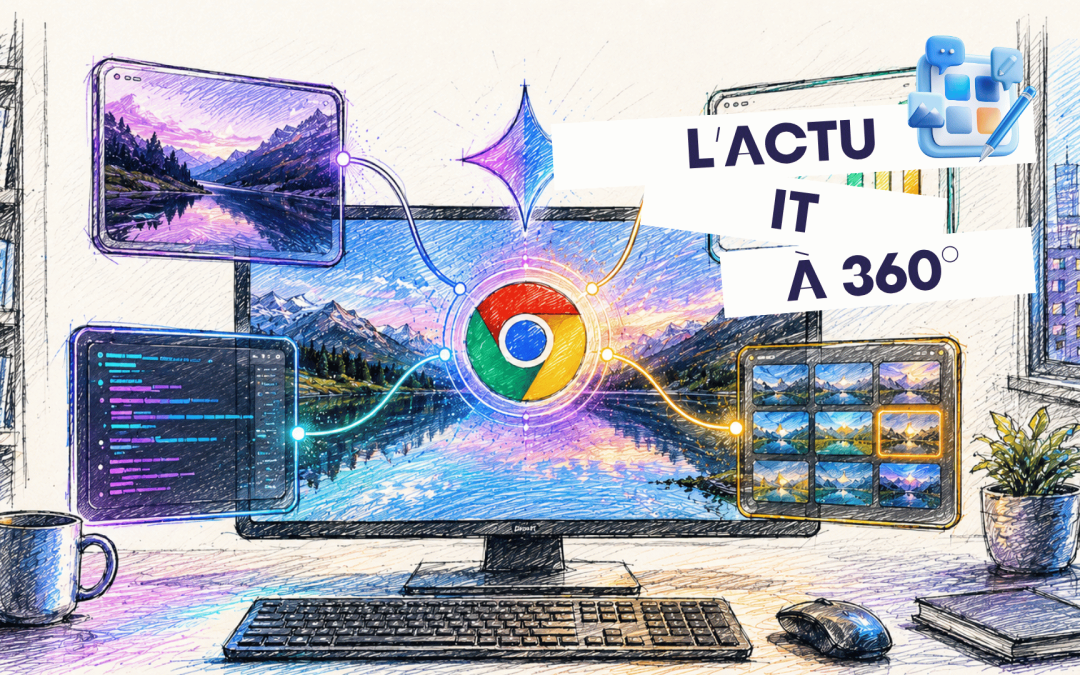
Google Chrome sees what you see: Gemini can now analyse your screen
Chrome takes a new step towards the intelligent browser Web browsers no longer simply display web pages. They are gradually becoming genuine assistants capable of understanding the context in which users are working. With the new “Select from screen” feature, Google...
SpaceX buys Cursor: agentic AI becomes the new standard in software development
An acquisition that reaches far beyond the software world SpaceX’s acquisition of Anysphere, the company behind Cursor, for an estimated $60 billion marks a major turning point in the tech industry. Behind this spectacular deal lies a much deeper transformation: the...

Europe’s AI takes shape: OVHcloud is developing its own LLMs
OVHcloud wants to move from cloud to artificial intelligence Long recognised as a major player in European cloud, OVHcloud now aims to play a much bigger role in the artificial intelligence ecosystem. At the VivaTech trade show, Octave Klaba, the group’s founder and...

F5 strengthens its WAF to tackle the cyber threats of the AI era
Cyberattacks are evolving faster than patches Artificial intelligence is transforming corporate cybersecurity, but it is also benefiting attackers. New models capable of rapidly identifying vulnerabilities or automating certain exploitation phases are dramatically...