


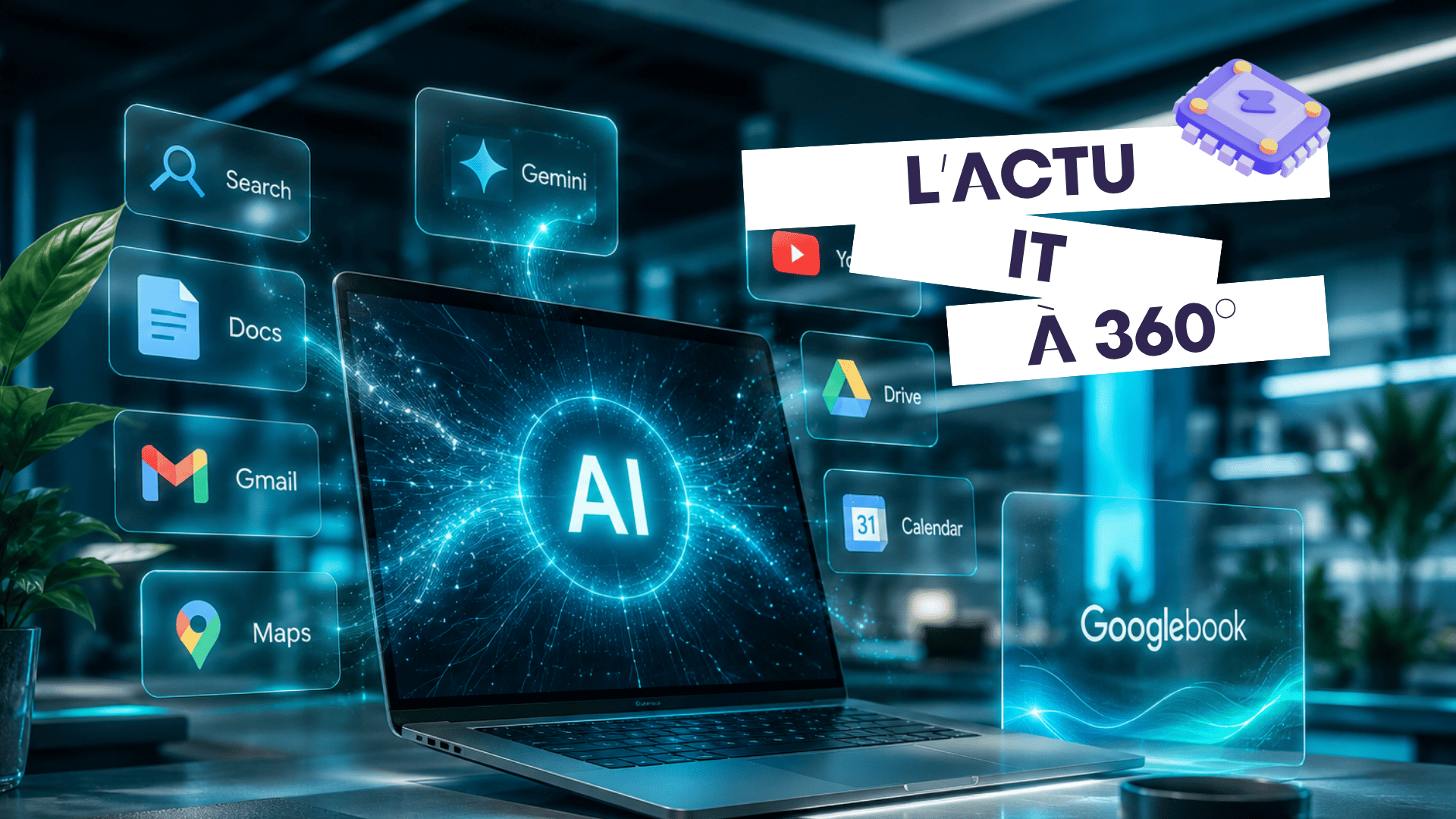
A new generation of PCs designed for artificial intelligence
Google is preparing a new category of laptops called “Googlebook”, designed from the ground up around artificial intelligence. After AI-powered smartphones, the company now wants to turn the PC itself into a permanent intelligent assistant. This marks a major break: for decades, computers were designed to run applications. With Googlebooks, the goal changes. The system becomes centred on AI, able to anticipate needs, automate certain tasks and interact naturally with the user.
The computer becomes an intelligent environment
Future Googlebooks are expected to integrate AI capabilities directly at operating system and hardware level. This involves, in particular, specialised chips called NPUs (Neural Processing Units), capable of running artificial intelligence models locally. This approach makes it possible to perform certain tasks without relying entirely on the cloud: real-time translation, contextual assistance, content generation or workflow automation. The PC then becomes an intelligent environment able to act continuously in the background.
A new battle between Google, Microsoft and Apple
With this project, Google joins a race already under way, with Microsoft’s Copilot+ PCs and Apple’s AI-optimised chips. The battle is no longer just about conventional performance, but about machines’ ability to integrate artificial intelligence features smoothly and permanently. According to IDC, AI PCs could account for more than 60% of laptop sales by 20281. This transition could completely redefine the computer industry.
The cloud is not disappearing, it is becoming hybrid
Contrary to some preconceptions, these AI computers do not replace the cloud. They rely on a hybrid architecture in which some processing is carried out locally and some in remote infrastructure. This approach improves speed, reduces some latency and limits dependence on a permanent connection. For businesses, it also opens up prospects in terms of data privacy and security.
Practical uses for businesses and SMEs
For SMEs, this development could transform employees’ day-to-day work. Googlebooks promise tools able to summarise meetings, generate documents, organise tasks or automate certain administrative operations directly from the system. This automation could improve productivity without requiring additional complex software. The computer thus becomes a genuine intelligent work assistant.
Hardware becomes strategic again in the age of AI
The emergence of AI PCs is also putting hardware back at the centre of technology issues. For years, value shifted mainly towards software and the cloud. With AI, local computing power is becoming essential again. Chip performance, power management and neural computing capabilities are becoming key to delivering smooth experiences. This development is reviving competition around hardware architectures.
Understanding embedded AI systems is becoming essential
This transformation highlights a strategic skill: hardware and intelligent systems. Future IT professionals will need to understand how hybrid architectures, NPUs and environments capable of running AI models locally work. It is no longer just about managing a computer, but about mastering an intelligent system able to interact constantly with its user.
The end of the traditional PC?
With Googlebooks, Google illustrates an underlying trend: the personal computer is entering a new phase in its history. The classic interface based on applications and menus could gradually give way to systems centred on artificial intelligence and natural interactions. For students and future IT professionals, this is a major development. It shows that the future of personal computing will no longer be defined solely by raw power, but by machines’ ability to understand, anticipate and automate how they are used.
360° IT News — decoding technology to understand the jobs of tomorrow.
Further reading
The arrival of Googlebooks illustrates a wider transformation of digital devices, now designed around artificial intelligence and automated interactions. This shift also affects smartphones and mobile interfaces, where AI is gradually replacing traditional app-centred use. On a related topic, read our article “Google Pixel: why you will soon no longer need to open your apps”, which examines how Google is redefining the user experience through on-device artificial intelligence.
References
1. IDC. (2025). AI PC market forecast.
https://www.idc.com

AWS strengthens OpenSearch to connect AI to enterprise data
AI agents are forcing the cloud to evolve The rise of agentic AI is profoundly transforming cloud infrastructure. Unlike traditional conversational assistants, intelligent agents must access data, interact with several systems and carry out tasks autonomously. To meet...
With Stainless, Anthropic aims to put Claude at the heart of software development
The AI battle is shifting to developer tools Anthropic is continuing its rise in artificial intelligence with the acquisition of Stainless, a start-up specialising in development tools and API automation. Behind this acquisition lies a significant strategic...
Microsoft transforms Office with Fintool and autonomous AI
Office enters the age of intelligent agents Microsoft is stepping up its agentic artificial intelligence strategy with the acquisition of Fintool, a start-up specialising in automated financial analysis. Founded in San Francisco by Frenchmen Nicolas Bustamante and...

OpsMill: the start-up that wants to prepare IT systems for the AI shock
Artificial intelligence is moving faster than IT infrastructure Generative artificial intelligence is rapidly transforming businesses, but one reality is becoming increasingly clear: today’s IT infrastructure is not ready to absorb this revolution. This is...

What if your future cloud fitted in a drop of DNA?
Data storage is reaching its limits Every day, humanity produces a gigantic amount of data. In 2025, the volume generated worldwide each day is estimated at almost 300 exabytes, the equivalent of a century of European audiovisual archives created every 24 hours1. With...

+13.5% in 2026: corporate IT spending soars
A sharp acceleration in IT investment Worldwide IT spending is expected to reach 6.31 trillion dollars in 2026, a rise of 13.5% year on year, according to Gartner’s latest forecast1. This figure marks a clear acceleration compared with previous estimates (+10.8%),...
Microsoft builds legal AI into Word: contracts go automated
Word becomes an intelligent legal tool Microsoft is taking a new step by building artificial intelligence specialised in legal analysis directly into Word. The aim is clear: to automate contract review, detect risks and speed up document production. At a time when...
Merck and Google Cloud: a key partnership for agentic AI in the enterprise
A strategic investment to transform the company through AI Biopharmaceutical giant Merck has announced a 1-billion-dollar, 10-year partnership with Google Cloud, with a clear goal: to embed agentic artificial intelligence at the heart of its operations. This project...
Chrome Enterprise goes AI: Google automates browsing and workflows
The browser becomes a genuinely intelligent work tool Google is upgrading Chrome Enterprise with advanced artificial intelligence capabilities, turning the browser into an active platform able to carry out tasks. Autonomous browsing, workflow automation and...
$32 billion: Google launches a cyber army of AI agents
Cybersecurity enters a new dimension Google has made a major move by announcing an investment of $32 billion in developing a “cyber army” of artificial intelligence agents. Behind this term lies a technological reality: systems capable of automatically detecting,...