


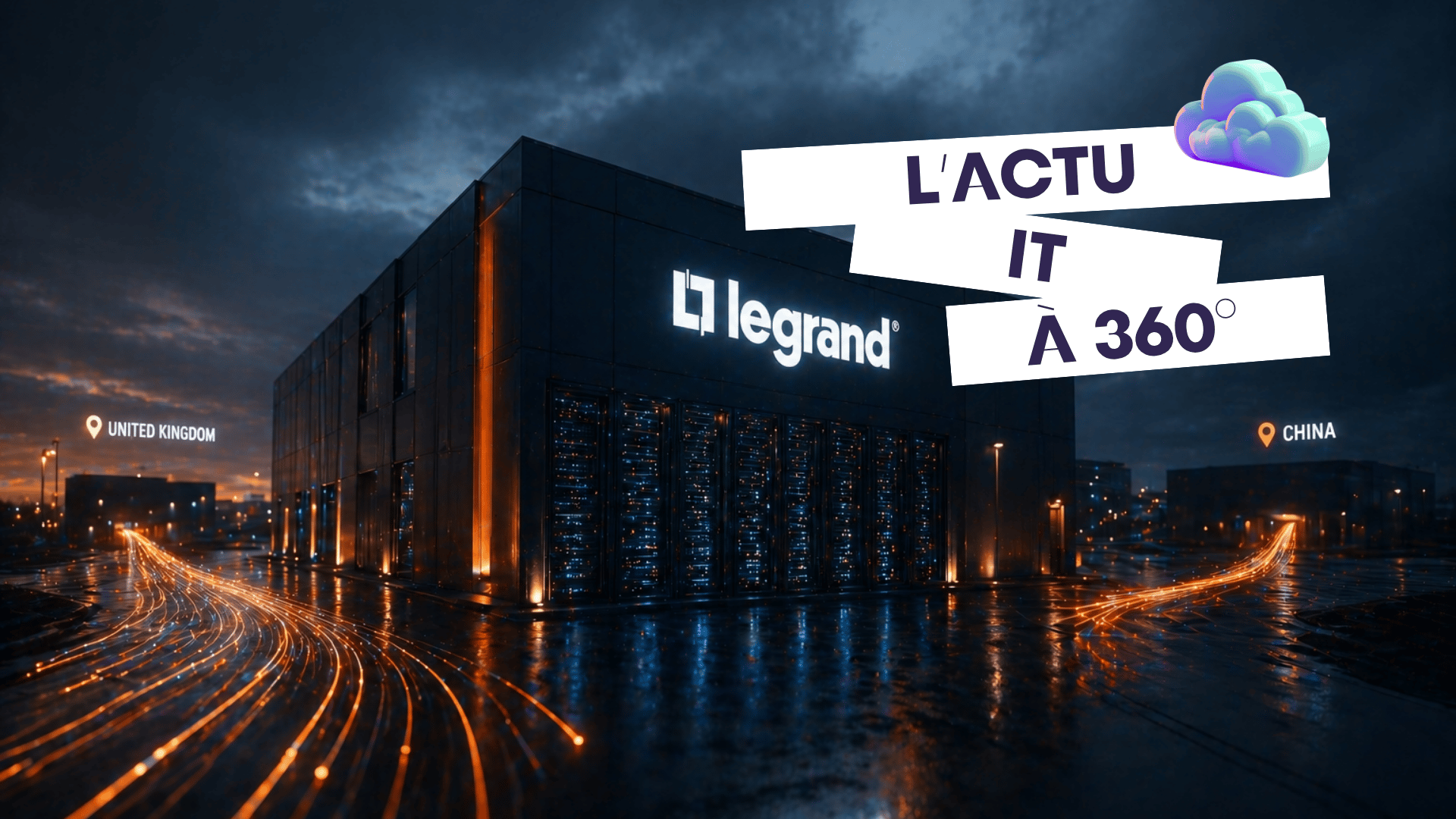
Data centres are becoming the heart of the global digital economy
Legrand is stepping up its investments in China and the United Kingdom to strengthen its presence in the data centre sector, which has become critical infrastructure for the digital economy. This strategy comes against a backdrop of massive market growth, estimated at more than 300 billion dollars by 2030, driven by the explosion of cloud, artificial intelligence and data1. Today, every application, every digital service and every business tool relies on this infrastructure, which is becoming the invisible foundation of digital transformation.
An international strategy to capture cloud growth
By targeting key markets such as China and the United Kingdom, Legrand is seeking to position itself as close as possible to areas of strong technological growth. China is a strategic market with huge demand for digital infrastructure, while the United Kingdom is establishing itself as a major European hub for data centres. This expansion enables Legrand to meet companies’ growing needs for connectivity, storage and data processing, while strengthening its position in the cloud value chain.
Infrastructure under pressure as usage soars
Demand for data centres is soaring under the effect of several trends: migration to the cloud, adoption of artificial intelligence, the growth of streaming and the proliferation of connected devices. According to some estimates, the global volume of data was expected to reach more than 180 zettabytes by 2025, requiring ever greater processing capacity2. This growth is putting infrastructure under pressure, requiring massive investment to guarantee performance, availability and security.
Performance, energy, security: the new challenges for data centres
Data centres are no longer simple storage spaces; they are becoming highly optimised environments. The challenges are many: improving performance, reducing energy consumption and ensuring service continuity. Today, this infrastructure consumes around 1 to 2% of the world’s electricity, which is pushing players in the sector to innovate to limit their environmental impact3. The solutions developed by companies such as Legrand aim to optimise energy management, cooling and the security of facilities.
A strategic lever for companies and SMEs
For SMEs, these investments have a direct impact. Access to high-performance data centres makes it possible to use cloud services, manage data in real time and deploy artificial intelligence solutions without investing in costly in-house infrastructure. This democratises access to advanced technologies and accelerates companies’ digital transformation. Data centres are thus becoming a lever for competitiveness, enabling organisations to become more agile and efficient.
Understanding infrastructure is becoming a key skill
This development highlights a strategic skill: cloud computing, which is closely linked to physical infrastructure. IT professionals need to understand how data centres work, their architecture and their role in the digital ecosystem. It is no longer just about using cloud services, but about understanding the infrastructure that makes them possible. This skill is becoming essential for designing, managing and securing complex digital environments.
A global battle to control digital infrastructure
With this strategy, Legrand is part of a global movement in which companies are positioning themselves on critical digital infrastructure. Data centres are becoming a major geopolitical and economic issue, at the heart of digital sovereignty and corporate competitiveness. For students and future IT professionals, understanding these issues is essential, as they define the foundations on which all digital innovation rests, from the cloud to artificial intelligence.
360° IT News — decoding technology to understand the jobs of tomorrow.
References
1. Statista. (2024). Data center market size worldwide.
https://www.statista.com
2. IDC. (2023). Global DataSphere Forecast.
https://www.idc.com
3. International Energy Agency. (2024). Data centres and energy consumption.
https://www.iea.org

Lumo AI 2.0 speeds up without sacrificing data protection
Proton wants to prove that a high-performing AI can also be private The artificial intelligence race is no longer played out solely on model performance. User trust and data protection are now becoming major differentiators. With Lumo AI 2.0, Proton is upgrading its...

Djinn Stealer: the malware targeting companies’ cloud and AI credentials
Cybercriminals are changing targets Cyberattacks are no longer aimed solely at data or workstations. The credentials used to access cloud platforms, artificial intelligence environments and development tools have become highly sought-after assets. It is against this...

Claude Tag turns Slack into a genuine agentic workspace
AI agents settle at the heart of collaborative work Artificial intelligence is no longer limited to assistants accessed in a chat window. With Claude Tag, Anthropic is taking a new step by building an AI agent directly into Slack. Available in beta for Claude...

IBM and OpenAI want to arm businesses against machine-speed cyberattacks
Defenders must now fight AI with AI Cyberattacks are evolving at unprecedented speed. Thanks to artificial intelligence models, attackers can automate the search for vulnerabilities, analyse code in seconds and quickly identify the most exposed systems. To respond to...

Open-source security scales up: IBM, Red Hat and Palo Alto join forces
Cyberattacks push IT giants to join forces Open-source components are present in virtually all modern applications, from cloud platforms to business software. This dependence, however, comes with a growing risk: vulnerabilities are now discovered and exploited much...

With Lambda, AWS prepares cloud infrastructure for autonomous AI agents
Serverless enters a new phase The cloud is evolving to meet the needs of a new generation of applications based on agentic artificial intelligence. As AI agents become capable of carrying out complex tasks for hours at a time, traditional serverless architectures are...
With Code Layers, Figma brings design and development together for good
A new step towards building apps without boundaries Design and software development have long followed two separate paths. Designers imagined the interfaces, developers then translated them into code, with many back-and-forth exchanges and sometimes discrepancies...

Google Chrome sees what you see: Gemini can now analyse your screen
Chrome takes a new step towards the intelligent browser Web browsers no longer simply display web pages. They are gradually becoming genuine assistants capable of understanding the context in which users are working. With the new “Select from screen” feature, Google...
SpaceX buys Cursor: agentic AI becomes the new standard in software development
An acquisition that reaches far beyond the software world SpaceX’s acquisition of Anysphere, the company behind Cursor, for an estimated $60 billion marks a major turning point in the tech industry. Behind this spectacular deal lies a much deeper transformation: the...

Europe’s AI takes shape: OVHcloud is developing its own LLMs
OVHcloud wants to move from cloud to artificial intelligence Long recognised as a major player in European cloud, OVHcloud now aims to play a much bigger role in the artificial intelligence ecosystem. At the VivaTech trade show, Octave Klaba, the group’s founder and...