


News in brief
With Project Kuiper, Jeff Bezos is committing Amazon to a major transformation of the world’s internet infrastructure by deploying tens of thousands of satellites in low Earth orbit. The goal is not limited to connecting isolated areas, but to building a global alternative to traditional terrestrial networks. At the same time, the launch of a smartphone shows a clear determination to control the entire value chain, from the network to the end user. This strategy is part of a global race in which digital infrastructure is becoming a lever of economic and technological power.¹
Controlling the network means controlling digital usage
The real breakthrough lies not only in satellite technology, but in the logic of a global platform. By combining space connectivity, cloud services (AWS) and devices, Amazon can offer a complete ecosystem in which data, applications and users are interconnected. This makes it possible to optimise performance, reduce latency and offer new services, particularly for the Internet of Things, real-time applications or critical services. This approach turns the internet into an integrated infrastructure, run by a handful of major players able to control its flows.
Connecting businesses everywhere, even beyond conventional networks
For SMEs, this development could be a real accelerator. In rural, industrial or poorly served areas, internet access remains an obstacle to digital transformation. Satellite constellations can remove this barrier by offering fast, stable connectivity regardless of local infrastructure. This opens the door to using the cloud, managing data in real time and integrating artificial intelligence solutions. The stakes are high: enabling all companies, wherever they are located, to access the same digital opportunities.
An explosion of uses driven by global connectivity
Beyond internet access, these infrastructures will transform usage. We can imagine applications in logistics, with real-time tracking of goods anywhere in the world, in connected agriculture, or in crisis and natural disaster management. Satellites are becoming a relay for distributed systems, in which data flows continuously between objects, users and cloud platforms. This permanent connectivity will accelerate the adoption of technologies such as AI, cloud computing and IoT by making them accessible on a larger scale.
A growing dependence on tech giants
But this transformation also raises critical issues. With infrastructure concentrated in the hands of a few players, companies become dependent on global platforms for their connectivity, data and services. This dependence raises questions of digital sovereignty, cybersecurity and governance. Companies will need to be able to diversify their solutions, secure their data and understand the implications of these technology choices for their IT strategy.
Managing hybrid networks becomes essential
This development highlights a key skill: systems and network administration in a hybrid environment. IT professionals now have to manage infrastructure combining terrestrial networks, satellites and the cloud. This means understanding global connectivity, optimising performance and ensuring the security of exchanges. This ability to orchestrate complex systems is becoming essential to support companies’ digital transformation and make full use of new infrastructure.
Towards a global, distributed and strategic internet
With projects such as Kuiper, the internet is entering a new phase in which infrastructure is becoming global, distributed and strategic. The boundaries between network, cloud and services are gradually disappearing in favour of integrated ecosystems. For students and future IT professionals, this means jobs are evolving towards architect roles able to understand, connect and manage these complex environments. The challenge is no longer just technical; it is also economic and strategic, in a world where connectivity is becoming a key competitive factor.
360° IT News — decoding technology to understand the jobs of tomorrow.
References
1. PepsiCo. Logistics and supply chain innovation initiatives.
https://www.pepsico.com
AWS strengthens OpenSearch to connect AI to enterprise data
AI agents are forcing the cloud to evolve The rise of agentic AI is profoundly transforming cloud infrastructure. Unlike traditional conversational assistants, intelligent agents must access data, interact with several systems and carry out tasks autonomously. To meet...
With Stainless, Anthropic aims to put Claude at the heart of software development
The AI battle is shifting to developer tools Anthropic is continuing its rise in artificial intelligence with the acquisition of Stainless, a start-up specialising in development tools and API automation. Behind this acquisition lies a significant strategic...

Microsoft transforms Office with Fintool and autonomous AI
Office enters the age of intelligent agents Microsoft is stepping up its agentic artificial intelligence strategy with the acquisition of Fintool, a start-up specialising in automated financial analysis. Founded in San Francisco by Frenchmen Nicolas Bustamante and...
Googlebook: Google wants to reinvent the computer around AI
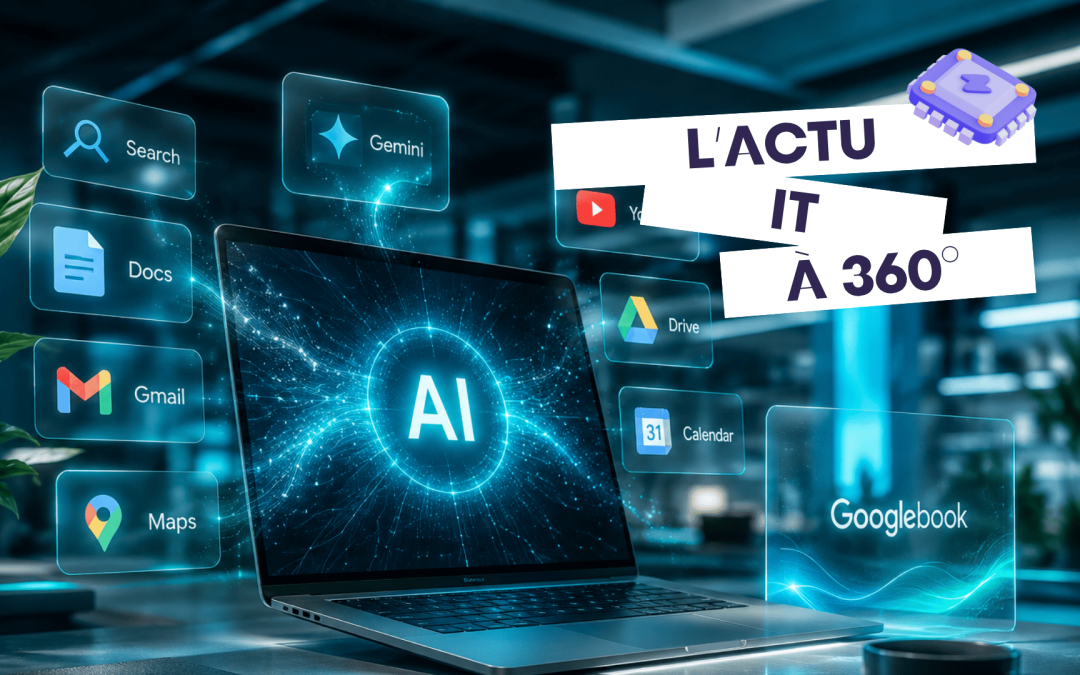
A new generation of PCs designed for artificial intelligence Google is preparing a new category of laptops called “Googlebook”, designed from the ground up around artificial intelligence. After AI-powered smartphones, the company now wants to turn the PC itself into a...

OpsMill: the start-up that wants to prepare IT systems for the AI shock
Artificial intelligence is moving faster than IT infrastructure Generative artificial intelligence is rapidly transforming businesses, but one reality is becoming increasingly clear: today’s IT infrastructure is not ready to absorb this revolution. This is...
What if your future cloud fitted in a drop of DNA?
Data storage is reaching its limits Every day, humanity produces a gigantic amount of data. In 2025, the volume generated worldwide each day is estimated at almost 300 exabytes, the equivalent of a century of European audiovisual archives created every 24 hours1. With...
+13.5% in 2026: corporate IT spending soars
A sharp acceleration in IT investment Worldwide IT spending is expected to reach 6.31 trillion dollars in 2026, a rise of 13.5% year on year, according to Gartner’s latest forecast1. This figure marks a clear acceleration compared with previous estimates (+10.8%),...
Microsoft builds legal AI into Word: contracts go automated
Word becomes an intelligent legal tool Microsoft is taking a new step by building artificial intelligence specialised in legal analysis directly into Word. The aim is clear: to automate contract review, detect risks and speed up document production. At a time when...
Merck and Google Cloud: a key partnership for agentic AI in the enterprise
A strategic investment to transform the company through AI Biopharmaceutical giant Merck has announced a 1-billion-dollar, 10-year partnership with Google Cloud, with a clear goal: to embed agentic artificial intelligence at the heart of its operations. This project...
Chrome Enterprise goes AI: Google automates browsing and workflows
The browser becomes a genuinely intelligent work tool Google is upgrading Chrome Enterprise with advanced artificial intelligence capabilities, turning the browser into an active platform able to carry out tasks. Autonomous browsing, workflow automation and...