


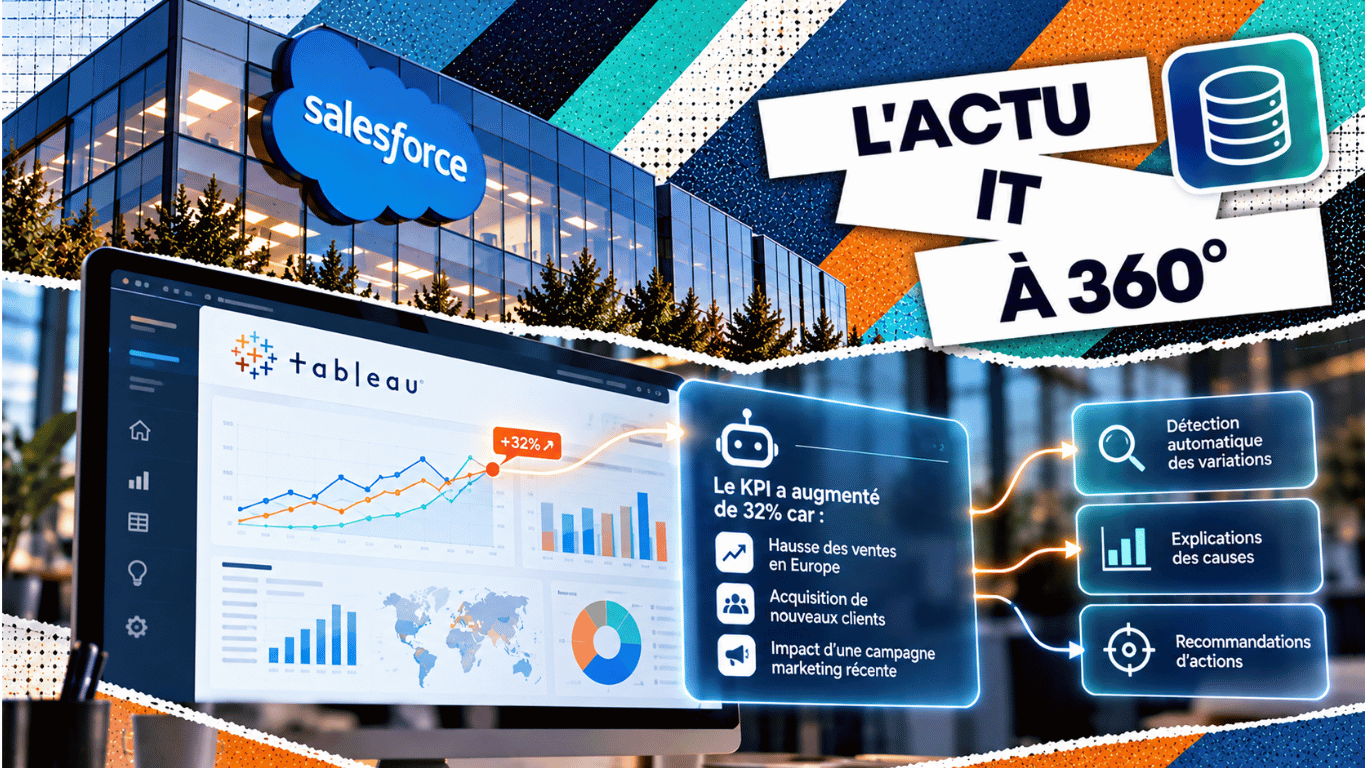
Salesforce has announced a definitive agreement to acquire Loops, an AI-based analytics platform, with the intention of integrating its technology into Tableau after closing.[1] The aim is to monitor metrics and bring out the factors associated with their changes. For businesses, the promise is to spot earlier what deserves analysis, provided they have reliable data and do not mistake a suggested explanation for a proven cause.
A deal announced before an integration that has yet to be built
The transaction is expected to close in early November, during Salesforce’s fiscal year 2027, subject to customary conditions. The press release gives no precise date for when Loops’ capabilities will be available in Tableau.[1] This is therefore an announced product direction, not a new feature already available to all users.
This distinction matters for a team preparing its budget or its analytics architecture. It can follow the project and identify its needs, but it should not base an operational deadline on an integration whose terms have yet to be specified.
Metrics become the starting point for an investigation
According to Salesforce, Loops monitors performance, detects trends and anomalies, and then brings out what contributes to changes. Its functions can be triggered from Slack or by email. The vendor wants to use them to strengthen Tableau’s agentic analytics and the prioritisation of actions.[1]
A key performance indicator, or KPI, summarises one dimension of the business: conversion, processing time or retention, for example. When it changes, the first need is often to work out where to look. Does the change concern all customers, or one particular region, product or channel? Proactive analysis can help organise this search.
Detecting a change is not enough to make a decision
This grid distinguishes three stages of analytical reasoning and the checks they require. It is an editorial reading of the business need.
| Stage | Question to address | Useful check |
|---|---|---|
| Detection | Which metric has changed and over what period? | Check data freshness and the comparison baseline. |
| Explanation | Which segments contribute to the change? | Examine volumes, changes in measurement and other factors. |
| Action | What intervention could improve the result? | Validate the hypothesis and measure the effects before rolling it out. |
A factor associated with a decline is not always its cause
A channel may account for a large share of a drop in sales because its traffic has changed, because a product is unavailable there or because data collection is incomplete. Breaking down a result helps locate the phenomenon; it does not automatically decide between all these explanations.
Before changing a campaign or a process, the analysis must be compared with business events. A controlled comparison or an experiment can then help test a hypothesis. The decision depends as much on this verification as on the clarity of the generated commentary.
Defining KPIs remains essential groundwork
Two departments may use the same word for different measures. A conversion rate calculated per visit does not match a rate calculated per user. Likewise, a cancelled order or a late-arriving event can change the result depending on the rules applied.
Continuous monitoring therefore requires a shared definition: formula, population, period, exclusions and reference source. The history of changes must also be kept. An alert triggered after a formula change does not necessarily describe a real change in activity.
An SME can test the value on a single metric
Take an illustrative scenario: an online shop notices a drop in its conversion rate. The team compares devices, channels and product categories. If the drop is concentrated on mobile, it then checks for payment incidents, stock shortages and recent changes to the customer journey. This scenario is not a customer result published by Salesforce.
The pilot should check that the tool surfaces useful observations without multiplying secondary alerts. The team can measure the time to a confirmed anomaly, the time needed to qualify the explanation and the share of alerts that are genuinely actionable. Nor does the absence of an alert prove the absence of a problem.
To assess a future integration, data access, costs and the scope of sources will need to be clarified. The press release provides no independent measure of accuracy or of generalisable time savings. These points remain to be verified on the company’s own data.
The IT skill to remember: Data Management
This development draws directly on Data Management. Professionals must know where information comes from, check its quality and ensure that transformations preserve the meaning of measures. A convincing explanation can still be misleading if the starting data is incomplete or poorly reconciled.
Their role includes documenting metrics and managing access rights. Users must understand what a KPI measures and what limits frame its interpretation. The details surfaced in an alert must also respect authorised access, particularly when they concern customers or employees.
The work continues in dialogue with business teams. Analysts must be able to verify the observations put forward, spell out uncertainties and track the effect of decisions taken. Automation can speed up investigation; the responsibility for giving results a reliable meaning remains.
Proactive analysis must steer a useful investigation
The value of proactive analysis is measured by its ability to steer a useful investigation. A dashboard that comments on its own changes does not thereby become an autonomous decision-maker: data quality, hypothesis testing and monitoring of results remain decisive.
Further reading
Four CCCLX reads to explore data quality, sharing and use in more depth.
Google Cloud Storage Intelligence Advisor detects storage anomalies
Talk to your database: Oracle improves its NL2SQL AI
Databricks extends Delta Sharing to AI and aims to break down data silos
Merck and Google Cloud commit one billion dollars to agentic AI
Sources
- 01
Salesforce (12 October 2026). “Salesforce Signs Definitive Agreement to Acquire Loops”. Announcement of the acquisition agreement and plans to integrate Loops technology into Tableau.

Data centres in space: why Nvidia wants to revolutionise the cloud
News in brief At the GTC 2026 conference, Nvidia announced its intention to accelerate the development of artificial intelligence in space, joining an emerging movement around orbital data centres. The company is no longer content to supply chips for satellites; it is...

Claude Marketplace: what Anthropic’s new platform changes for businesses
News in brief Anthropic has just announced Claude Marketplace, a new platform that allows companies to access, share and use artificial intelligence agents based on its Claude model. The aim is no longer just to offer conversational AI, but to create a genuine...

Automated code review: Anthropic’s Claude now analyses developers’ code
News in brief Artificial intelligence continues to transform developers’ work. Anthropic, the company behind the Claude AI model, has just announced new capabilities that allow its assistant to analyse computer code and help developers with their code review...

Memerist: the free Linux app for creating memes in seconds
News in brief Creating a meme has become an everyday activity on the internet. Humorous images circulate daily on social networks, forums and messaging apps, often used to comment on the news, share an idea or simply make people laugh. Yet producing a meme quickly is...

Microsoft unveils Microsoft 365 E7: Copilot and AI agents at the heart of its enterprise strategy
News in brief Microsoft recently announced Microsoft 365 E7, a new offering for businesses that places artificial intelligence at the heart of the working environment. This development is part of Microsoft’s overall strategy to transform traditional productivity tools...

Global cyber-espionage: the Salt Typhoon affair shows why cybersecurity is becoming crucial
News in brief A vast cyber-espionage operation called Salt Typhoon has reportedly infiltrated several telecom operators around the world. Hacker groups linked to China are believed to be behind these attacks, which can access sensitive communication infrastructure....

CCCLX wins Bronze Trophy at IT Night 2025!
CCCLX, the 360° IT school, was honored at IT Night 2025 - La Nuit de l'Entreprise Numérique, winning the Bronze Trophy in the Schools / Training category. A fine accolade in the context of this emblematic event for the French digital ecosystem, organized annually...

A revolution in higher education financing by aivancity/CCCLX and Umanity
A concrete solution to democratize access to education for the professions of tomorrow This scheme, the only one of its kind in France, complements a series of measures put in place by aivancity to promote diversity and equitable access to its programs (tuition-free...

White paper: How generative AI is transforming SMEs
White paper: How generative AI is transforming SMEs In a world where technological innovation is redefining the rules of the game, small and medium-sized businesses have never had so much to gain... or lose. Against this ever-changing backdrop, CCCLX unveils its new...

CCCLX: A new IT school dedicated to SMEs and startups is born
On April 28, 2025, CCCLX was officially unveiled at the CCI Paris during a press conference packed with symbols and commitments. The launch was attended by a number of leading personalities: Soumia Malimbum, President of CCI Paris, Alain Martinez, President of CPME...