



Cisco and NVIDIA have announced a project for a pluggable optical form factor, USFP, capable of supporting 400 Gb/s per lane. Cisco is also unveiling the Silicon One G302 switching chip, rated at 51.2 Tb/s.[1] These announcements address a key challenge for AI infrastructure: accelerators must exchange data quickly enough for the installed computing power to be genuinely usable. They do, however, concern separate components and timelines.
GPUs need to receive and share data
When processing is spread across several accelerators, part of the work depends on exchanges between machines. Waiting for data or for results from another node can slow down the entire computation. Adding GPUs is therefore not always enough to speed up a task if the network or storage is already limiting how fast they are fed.
The difficulty lies in locating the bottleneck. A saturated link, occasional congestion, poor traffic distribution or overly slow storage can all produce similar symptoms. The response must be based on measurements of the workload actually being run, before choosing faster equipment.
G302 powers the rack network while USFP prepares the optics
The G302 is aimed at top-of-rack switches, which connect servers to the data centre network. Cisco is announcing 200 Gb/s SerDes electrical interfaces and expects first shipments before the end of 2026.[1] The 51.2 Tb/s figure refers to aggregate switching capacity, not the throughput of an individual connection.
USFP, developed with NVIDIA, is a proposed optical module form factor. The partners plan an open specification.[1] A distinction must therefore be drawn between the chip being presented and this optical development, rather than attributing already available 400 Gb/s lanes to the G302.
Three figures that describe different things
Throughput is expressed here in bits per second. Aggregate capacity does not correspond to the usable throughput guaranteed to an application.
| Metric | What it describes | What it does not prove |
|---|---|---|
| 51.2 Tb/s | Switching capacity of the G302.[1] | The throughput available to each server. |
| 400 Gb/s per lane | Target per-lane capacity for USFP.[2] | The immediate availability of a complete link. |
| 6.4 Tb/s aggregate | 16 lanes at 400 Gb/s in the USFP project.[2] | An equivalent speed-up of AI applications. |
Density also depends on the number of lanes
The Cisco blog describes 16 lanes at 400 Gb/s, i.e. 6.4 Tb/s aggregate, with a possible evolution to 32 lanes and 12.8 Tb/s. It compares this proposal with 1.6 Tb/s pluggable modules to claim a fourfold increase in bandwidth density.[2] This factor therefore does not stem solely from doubling the per-lane throughput.
Maintenance matters as much as peak throughput
Cisco highlights the retention of field-replaceable modules and established operating practices for pluggable optics.[2] For an operator, the ability to service a module can weigh on the choice of architecture, just as much as throughput or footprint.
Higher density must nonetheless be assessed against cooling, cabling and spare-part availability constraints. The number of interventions, replacement lead times and compatibility conditions can change the real cost of an infrastructure over several years.
Energy gains have yet to be measured on the complete system
Cisco mentions energy efficiency potentially improved by around 1.3 times thanks to 400 Gb/s SerDes.[2] This indication does not mean that a data centre’s total consumption will fall in the same proportion. Higher capacity may also come with an increase in processing volumes.
A meaningful comparison must specify the load, the throughput actually carried and the scope measured. It should include network equipment, optics and cooling. The announcements reviewed do not present an independent benchmark that would allow the gain to be generalised to all environments.
SMEs can draw a sizing method from this
Most SMEs do not need to prepare a network for these speeds right away. However, an organisation that runs several GPU servers or buys remote computing capacity needs to understand what is limiting its workloads. The network is part of the service to be assessed, even when it is managed by a provider.
An illustrative scenario is to compare the same task on one and then several servers, observing duration, GPU utilisation and network traffic. If the time saving remains small, the team also examines storage and how the work is distributed. This test helps establish a diagnosis; it does not prove that the network is necessarily to blame.
The key IT skill: Systems and Network Administration
This development directly calls on Systems and Network Administration. Professionals must understand the paths data takes and distinguish theoretical throughput from observed performance. A capacity stated on a datasheet is not enough to size a service.
Their role includes analysing congestion, latency and dependencies on storage or compute. They must also check interfaces, optical modules and compatible software versions. These checks help avoid an investment that would simply move the bottleneck elsewhere.
Finally, network administration involves monitoring and incident recovery. Metrics must make degradations visible before they have a lasting impact on workloads. Having maintenance access and replacement procedures remains essential, even on a very high-performance infrastructure.
The value of USFP will therefore depend on performance measured on applications, equipment compatibility and operating conditions. To size an infrastructure, the real limits of compute, network and storage must first be identified.
Further reading
Four CCCLX reads on data centres, data and AI infrastructure.
AI powers Nokia: data centres reshape the networking market
Google Cloud Storage Intelligence Advisor detects storage anomalies
Databricks extends Delta Sharing to AI and aims to break down data silos
AI voice agents: Oracle details a LiveKit architecture on OCI
Sources
- 01
Cisco (12 October 2026). “Cisco Advances Scalability and Openness at OCP 2026”. Announcement of the Silicon One G302 switch and the USFP development project with NVIDIA.
- 02
Gartner, B. and Eatherton, W., Cisco Blogs (12 October 2026). “Cisco and NVIDIA Announce USFP: Expanding the Path to AI Connectivity”. Details on lanes, aggregate capacity and the gains announced for the USFP form factor.

Mistral Large 4: what its trillion-parameter model could change for businesses
Mistral has opened the public preview of Mistral Large 4, nicknamed “Le Chonk”, and plans to release its weights by the end of the month.[1] This European model targets agentic use cases in particular, as well as cybersecurity, finance and industry. For businesses,...

IBM Bob: developing with AI without your code leaving the company
IIBM has announced a self-hosted version of Bob, its agentic development platform, for internal infrastructure, private or sovereign clouds and environments isolated from the internet.[1] This option addresses a concrete obstacle: some applications contain code, data...

HPE is preparing a network that anticipates incidents and automates certain interventions
HPE plans to deploy a Self-Driving Network for the 2027 Ryder Cup, with Wi-Fi 7 and an operations centre bringing together data and AI tools.[1] The stated aim is to monitor usage, adapt the network and move towards autonomous interventions. For businesses, the...
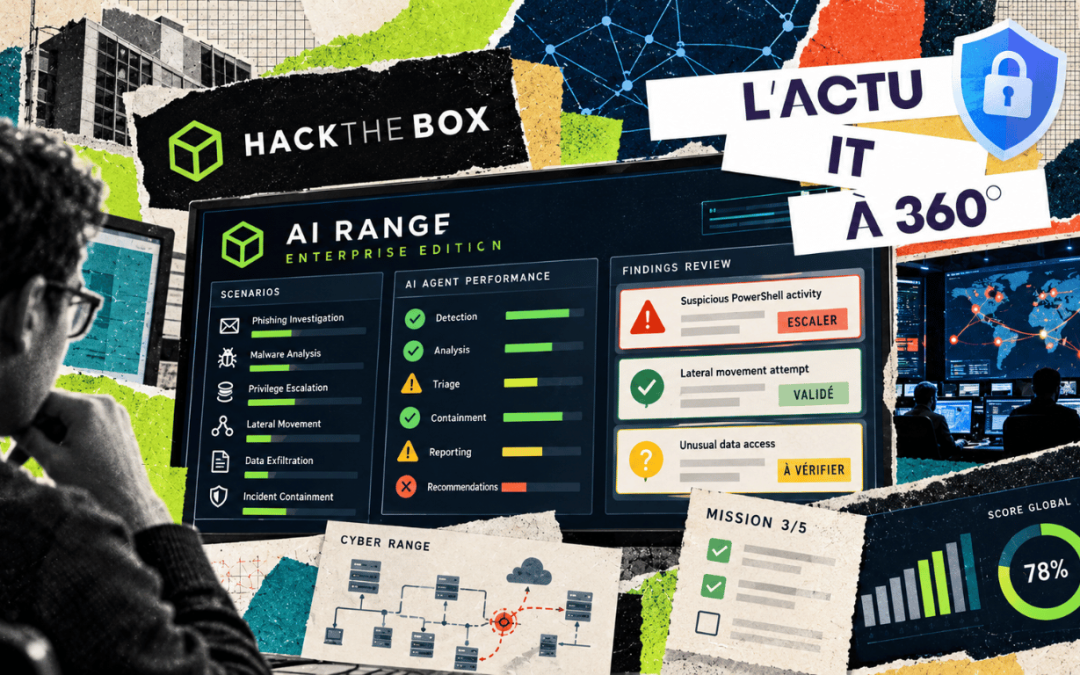
Can your AI agent really defend your company? Hack The Box puts its skills to the test
Hack The Box is launching AI Range Enterprise Edition to let security teams assess their own AI agents on the roles assigned to them.[1] For businesses, the stakes are concrete: having evidence before delegating a task, then checking that this evidence remains valid...

VAST Data wants AI to work with sensitive data in a protected environment
VAST Data has unveiled DataEnclave, a confidential execution capability designed to bring artificial intelligence models closer to companies’ sensitive data. Presented as a preview, it is due to go on sale in the first quarter of 2027.[1] The aim is to make certain...
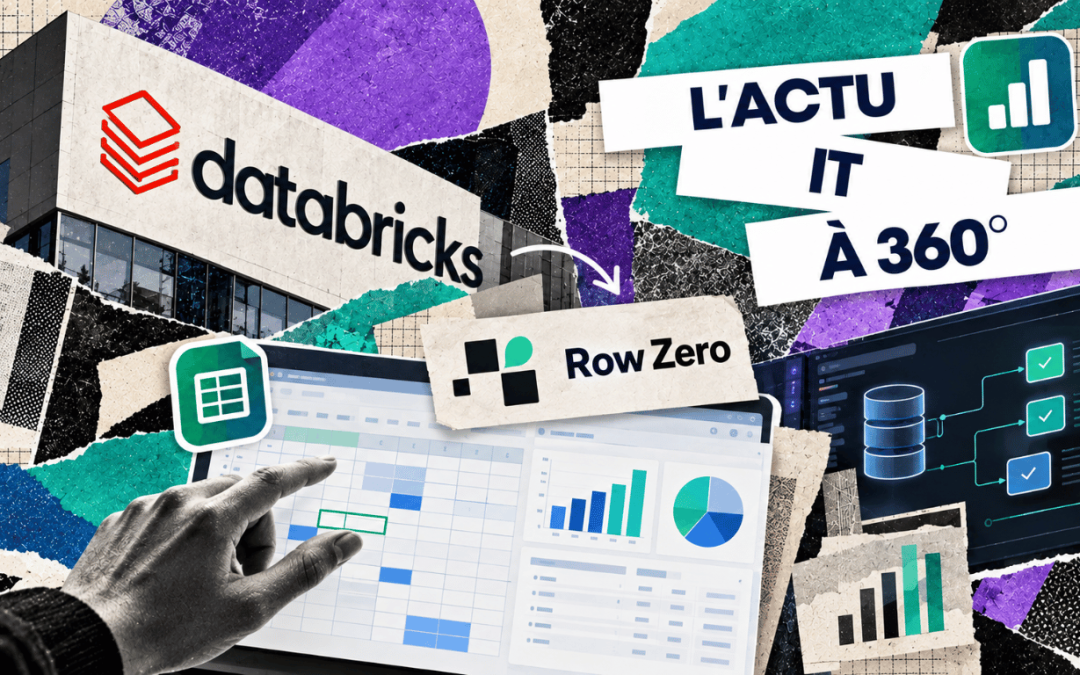
Databricks buys Row Zero to bring spreadsheets closer to governed data
Databricks has announced the acquisition of Row Zero and plans to integrate its spreadsheet experience into Genie.[1] The aim is to let business teams explore data in a familiar interface, with greater control over access and usage. For companies, the challenge is to...

Google Cloud takes its X5 instances to 48 TB for large SAP databases
Google Cloud has announced the general availability of the X5 series, which raises the maximum advertised memory capacity on a single node to 48 TB, compared with 32 TB for X4.[1] Aimed in particular at very large SAP HANA databases, the offering is based on bare...

Cloud Storage: Google automates the detection of anomalies
A rise in reads, cross-region transfers or stored volume can inflate the cloud bill and disrupt applications. With Storage Intelligence advisor, Google offers a view of unusual changes in Cloud Storage, along with leads for investigating them. For businesses, the...

AI voice agents: Oracle details a LiveKit architecture on OCI
Oracle has described an architecture that pairs the LiveKit Agents framework with Oracle Cloud Infrastructure to automate real-time voice calls. The design links telephony, AI models and business services, while placing internal components in private subnets. For...

GitHub Copilot bulks up for business: coding agents come under IT control
Copilot is no longer just there to suggest the next line GitHub Copilot is continuing its transformation. Originally known mainly for completing code in the editor, the tool is now evolving towards agents capable of exploring a project, modifying files, using tools...