



Broadcom has unveiled VMware HyperArmor, a solution designed to protect the ESX hypervisor of VMware Cloud Foundation, with announced support for ESX 8.x and later versions.[1] The stakes go beyond the security of a single application: the hypervisor is a shared foundation for several virtual machines. Strengthening its protections must therefore go hand in hand with control over administrator access and the continuity of hosted services.
The virtualisation host carries critical responsibilities
The hypervisor allows several virtual machines to share the resources of a physical server. It plays a role in running and isolating them. A protection installed in a guest system does not necessarily cover all access to, and all operations on, the host that runs it.
This distinction matters for an SME whose services rely on a handful of hosts: email, business applications or databases may share the same foundation. The compromise of an administrator account for this infrastructure can therefore have far wider consequences than that of a single workstation.
Three protections target host operations
Broadcom combines host-level virtual patching, control of executables and scripts, and multi-factor authentication in the SSH login flow.[1] These mechanisms address different risks and should be assessed separately.
| Protection | Announced function | Useful check |
|---|---|---|
| Virtual patching | Block malicious actions within the host. | Identify the threats covered and keep to the patching schedule. |
| Allowed execution | Restrict executables and scripts to an approved set. | Review the initial baseline and test operational scripts. |
| MFA for SSH | Add a time-based code tied to a separate identity. | Test routine access, removal of rights and recovery. |
Virtual patching does not fix vulnerable code
The vendor states that the mitigation mechanisms can take effect without rebooting the host or upgrading software for that mitigation.[1] This protection must be distinguished from installing a patch: preventing an exploitation scenario does not necessarily remove the vulnerability from the software.
For the IT team, the potential benefit is an additional layer of protection while an update is being prepared. It remains necessary to know the scope covered, follow security advisories and validate official patches. A compensating control must not become a reason to postpone applying them indefinitely.
The trust baseline must be reviewed before activation
The press release states that HyperArmor inventories the scripts already present on the host and allows them automatically, with administrators then able to approve new scripts.[1] This approach makes the initial state particularly important: the presence of a file is not enough to prove that it is legitimate.
Before deployment, the team should identify the scripts used for backups, monitoring and maintenance operations. It must check where they come from and remove anything unnecessary. An overly broad allow list reduces the value of the control; an incomplete one may block essential tasks.
The second factor targets a specific access path
The technical blog describes a time-based one-time password, or TOTP, requested after the SSH credentials.[2] The announced scope is therefore SSH login to the hypervisor. It should not be inferred that all administrative access, APIs and consoles are automatically protected by the same mechanism.
An inventory of access paths remains essential. The organisation must also plan for the loss of a second factor, the departure of an administrator and emergency interventions. These procedures must allow a controlled recovery without creating a permanent and insufficiently monitored emergency access route.
An SME can test the protection on a representative host
An illustrative pilot could use a test environment with non-critical virtual machines and the company’s usual scripts. The team would check that an approved script runs, that a new, harmless but unauthorised script is blocked and that an SSH login does require the second factor. This scenario is a suggested qualification approach, not a published customer result.
Testing should also cover backups, monitoring and scheduled tasks. Response times and resource consumption should be measured, and the alerts and the procedure for removing the system documented. The announcements reviewed provide no independent benchmark or pricing details from which conclusions could be drawn for each infrastructure.
The key IT skill: Systems and Network Administration
This development draws directly on Systems and Network Administration. Professionals must understand the dependencies between hosts, virtual machines and business services. This knowledge makes it possible to choose a test scope and anticipate the consequences of a block or a change in access rights.
Their work includes hardening configurations and managing change. They check privileged accounts, allowed scripts and necessary updates. Operations and security teams must share the same information so that a protection does not disrupt an essential operation.
Responsibility continues after activation. The administrator analyses events, reviews permissions and tests recovery procedures. A protected infrastructure must remain manageable, observable and recoverable when an incident occurs.
Hypervisor protection must remain verifiable
HyperArmor adds announced host-level controls: mitigation of certain threats, restriction of execution and MFA for SSH. Their value will depend on the scope covered, the configuration chosen and the tests carried out in the environment concerned. The security of the virtualised foundation also relies on patch management, access control and proven recovery procedures.
Further reading
Four CCCLX reads on component protection and infrastructure administration.
Azure Linux 4.0: is Microsoft preparing for life after Windows Server?
Open-source security scales up: IBM, Red Hat and Palo Alto join forces
Project Glasswing: Anthropic goes on the offensive against software vulnerabilities
Sandbox, terminal, policies: GitHub puts guardrails around its coding agents
Sources
- 01
Broadcom (13 October 2026). “Broadcom Introduces VMware HyperArmor, Expanding Hypervisor Security and Protections for VMware Cloud Foundation”. Announcement of the solution, its protections and supported versions.
- 02
Shenoy, P., VMware Cloud Foundation Blog (13 October 2026). “Proactive Defense: Enhancing Hypervisor Security in the AI Era”. Technical overview of the controls announced for the hypervisor.

Data centre boom: Legrand goes on the offensive in China and the UK
Data centres are becoming the heart of the global digital economy Legrand is stepping up its investments in China and the United Kingdom to strengthen its presence in the data centre sector, which has become critical infrastructure for the digital economy. This...
GPT-5.4-Cyber: OpenAI responds to Claude Mythos in the AI cybersecurity battle
A new front line in the artificial intelligence war On 14 April 2026, OpenAI launched GPT-5.4-Cyber, a model specialising in cybersecurity, just days after Anthropic announced Claude Mythos. This timing is no coincidence: it marks an acceleration in the competition...

Claude Mythos: beyond the buzz, what are the real stakes for IT security?
An AI that promises to transform cybersecurity With Claude Mythos, Anthropic is showcasing a new generation of artificial intelligence able to analyse, detect and anticipate cybersecurity threats. At a time when cyberattacks are soaring, with more than 2,200 attacks a...
Microsoft reinvents development with AI agents in VS Code
Software development enters the age of agents Microsoft is taking a new step by integrating artificial intelligence agents into Visual Studio Code, with a beta version available via the Insiders channel. This development comes at a time when VS Code is used by more...

In the cloud era, enterprise networks are changing standards
The network is no longer just support: it is becoming a driver of performance For a long time, the enterprise network was regarded as a simple technical infrastructure, often invisible as long as it worked. But with the explosion of the cloud, SaaS applications and...

Windows 11: Microsoft wants to speed up user testing with Insider
Software testing becomes a lever for innovation Microsoft is overhauling its Windows Insider programme, which now brings together more than 10 million testers worldwide, to simplify access to experimental versions of Windows 11 and speed up user feedback. In an...

51,600 satellites: Jeff Bezos steps up the battle for the global internet
News in brief With Project Kuiper, Jeff Bezos is committing Amazon to a major transformation of the world’s internet infrastructure by deploying tens of thousands of satellites in low Earth orbit. The goal is not limited to connecting isolated areas, but to building a...

PepsiCo automates its logistics: a turning point for smart warehouses
News in brief PepsiCo France is investing in an automated, multimodal warehouse that combines robotics, digital systems and intelligent management of logistics flows. The aim is no longer simply to store and distribute products, but to turn the warehouse into a...
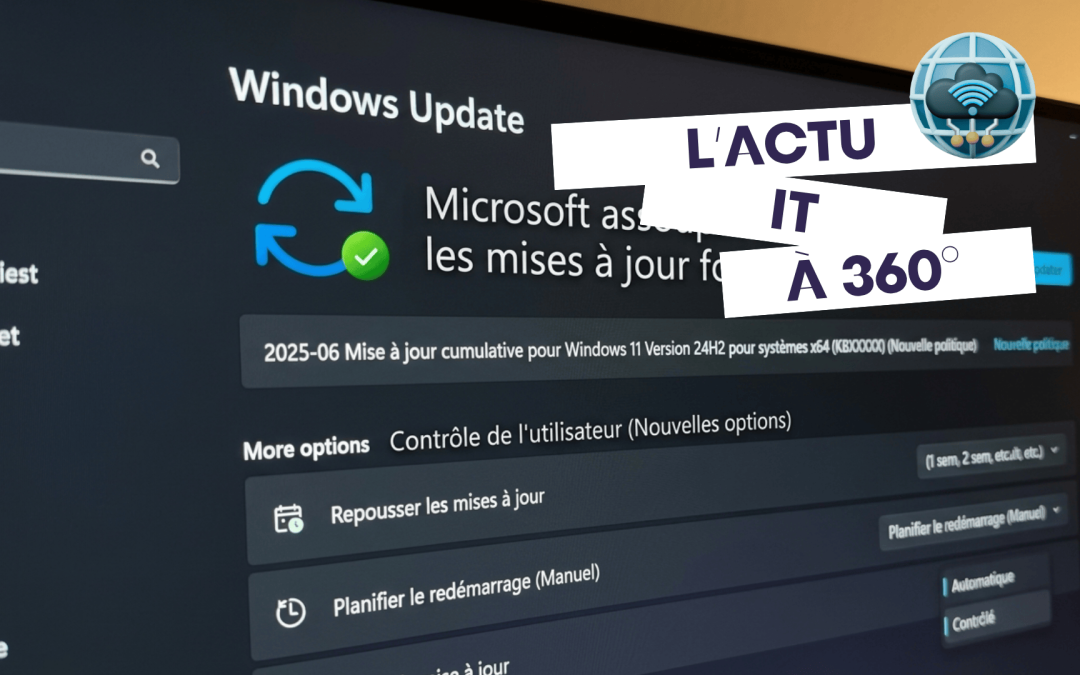
Windows 11: Microsoft finally relaxes forced updates
News in brief Microsoft is preparing to overhaul the way updates are managed in Windows 11, giving users greater control over their installation, notably by making it easier to postpone them or avoid certain enforced interruptions. This change responds to a...

WeChat goes autonomous AI: Tencent steps up with OpenClaw
News in brief Tencent has just integrated OpenClaw into WeChat, turning the app into far more than a simple communication tool. This development introduces agents capable of carrying out tasks directly from the interface, without going through several applications or...