


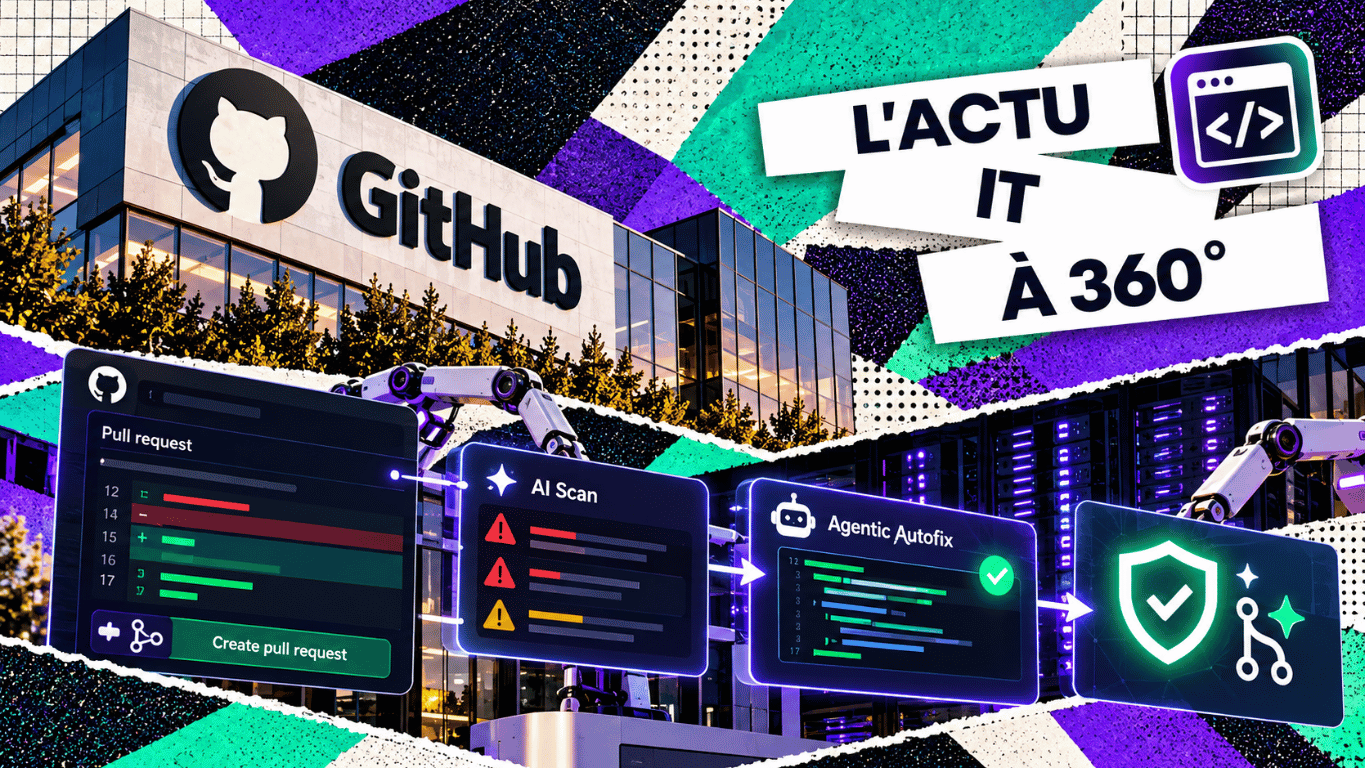
GitHub has announced the general availability of AI Scan for pull requests and Agentic Autofix for code scanning alerts.[1][2] These features bring AI assistance closer to the work of securing code. They do, however, operate on different scopes: proposed changes for the former, alerts on the default branch for the latter. For businesses, the challenge is to prepare fixes more effectively while keeping technical validation in place before they are merged.
AI Scan reviews changes before they are merged
A pull request is used to propose a change and have it reviewed before it is merged. AI Scan complements CodeQL there, notably for PHP, Bash, Terraform and certain less well-covered frameworks. Once enabled alongside code scanning, it surfaces findings flagged as AI-generated, sometimes accompanied by an explanation and a suggested fix.[1]
These findings remain advisory: they do not cause the code scanning check to fail and do not block merging via ruleset requirements. AI Scan does not process pull requests from forks or those created by Dependabot.[1] A team must therefore organise how these findings are read and dealt with, without assuming that their presence automatically holds up a release.
Agentic Autofix prepares a fix from an existing alert
Agentic Autofix can be assigned a code scanning alert located on the default branch. It explores the relevant files, proposes a change, re-runs CodeQL and can iterate before opening a draft pull request for review.[2]
GitHub explicitly excludes alerts that exist only in a pull request or another branch from this assignment to Copilot.[2] The two new features should therefore not be described as an automatic pipeline in which every AI Scan finding is immediately handed over to Agentic Autofix.
An alert disappearing on a new scan gives a useful indication about the targeted issue. It does not prove that the application retains all its expected behaviour, nor that the change introduces no other defect. Functional tests and a review of the change remain necessary.
Two paths and a human decision
The table distinguishes between the announced features and the responsibility of the team using them.
| Stage | What GitHub provides | Team check |
|---|---|---|
| Detection during review | AI Scan flags risks in proposed changes.[1] | Assess the risk and decide how to handle it before merging. |
| Preparing the fix | Agentic Autofix works on an alert from the default branch.[2] | Review the modified files and the relevance of the fix. |
| Validation | A new CodeQL scan accompanies the agent’s work.[2] | Also check business tests and side effects. |
Access conditions matter when choosing a pilot
AI Scan is available for public repositories; private or internal organisation repositories require GitHub Code Security or GitHub Advanced Security. A Copilot licence is not required.[1] Agentic Autofix is aimed at customers of these offerings on GitHub Enterprise Cloud, with administrative activation and a defined Copilot billing method.[2]
Both features consume Code Security AI credits; Agentic Autofix also uses GitHub Actions minutes.[1][2] Before rolling out, SMEs need to check their plan, the scope of repositories and the associated budget. The economic benefit will depend as much on review time as on the number of fixes actually accepted.
SMEs can evaluate results in two distinct situations
First illustrative scenario: a team modifies a PHP form and receives a finding in its pull request. The developer checks whether user input can actually reach the sensitive operation, examines the suggestion, then adds a test reproducing the case. A plausible answer from the AI is not enough to establish whether the risk exists or has gone away.
Second scenario: a code scanning alert already exists on the default branch of an eligible repository. The team assigns it to Agentic Autofix, then reviews the proposal. It checks that the fix does not inadvertently change access rights, accepted formats or business results. These scenarios are an evaluation approach, not published customer results.
The pilot can track the time to a validated fix, the proportion of suggestions retained and the regressions detected. Counting only closed alerts could mask an excessive verification workload or unsuitable changes.
Developers must understand the vulnerability as well as the fix
This development raises the bar for Web Programming and Management. Reading code remains essential to understand the path data takes, spot a fragile assumption and determine whether the fix addresses the root cause. Professionals must be able to explain why a change reduces the risk.
The skill is also reflected in the quality of tests. A case that fails before the fix and passes afterwards provides a useful benchmark, to be complemented by checks on legitimate uses. In particular, a stricter control must not prevent a necessary function from working or shift the vulnerability elsewhere.
Finally, the developer organises the review and documents decisions. They must know when to accept a suggestion, modify it or reject it. Delegating to an agent can speed up preparatory work, but command of the application remains essential to decide what gets merged.
Editor’s note
The progress to measure is a fix that is understood, tested and maintainable. These tools can help reduce research and preparation work; their real value will depend on the coverage of the scans and on teams’ ability to verify the proposals.
Further reading
Four CCCLX reads on assisted development and software security.
Sandbox, terminal, policies: GitHub puts guardrails on its code agents
Project Glasswing: Anthropic goes on the offensive against software vulnerabilities
Open-source security changes scale: IBM, Red Hat and Palo Alto join forces
With Code Layers, Figma brings design and development firmly together
Sources
- 01
GitHub Changelog (15 October 2026). “AI Scan for pull requests generally available”. Overview of the general availability, scope and terms of use of AI Scan.
- 02
GitHub Changelog (15 October 2026). “Agentic autofix for code scanning alerts general availability”. Details of how Agentic Autofix works, its access conditions and billing.

Data centre boom: Legrand goes on the offensive in China and the UK
Data centres are becoming the heart of the global digital economy Legrand is stepping up its investments in China and the United Kingdom to strengthen its presence in the data centre sector, which has become critical infrastructure for the digital economy. This...
GPT-5.4-Cyber: OpenAI responds to Claude Mythos in the AI cybersecurity battle
A new front line in the artificial intelligence war On 14 April 2026, OpenAI launched GPT-5.4-Cyber, a model specialising in cybersecurity, just days after Anthropic announced Claude Mythos. This timing is no coincidence: it marks an acceleration in the competition...

Claude Mythos: beyond the buzz, what are the real stakes for IT security?
An AI that promises to transform cybersecurity With Claude Mythos, Anthropic is showcasing a new generation of artificial intelligence able to analyse, detect and anticipate cybersecurity threats. At a time when cyberattacks are soaring, with more than 2,200 attacks a...
Microsoft reinvents development with AI agents in VS Code
Software development enters the age of agents Microsoft is taking a new step by integrating artificial intelligence agents into Visual Studio Code, with a beta version available via the Insiders channel. This development comes at a time when VS Code is used by more...

In the cloud era, enterprise networks are changing standards
The network is no longer just support: it is becoming a driver of performance For a long time, the enterprise network was regarded as a simple technical infrastructure, often invisible as long as it worked. But with the explosion of the cloud, SaaS applications and...
Windows 11: Microsoft wants to speed up user testing with Insider
Software testing becomes a lever for innovation Microsoft is overhauling its Windows Insider programme, which now brings together more than 10 million testers worldwide, to simplify access to experimental versions of Windows 11 and speed up user feedback. In an...

51,600 satellites: Jeff Bezos steps up the battle for the global internet
News in brief With Project Kuiper, Jeff Bezos is committing Amazon to a major transformation of the world’s internet infrastructure by deploying tens of thousands of satellites in low Earth orbit. The goal is not limited to connecting isolated areas, but to building a...
PepsiCo automates its logistics: a turning point for smart warehouses
News in brief PepsiCo France is investing in an automated, multimodal warehouse that combines robotics, digital systems and intelligent management of logistics flows. The aim is no longer simply to store and distribute products, but to turn the warehouse into a...

Windows 11: Microsoft finally relaxes forced updates
News in brief Microsoft is preparing to overhaul the way updates are managed in Windows 11, giving users greater control over their installation, notably by making it easier to postpone them or avoid certain enforced interruptions. This change responds to a...

WeChat goes autonomous AI: Tencent steps up with OpenClaw
News in brief Tencent has just integrated OpenClaw into WeChat, turning the app into far more than a simple communication tool. This development introduces agents capable of carrying out tasks directly from the interface, without going through several applications or...