


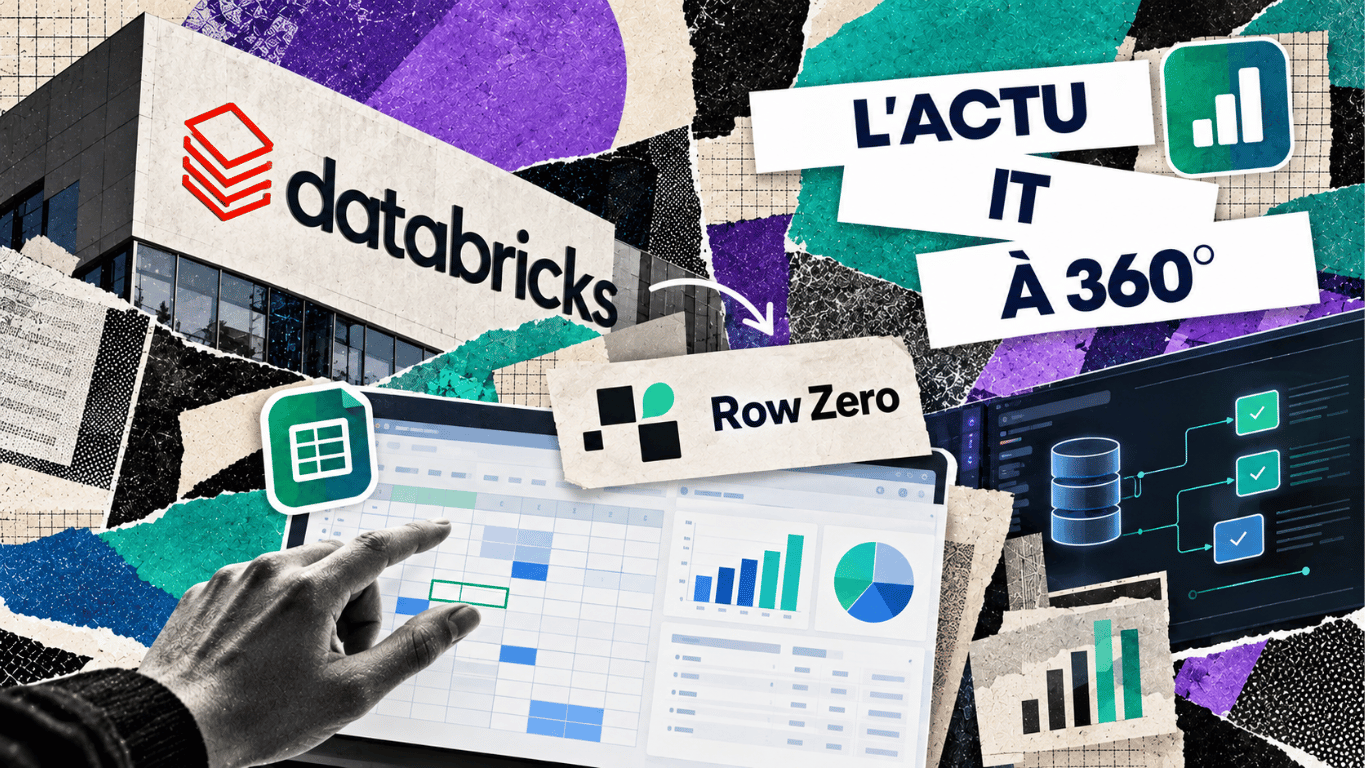
Databricks has announced the acquisition of Row Zero and plans to integrate its spreadsheet experience into Genie.[1] The aim is to let business teams explore data in a familiar interface, with greater control over access and usage. For companies, the challenge is to keep the flexibility of the spreadsheet while limiting analyses built on scattered copies.
The spreadsheet joins the Genie project
In its press release of 24 September, Databricks presents Row Zero as a way of complementing Genie with a spreadsheet interface for finance, operations, sales and marketing teams. The integration is to rely on Genie Ontology, Unity Catalog and Unity Gateway. The vendor plans to offer it on the web, desktop and mobile, without giving a precise availability timeline.[1]
A distinction must therefore be drawn between the announced acquisition, Row Zero’s already documented features and their future native integration. The existing product’s documentation makes it possible to examine the mechanisms available; it does not prove that the whole package is already deployed in Genie.
Refreshable data in a familiar interface
Row Zero lets users publish queries as shared sources, then use them in connected tables. Data can be refreshed manually or on a schedule. Connectors are documented for Databricks, Snowflake, BigQuery and Postgres, among others.[2]
This approach can cut down on the routine of downloading a file, renaming it, sending it on and starting all over again with every update. It does not mean, however, that every cell instantly reflects every change in the database. The refresh frequency and the scope of the query still have to be defined.
Take an illustrative example: a sales team is preparing a revenue forecast. It could start from a shared orders source and work on its assumptions in the spreadsheet. To compare two scenarios, however, it would need to record the date of the data, the scope chosen and the assumptions used. An up-to-date source does not remove the need to make the reasoning reproducible.
Governance also depends on the identity used
The documentation distinguishes between two cases. With OAuth, a shared source runs the query on the user’s behalf and applies their rights in the warehouse, including row-level restrictions. With a service account, the people authorised to use the source run the query with the permissions of that shared account.[2]
The choice of connection mode therefore has a direct bearing on what users can see. For IT teams, the task is to check the rights actually granted to each group, then test both authorised and denied access cases. A simpler interface must not make permissions harder to read.
Limiting exports does not mean eliminating them
Row Zero documents policies for controlling downloads, copy-and-paste and sharing. Workspaces can also have their own security settings and connections.[3] These capabilities have to be configured to match the organisation’s practices.
The product retains CSV export and the ability to write results back to a data warehouse. The latter requires a connection and the appropriate write permissions. The documentation describes how to create results tables and recommends keeping them separate from the reference tables managed by the data team.[4]
The relevant promise is therefore better control over how data circulates. A company will have to decide which results may leave, for which recipients and after what validation. A legitimate need to share with a partner is not handled in the same way as internal consultation of a metric.
Data teams become responsible for usage as much as for sources
Our reading of this acquisition is that the data platform is seeking to move closer to where business teams build their analyses. Technical teams no longer simply deliver access to a database: they must make sources understandable, specify how fresh they are and explain the limits of the metrics provided.
Row Zero’s deployment guide recommends preparing reusable sources around business entities and common reports.[5] For an SME that already has a data warehouse, a limited first use case can help test this way of working. The acquisition alone does not justify replacing its tools or migrating its platform.
Four uses and four checkpoints
The examples below illustrate the trade-offs to prepare for. They are not results observed at customers.
| Business use | Potential benefit | Control to plan |
|---|---|---|
| Financial forecasting | Start from shared data to compare scenarios. | Document assumptions and validate formulas. |
| Sales tracking | Refresh the scope of the sales analysed. | Check the data date and rights per team. |
| Marketing analysis | Cross-reference campaign results in a spreadsheet. | Check definitions and accessible data. |
| Publishing results | Reuse an analysis in the warehouse. | Separate trials from reference data. |
Agents add a validation requirement
Databricks also highlights a spreadsheet that can be used by both humans and agents, with interpretable and auditable actions.[1] This approach may make some operations easier to examine, but being able to review an action does not guarantee that it is correct.
In a margin analysis, for example, a calculation can be arithmetically accurate while using the wrong definition of cost. The organisation must therefore specify who approves metrics, which actions require validation and how to reverse an erroneous result. Traceability helps to understand a decision; it does not replace business judgement.
Reliability is built between the source and the calculation
This development strengthens the role of Data Management. Professionals must be able to link an analysis to its source, understand access rights and explain what each metric represents. The quality of the work also depends on how fresh the information is and how consistent the definitions used are.
It is also their job to support users in creating reusable sources and validating transformations. A formula, a filter or a join can change the meaning of a result even when the original data is reliable.
For the company, this skill makes analyses verifiable without taking all autonomy away from business teams. The professional’s value lies in their ability to organise an understandable, controlled use of data, from consultation through to the publication of results.
Success will be measured in day-to-day use
The coming together of Databricks and Row Zero opens up a way to narrow the gap between data platforms and business tools. Its value will have to be proven against concrete criteria: fewer contradictory copies, better-understood rights and less preparation time, without losing control over calculations.
Before any deployment, companies will need confirmation of the integration’s availability, the commercial terms and the supported features. The decisive question will be whether this connected spreadsheet genuinely simplifies work while making it possible to explain and reproduce decisions.
ALSO READ
These four CCCLX analyses expand on questions of data access, interoperability and control over platform usage.
Databricks extends Delta Sharing to AI and aims to break down data silos
Talk to your database: Oracle improves its NL2SQL AI
Agentic Data Cloud: Google rethinks data for the age of AI agents
Google Cloud takes on the hidden bill of AI agents
Sources
- 01
Databricks (24 September 2026). “Databricks Acquires Row Zero, Bringing Live, Governed Spreadsheets to Genie”. Announcement of the acquisition and the features planned for Genie.
- 02
Row Zero. “Shared Data Sources”. Shared data sources, refreshes and OAuth or service-account connection modes.
- 03
Row Zero. “Spreadsheet security and data governance”. Security, download, sharing and access controls.
- 04
Row Zero. “Data Export”. Exporting data and writing results to a warehouse.
- 05
Row Zero. “Enterprise Launch Guide”. Advice on structuring deployment and preparing reusable sources.

Data centres in space: why Nvidia wants to revolutionise the cloud
News in brief At the GTC 2026 conference, Nvidia announced its intention to accelerate the development of artificial intelligence in space, joining an emerging movement around orbital data centres. The company is no longer content to supply chips for satellites; it is...

Claude Marketplace: what Anthropic’s new platform changes for businesses
News in brief Anthropic has just announced Claude Marketplace, a new platform that allows companies to access, share and use artificial intelligence agents based on its Claude model. The aim is no longer just to offer conversational AI, but to create a genuine...

Automated code review: Anthropic’s Claude now analyses developers’ code
News in brief Artificial intelligence continues to transform developers’ work. Anthropic, the company behind the Claude AI model, has just announced new capabilities that allow its assistant to analyse computer code and help developers with their code review...

Memerist: the free Linux app for creating memes in seconds
News in brief Creating a meme has become an everyday activity on the internet. Humorous images circulate daily on social networks, forums and messaging apps, often used to comment on the news, share an idea or simply make people laugh. Yet producing a meme quickly is...

Microsoft unveils Microsoft 365 E7: Copilot and AI agents at the heart of its enterprise strategy
News in brief Microsoft recently announced Microsoft 365 E7, a new offering for businesses that places artificial intelligence at the heart of the working environment. This development is part of Microsoft’s overall strategy to transform traditional productivity tools...

Global cyber-espionage: the Salt Typhoon affair shows why cybersecurity is becoming crucial
News in brief A vast cyber-espionage operation called Salt Typhoon has reportedly infiltrated several telecom operators around the world. Hacker groups linked to China are believed to be behind these attacks, which can access sensitive communication infrastructure....

CCCLX wins Bronze Trophy at IT Night 2025!
CCCLX, the 360° IT school, was honored at IT Night 2025 - La Nuit de l'Entreprise Numérique, winning the Bronze Trophy in the Schools / Training category. A fine accolade in the context of this emblematic event for the French digital ecosystem, organized annually...

A revolution in higher education financing by aivancity/CCCLX and Umanity
A concrete solution to democratize access to education for the professions of tomorrow This scheme, the only one of its kind in France, complements a series of measures put in place by aivancity to promote diversity and equitable access to its programs (tuition-free...

White paper: How generative AI is transforming SMEs
White paper: How generative AI is transforming SMEs In a world where technological innovation is redefining the rules of the game, small and medium-sized businesses have never had so much to gain... or lose. Against this ever-changing backdrop, CCCLX unveils its new...

CCCLX: A new IT school dedicated to SMEs and startups is born
On April 28, 2025, CCCLX was officially unveiled at the CCI Paris during a press conference packed with symbols and commitments. The launch was attended by a number of leading personalities: Soumia Malimbum, President of CCI Paris, Alain Martinez, President of CPME...