


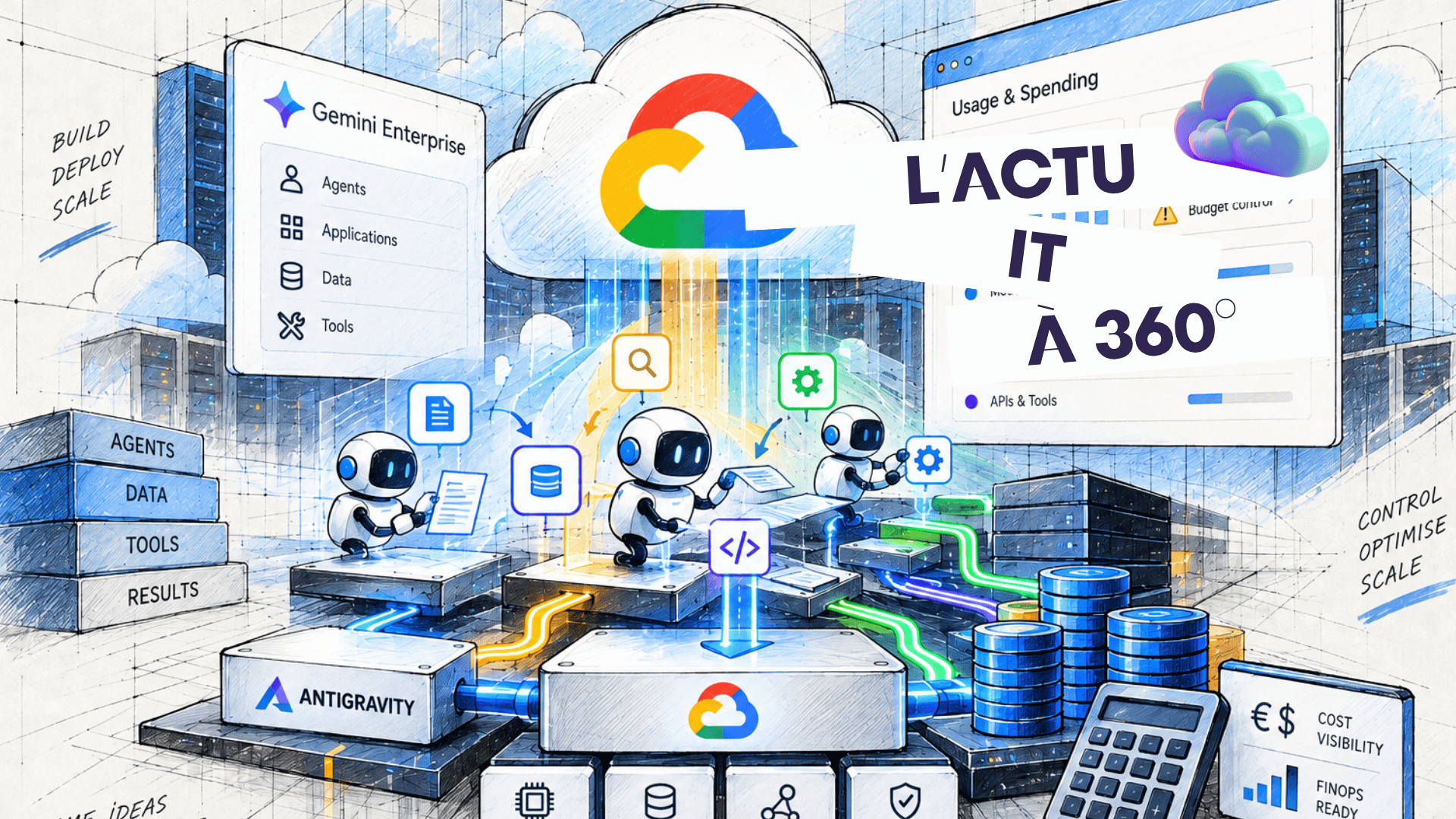
AI agents raise a new problem: how much does a task really cost?
As companies move from chatbots to AI agents able to work through multiple steps, the question of cost becomes much more complex. A chatbot generally handles a request and generates an answer, whereas an agent may query several models, search for data, call APIs, use tools, keep a memory and repeat certain operations before reaching its goal. Google Cloud wants to make this consumption more predictable with new billing and spending control options for agentic workloads in Gemini Enterprise, as well as for developer tools such as Google Antigravity.¹ The aim is clear: to let companies give their agents more autonomy without discovering too late that this autonomy comes with a bill that is hard to anticipate.
Google introduces more flexible billing for Gemini Enterprise
The first change directly concerns Gemini Enterprise’s business model. Until now largely structured around per-user licences with pooled quotas, the service is gaining a pay-as-you-go option that lets agentic workloads keep running without interrupting a task when the included quota is reached.¹ Organisations can also combine this on-demand consumption with their existing subscriptions, an approach designed for uses whose intensity can vary greatly from one project to another. This flexibility reflects a fundamental feature of agentic AI: two users with the same tool can generate very different consumption depending on the length of the tasks given to their agents, the number of tools used and the amount of reasoning required.
A monthly cap to stop an agent from exceeding the budget
Above all, Google is adding mechanisms that let IT and finance teams regain control over this consumption. Administrators can view spending and how it evolves in the Usage & Spending area of Gemini Enterprise, with a breakdown between the Gemini Enterprise application, the agent platform and development tools such as Antigravity.² They can also set a monthly spending limit at project level: once this cap is reached, usage billed as overage is automatically stopped.³ The principle brings the operation of AI agents directly in line with FinOps practices already applied to the cloud, with centralised visibility of consumption and safeguards designed to prevent an experiment or a particularly intensive workflow from turning a small budget line into uncontrolled spending.
Antigravity also puts the cost of agentic development under scrutiny
Developers are directly affected, since Google Antigravity, Google’s agentic environment for software development, is integrated into Gemini Enterprise’s AI tools. Google explains that administrators can thus manage spending, usage metrics, security and observability of developer tools in a single environment, rather than juggling multiple licences and billing consoles.⁴ This centralisation becomes particularly relevant when development agents can explore a codebase, modify several files, run tests and pursue a task over a long period: a single human instruction may hide numerous model calls and intermediate operations. The challenge is therefore no longer just knowing the price of a coding assistant subscription, but measuring what it really costs to run the workflows it automates.
Tokens, memory, sessions, tools: an agent’s bill becomes multidimensional
Above all, Google Cloud’s pricing model shows that an agent’s cost can no longer be reduced to the tokens consumed by its model. The platform can also charge for resources linked to its memory, sessions, storage and API calls. Since 1 September 2026, for example, Memory Bank has been billed according to the volume stored and the operations performed, while the tokens used to generate memories and embeddings are still billed separately. The Sessions and Skill Registry services also follow pricing that combines storage with read or write operations.⁵ An autonomous agent can therefore generate several layers of consumption at once: model reasoning, retaining its state, retrieving information, calling tools and the infrastructure needed to run it. For FinOps teams, tracking only the number of tokens therefore risks giving an incomplete view of the real cost of an agentic workflow.
With agents, every decision can carry a cloud cost
This transformation gives Cloud Computing a new dimension. Professionals responsible for designing and running AI architectures now need to understand how an agentic workflow consumes the various cloud resources, identify the most expensive steps and set limits in line with the value actually produced. An extremely powerful model is not necessarily the best choice for every operation: a simple task can be handed to a cheaper model, while a more powerful model is reserved for steps requiring more reasoning. Likewise, an agent’s memory, how long its sessions are kept or the number of calls to its tools can all be optimised. Cloud skills are thus moving closer to FinOps, with a new objective: no longer simply sizing an infrastructure, but building agents capable of producing enough value to justify every resource they consume.
Cost per task could replace cost per token
This development could ultimately change the indicators used to assess the economics of AI. Comparing the price of a million tokens remains useful, but becomes insufficient when an agent may carry out a variable sequence of operations to complete a single mission. Two agents using the same model can have radically different costs depending on their orchestration, their memory, the number of calls to their tools or their ability to avoid unnecessary steps. Google Cloud is therefore pushing companies towards a logic closer to cost per workflow or per result achieved, with tools to track spending and keep it in check before it becomes a problem. As agents move from experiments to deployments involving thousands of employees, this financial discipline could become as important as their accuracy or autonomy.
After the race for agents, the race for their profitability begins
Google Cloud’s new controls ultimately show that agentic AI is entering a more industrial phase. Companies no longer just want to know whether an agent can carry out a task; they need to determine how much that task costs when it is repeated thousands of times and how to prevent autonomous workflows from consuming more resources than planned. Visibility over spending, budget caps and flexible billing models are therefore becoming essential building blocks of agentic platforms. Having sought to make agents smarter and more autonomous, cloud providers are now starting to answer another equally strategic question: how can they be made economically sustainable at scale?
360° IT News — decoding technology to understand the jobs of tomorrow.
Further reading
The question of agent costs did not start with Google Cloud. Read our CCCLX article “The token war begins: Headroom wants to make AI less expensive”, which analyses how optimising context and token consumption can reduce the running cost of AI systems, another lever that complements the FinOps mechanisms now offered by cloud platforms.
References
1. Google Cloud. (2026). FinOps for the AI era: New flexible billing and cost controls for agents.
https://cloud.google.com/blog/products/ai-machine-learning/flexible-billing-and-cost-controls-for-agents-on-google-cloud
2. Google Cloud. (2026). View costs in Gemini Enterprise.
https://docs.cloud.google.com/gemini/enterprise/docs/view-costs
3. Google Cloud. (2026). Overview of overages and spend controls.
https://docs.cloud.google.com/gemini/enterprise/docs/manage-costs-overview
4. Google Cloud. (2026). Expanding Google Antigravity for enterprise customers.
https://cloud.google.com/blog/products/ai-machine-learning/expanding-google-antigravity-for-enterprise-customers
5. Google Cloud. (2026). Gemini Enterprise Agent Platform pricing.
https://cloud.google.com/products/gemini-enterprise-agent-platform/pricing

GitHub Copilot bulks up for business: coding agents come under IT control
Copilot is no longer just there to suggest the next line GitHub Copilot is continuing its transformation. Originally known mainly for completing code in the editor, the tool is now evolving towards agents capable of exploring a project, modifying files, using tools...

PDFs, presentations, audio: Adobe wants to turn Acrobat into a content factory
Acrobat no longer just wants to open your documents For more than thirty years, Acrobat has mainly been used to read, create, edit, sign and share PDFs. Adobe now wants to give it a much broader role. On 9 September 2026, the company announced new capabilities based...

Salesforce plugs Claude into its CRM: Claudeforce prepares for life after the interface
What if the CRM soon no longer needed to be opened? For decades, using a CRM meant navigating between customer records, dashboards, menus and forms. With Claudeforce, Salesforce and Anthropic want to change this logic: rather than forcing users to go into Salesforce...
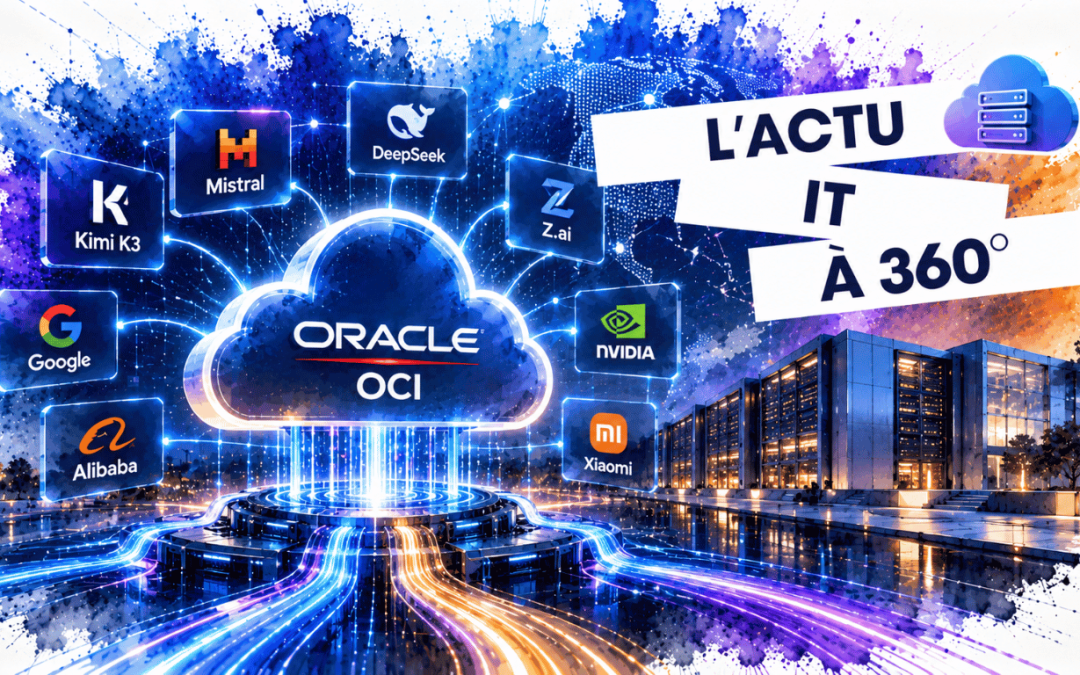
Kimi K3, Mistral, DeepSeek: Oracle turns OCI into an AI model hub
Oracle wants to make OCI a one-stop shop for AI Oracle is stepping up its efforts in the AI cloud battle by significantly expanding the catalogue of models available in OCI Enterprise AI. On 4 September 2026, the group announced in particular the integration of Kimi...
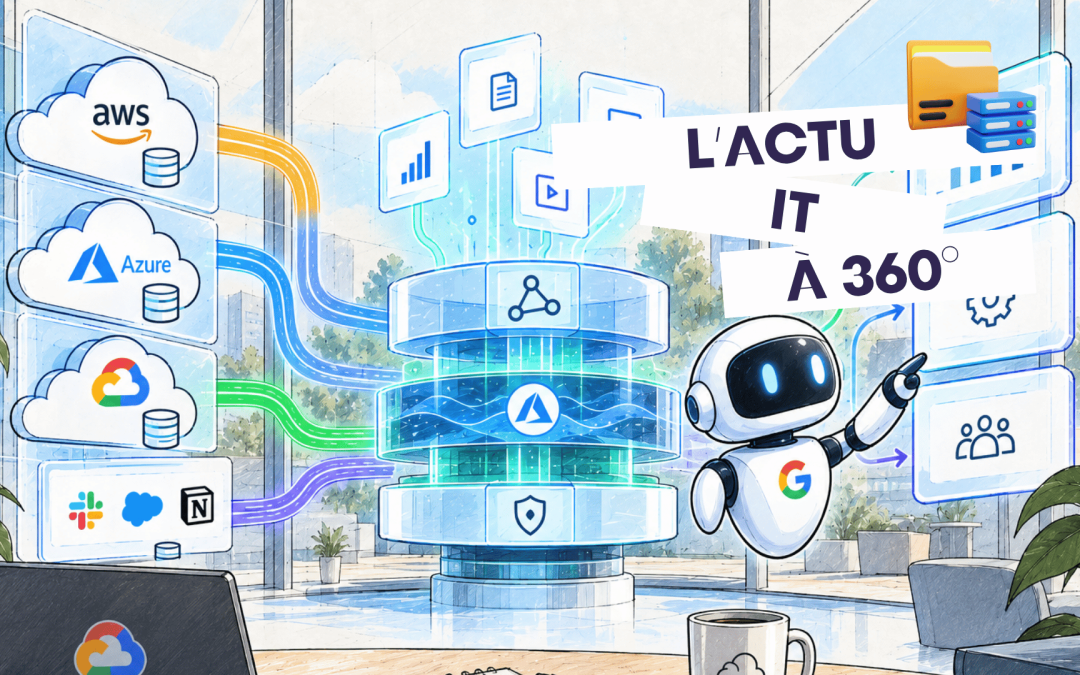
Agentic Data Cloud: Google rethinks data for the age of AI agents
AI agents are forcing Google to rethink data architecture AI agents promise to search for information, make decisions and act directly within company systems, but this autonomy depends on one essential condition: accessing the right data and, above all, understanding...
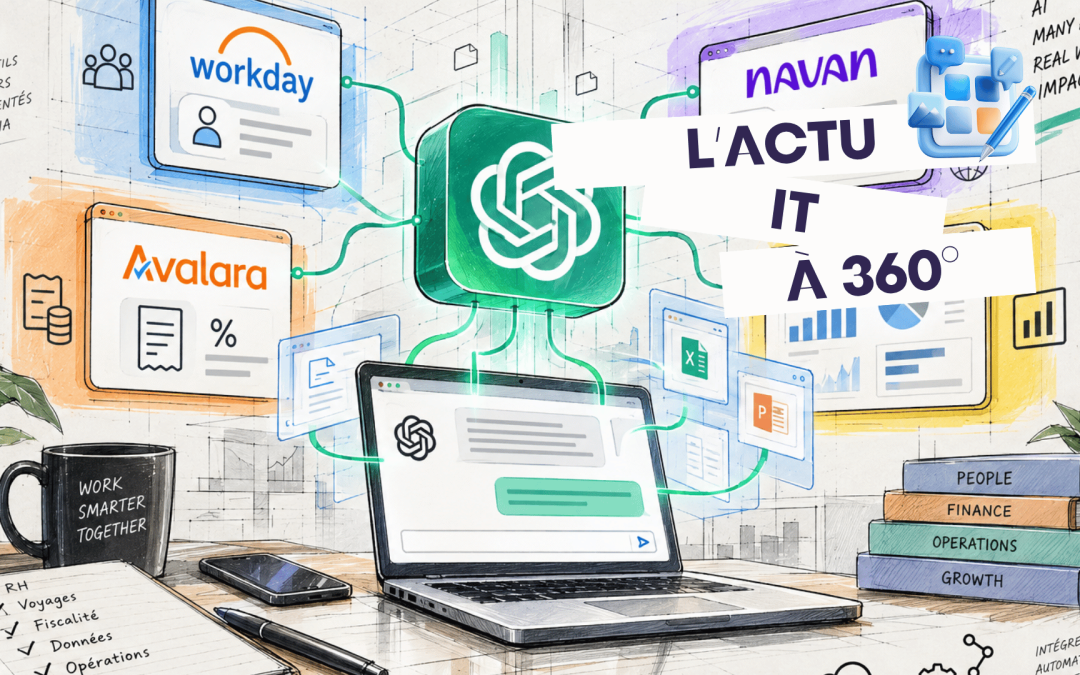
Workday, Navan, Avalara: ChatGPT Work moves into business software
ChatGPT Work is gradually leaving the chat window With GPT-6 Astra, OpenAI is no longer simply trying to improve the quality of ChatGPT’s answers. The company wants to bring its AI closer to the applications in which employees actually work. With the arrival of GPT-6...

From chip to cloud: Groq raises 350 million to scale up
Groq now wants to sell cloud rather than just chips Groq is pursuing a major strategic transformation. Long seen as one of Nvidia’s challengers thanks to its LPUs (Language Processing Units) specialised in artificial intelligence model inference, the group is now...

Muse Code: Meta launches its AI agent to tackle giant codebases
Meta wants to bring AI agents into complex software projects Meta is stepping up its efforts in AI-assisted software development with Muse Code, a new agent designed to work on large codebases, where traditional assistants can quickly lose the context needed to...

Qwen3.8-Max reportedly coded for 16 days without human intervention
Alibaba tests how far an autonomous AI developer can go Alibaba claims to have reached a new milestone in agentic software development with Qwen3.8-Max, its new flagship model launched in early August 2026. In an internal test, the model reportedly worked fully...
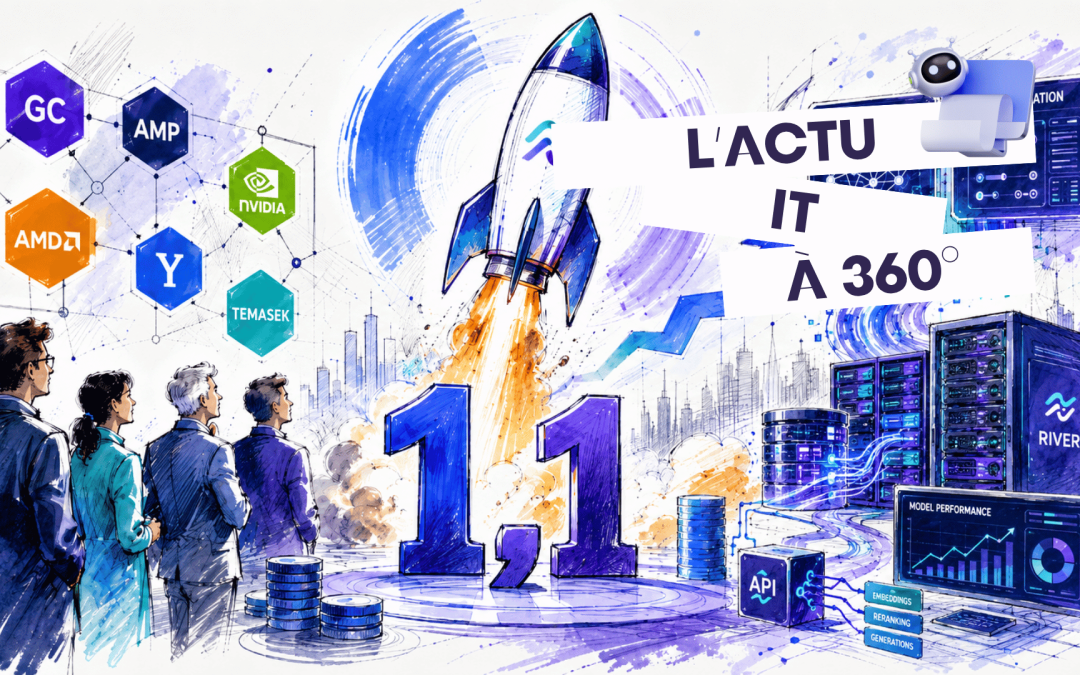
Two months, $1.1 billion: River AI is already exciting investors
A spectacular raise for a start-up barely out of the shadows Two months after emerging from stealth mode, River AI has just completed one of the most spectacular funding rounds of the year in artificial intelligence. The start-up founded by Igor Babuschkin, a former...