


Data storage is reaching its limits
Every day, humanity produces a gigantic amount of data. In 2025, the volume generated worldwide each day is estimated at almost 300 exabytes, the equivalent of a century of European audiovisual archives created every 24 hours1. With the rise of artificial intelligence, the cloud and connected devices, this growth is becoming exponential. Behind this explosion lies a major problem: today’s storage infrastructure is gradually approaching its technical, energy and environmental limits.
PearCode wants to turn DNA into digital infrastructure
Against this backdrop, the French deeptech company PearCode, a spin-off from the I3S laboratory in Sophia Antipolis, has just launched a first archiving solution based on synthetic DNA. Long regarded as a futuristic technology, DNA storage is now starting to leave the laboratory and enter the market. The principle is to encode digital data as genetic sequences that can be preserved for decades, or even centuries, without significant degradation.
A gram of DNA could hold an entire data centre
One of the most spectacular arguments for DNA storage lies in its density. According to several studies, a single gram of DNA could theoretically hold the equivalent of an entire data centre’s data2. On top of this comes a major advantage: unlike traditional infrastructure, DNA does not require a continuous power supply to retain data. At a time when data centres already account for 1 to 2% of global electricity consumption, this prospect is attracting strong interest from the technology industry3.
The real challenge: automating data writing and reading
While the promise is immense, the main obstacle remains automation. Today, writing and reading data on DNA is still slow and expensive. The challenge for companies like PearCode is therefore to industrialise these processes in order to reduce costs and access times. This is precisely where the global competition is being played out. The players able to make this technology fast, reliable and accessible could redefine digital storage infrastructure in the coming decades.
A potential revolution for businesses and critical archives
The first target uses concern sensitive data and long-term archives: administrative documents, scientific data, digital heritage or medical records. For businesses, this approach could sharply reduce cold storage costs while improving data durability. SMEs could also benefit indirectly from this development through more efficient, less energy-hungry cloud services.
Between science, cloud and digital sovereignty
DNA storage is not just about technology; it also raises strategic issues. Controlling the storage infrastructure of the future could become a major digital sovereignty issue. While traditional data centres require massive amounts of energy and materials, DNA paves the way for a new, more compact and potentially more sustainable approach to the cloud. This transition could transform the way states and companies manage their critical data.
Understanding tomorrow’s infrastructure becomes essential
This development highlights a key skill: data and digital infrastructure. Future IT professionals will need to understand new storage architectures, their constraints and their uses. It is no longer just a matter of managing servers or conventional cloud, but of anticipating technologies capable of completely redefining the digital ecosystem.
Towards a biological cloud?
Even though DNA storage is still emerging, PearCode shows that the technology is gradually entering an industrial phase. The idea of storing data in a biological molecule may seem futuristic, but it addresses a very concrete problem: the saturation of digital infrastructure. For students and future IT professionals, this is a fascinating development. It shows that the future of the cloud may no longer rest solely on giant servers, but also on technologies directly inspired by living organisms.
360° IT News — decoding technology to understand the jobs of tomorrow.
Further reading
The emergence of DNA storage illustrates a profound transformation of digital infrastructure in the face of the explosion in data volumes generated by artificial intelligence and the cloud. This development is part of a worldwide search for more compact, durable solutions capable of overcoming the limits of traditional data centres. On a related topic, read our article “Data centre boom: Legrand goes on the offensive in China and the United Kingdom”, which analyses how storage and computing infrastructure is becoming a major strategic issue for the digital economy.
References
1. Statista. (2025). Global data creation forecast.
https://www.statista.com
2. Nature. (2021). DNA data storage density research.
https://www.nature.com
3. International Energy Agency. (2024). Data centres and electricity consumption.
https://www.iea.org
Data centre boom: Legrand goes on the offensive in China and the UK
Data centres are becoming the heart of the global digital economy Legrand is stepping up its investments in China and the United Kingdom to strengthen its presence in the data centre sector, which has become critical infrastructure for the digital economy. This...
GPT-5.4-Cyber: OpenAI responds to Claude Mythos in the AI cybersecurity battle
A new front line in the artificial intelligence war On 14 April 2026, OpenAI launched GPT-5.4-Cyber, a model specialising in cybersecurity, just days after Anthropic announced Claude Mythos. This timing is no coincidence: it marks an acceleration in the competition...

Claude Mythos: beyond the buzz, what are the real stakes for IT security?
An AI that promises to transform cybersecurity With Claude Mythos, Anthropic is showcasing a new generation of artificial intelligence able to analyse, detect and anticipate cybersecurity threats. At a time when cyberattacks are soaring, with more than 2,200 attacks a...
Microsoft reinvents development with AI agents in VS Code
Software development enters the age of agents Microsoft is taking a new step by integrating artificial intelligence agents into Visual Studio Code, with a beta version available via the Insiders channel. This development comes at a time when VS Code is used by more...

In the cloud era, enterprise networks are changing standards
The network is no longer just support: it is becoming a driver of performance For a long time, the enterprise network was regarded as a simple technical infrastructure, often invisible as long as it worked. But with the explosion of the cloud, SaaS applications and...

Windows 11: Microsoft wants to speed up user testing with Insider
Software testing becomes a lever for innovation Microsoft is overhauling its Windows Insider programme, which now brings together more than 10 million testers worldwide, to simplify access to experimental versions of Windows 11 and speed up user feedback. In an...
51,600 satellites: Jeff Bezos steps up the battle for the global internet
News in brief With Project Kuiper, Jeff Bezos is committing Amazon to a major transformation of the world’s internet infrastructure by deploying tens of thousands of satellites in low Earth orbit. The goal is not limited to connecting isolated areas, but to building a...
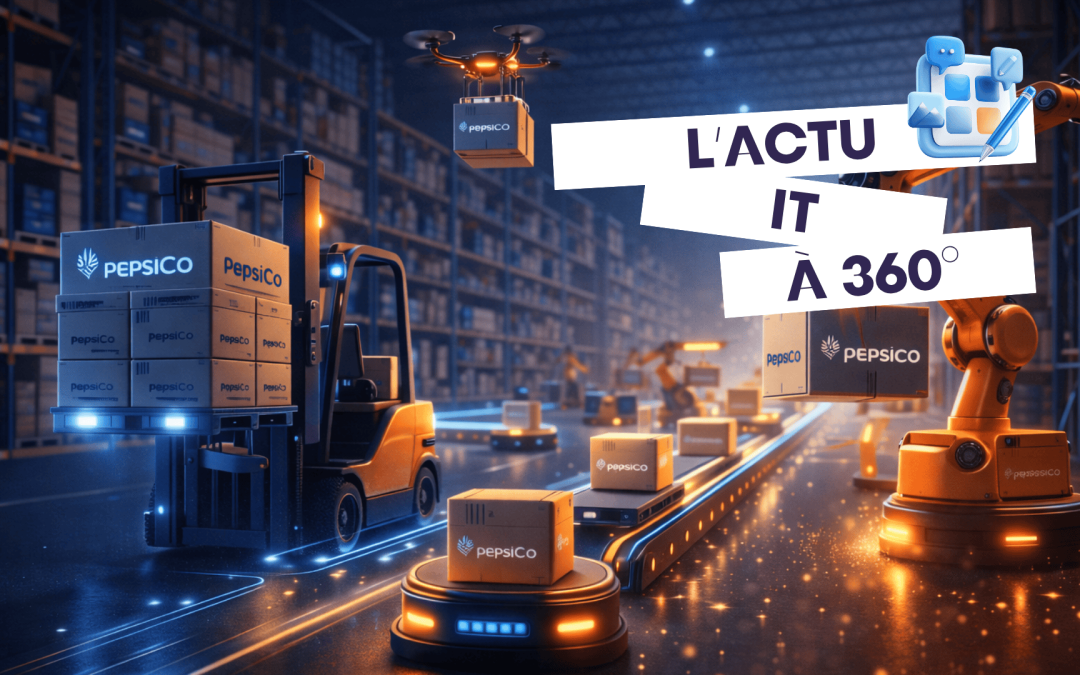
PepsiCo automates its logistics: a turning point for smart warehouses
News in brief PepsiCo France is investing in an automated, multimodal warehouse that combines robotics, digital systems and intelligent management of logistics flows. The aim is no longer simply to store and distribute products, but to turn the warehouse into a...

Windows 11: Microsoft finally relaxes forced updates
News in brief Microsoft is preparing to overhaul the way updates are managed in Windows 11, giving users greater control over their installation, notably by making it easier to postpone them or avoid certain enforced interruptions. This change responds to a...

WeChat goes autonomous AI: Tencent steps up with OpenClaw
News in brief Tencent has just integrated OpenClaw into WeChat, turning the app into far more than a simple communication tool. This development introduces agents capable of carrying out tasks directly from the interface, without going through several applications or...