


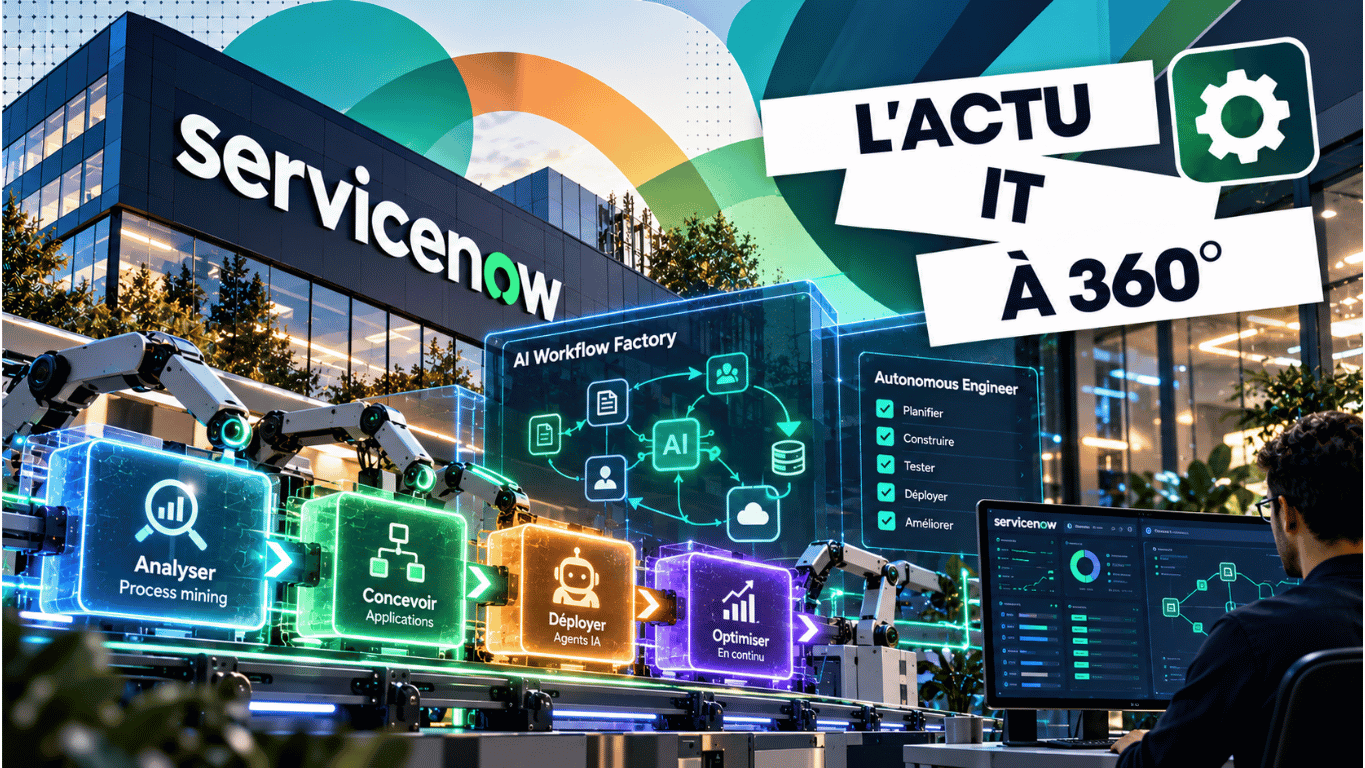
With AI Workflow Factory, ServiceNow aims to link the identification of inefficient processes with building and running their improvements. The announcement notably includes Autonomous Engineer, a tool designed to automate more of the implementation work.[1] For companies, the challenge is to shorten the path between an observed problem and a measurable fix, while keeping control of changes.
Linking the steps between diagnosis and result
ServiceNow structures this approach around Process Mining to spot improvement opportunities, Autonomous Engineer and Build Agent to build the changes, then App Engine to run the workflows. AI Control Tower is meant to oversee the actions and their governance.[1]
A workflow describes the sequence of tasks in a process, for example receiving an IT request, assigning it and resolving it. Process mining analyses execution traces to understand how this journey actually unfolds. Its value lies in making waiting times, rework and hand-offs between teams visible.
Linking these observations to build tools could avoid treating the diagnosis and the change to the process separately. But spotting a delay is not enough to conclude that it is unnecessary: it may correspond to a required approval or to a constraint that the data alone explain poorly.
Autonomous Engineer prepares a plan, then the build
The documentation describes a process in which Autonomous Engineer generates an implementation plan from the requirements, then Build Agent builds the work items in parallel. The AI Workflow Factory Prime bundle also brings together isolated development environments and tools for generating and running regression tests.[2]
These functions can help produce and check changes more quickly. They do not remove the need to define the expected behaviour, exceptions and access rules. A faithful implementation of an ambiguous request can still be ill-suited to the business need.
Four checkpoints in the improvement loop
This grid turns the announced functions into questions to ask before a deployment.
| Building block | Operational effect | Control question |
|---|---|---|
| Process analysis | Identify the steps associated with delays or rework. | Do the data cover real cases and their exceptions? |
| Build | Prepare and produce a change to the workflow. | Who validates the requirements and the necessary permissions? |
| Execution | Run the modified journey in the applications. | How do you test, monitor and restore the service? |
| Measurement | Compare the results achieved with the objectives set. | Does the gain in speed preserve quality and satisfaction? |
Two levels of availability to distinguish
AI Workflow Factory is announced as generally available worldwide on 6 October. Autonomous Engineer remains in early access on request. ServiceNow stresses that people continue to set the direction and approve the results.[1] The announcement therefore does not describe a company whose processes would all change freely without human intervention.
The documentation also advises checking contractual entitlements to access the tools and features of AI Workflow Factory Prime.[2] An organisation needs to identify the components available in its package, their availability level and the integrations required before planning a project.
For SMEs, start with recurring support requests
An SME already equipped with ServiceNow could look at requests that bounce several times from one team to another. A pilot would consist of improving how they are qualified or routed, then comparing the results on a limited scope. This scenario is a suggested assessment, not an announced customer result.
The team would measure resolution time, reassignments and reopened requests. A drop in the number of tickets would not be a success if users simply gave up on getting help. Employee feedback must therefore complement the technical indicators.
The cost of this approach includes licences, connections to applications, data quality and change tracking. For a company that does not have this platform, the investment must be weighed against the problem actually encountered. The announcement alone does not establish a return on investment.
The IT skill to remember: IT project management
This development draws on IT project management. Before delegating the build of a workflow, the need must be clarified, measurable objectives set and the people authorised to accept the result identified. The speed of production makes this scoping even more important.
Professionals must also coordinate business teams, developers and service providers. A change to a journey can shift the workload, alter the information collected or affect a connected application. These effects must be discussed and tested with the users concerned.
Management continues after deployment: tracking results, dealing with discrepancies and deciding on the next improvements. The skill lies in organising lasting change, with a budget, responsibilities and explicit success criteria, even when AI carries out a growing share of the tasks.
Continuous improvement will have to prove its worth
ServiceNow’s proposal brings observation and action together in a single environment. Its value will be borne out in the quality of the service delivered: less unnecessary rework, understandable changes and results tracked over time. Each automation must be traceable to a concrete need and an identified owner.
Further reading
Four CCCLX reads on integrating agents, development and process transformation.
Merck and Google Cloud: 1 billion for agentic AI
With Code Layers, Figma brings design closer to development
GitHub Copilot bulks up for enterprises: coding agents come under IT control
AI voice agents: Oracle details a LiveKit architecture on OCI
Sources
- 01
ServiceNow Newsroom (6 October 2026). “ServiceNow launches AI Workflow Factory to turn workflow improvement into a continuous, agentic AI-powered loop”. Source of the announcement and of the availability details presented.
- 02
ServiceNow Documentation (updated 9 September 2026). “AI Workflow Factory Prime, Brazil release”. Documentation of the tools, features and access conditions.
Editorial check of 6 October 2026. Features and availability are attributed to ServiceNow; no quantified gain is presented as an established result. The table and the SME pilot are editorial suggestions.

Mistral Large 4: what its trillion-parameter model could change for businesses
Mistral has opened the public preview of Mistral Large 4, nicknamed “Le Chonk”, and plans to release its weights by the end of the month.[1] This European model targets agentic use cases in particular, as well as cybersecurity, finance and industry. For businesses,...
IBM Bob: developing with AI without your code leaving the company
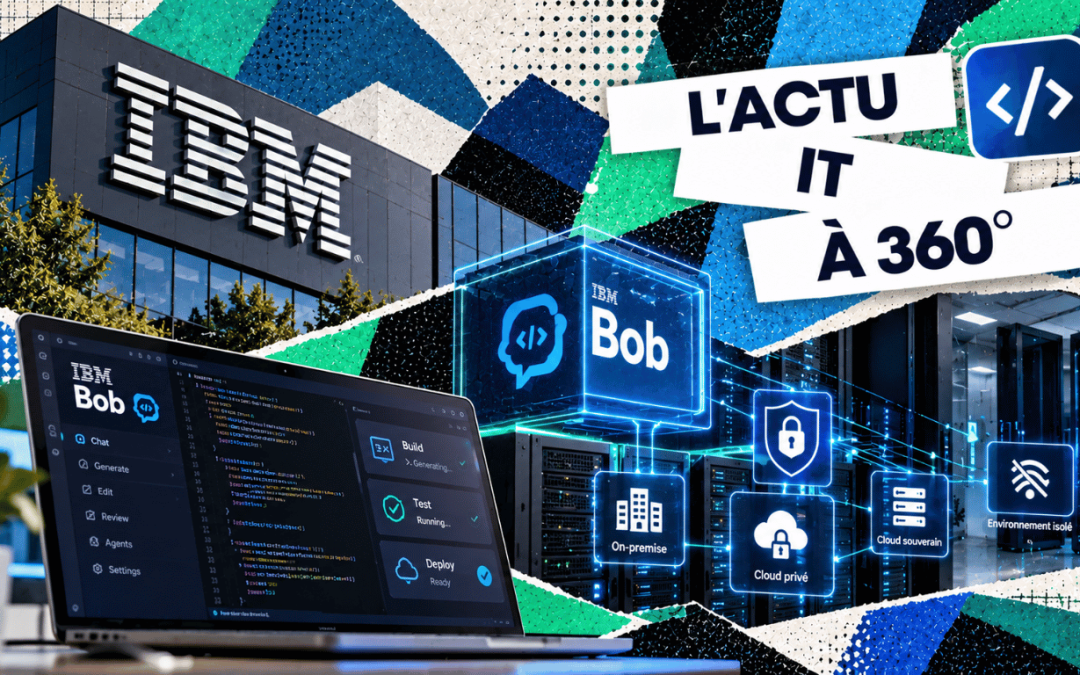
IIBM has announced a self-hosted version of Bob, its agentic development platform, for internal infrastructure, private or sovereign clouds and environments isolated from the internet.[1] This option addresses a concrete obstacle: some applications contain code, data...

HPE is preparing a network that anticipates incidents and automates certain interventions
HPE plans to deploy a Self-Driving Network for the 2027 Ryder Cup, with Wi-Fi 7 and an operations centre bringing together data and AI tools.[1] The stated aim is to monitor usage, adapt the network and move towards autonomous interventions. For businesses, the...
Can your AI agent really defend your company? Hack The Box puts its skills to the test
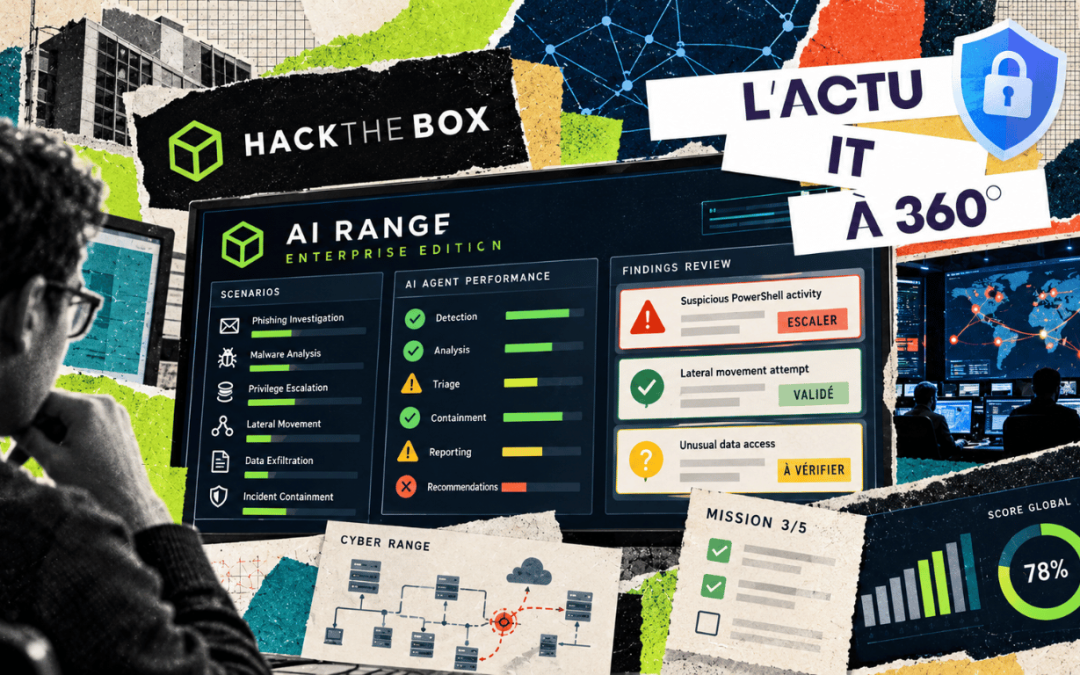
Hack The Box is launching AI Range Enterprise Edition to let security teams assess their own AI agents on the roles assigned to them.[1] For businesses, the stakes are concrete: having evidence before delegating a task, then checking that this evidence remains valid...
VAST Data wants AI to work with sensitive data in a protected environment
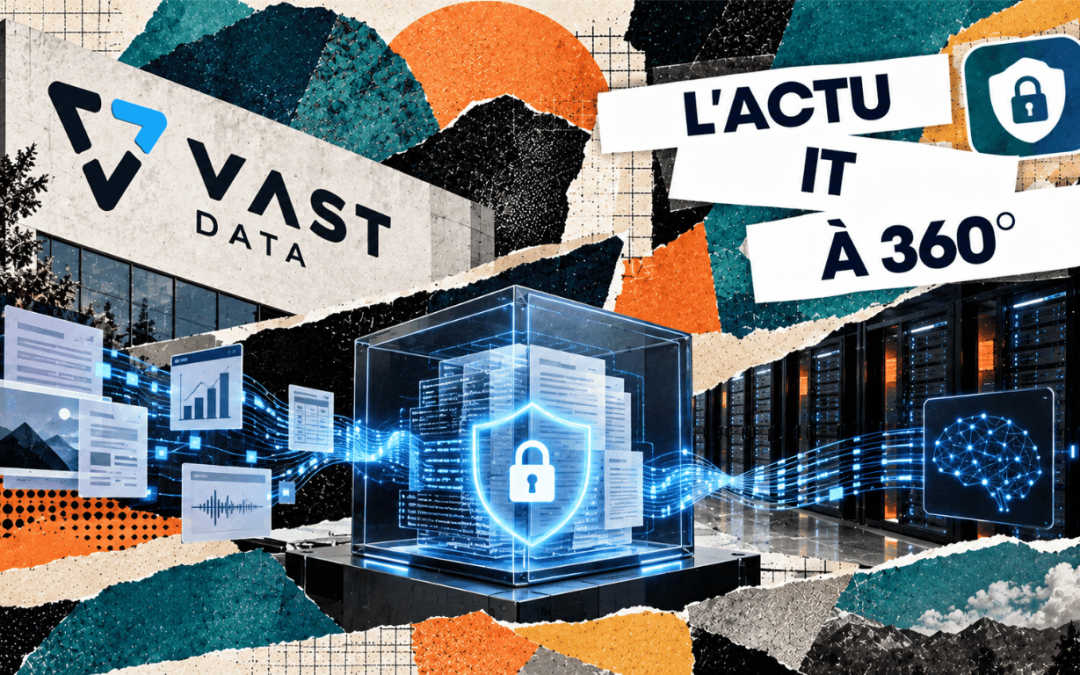
VAST Data has unveiled DataEnclave, a confidential execution capability designed to bring artificial intelligence models closer to companies’ sensitive data. Presented as a preview, it is due to go on sale in the first quarter of 2027.[1] The aim is to make certain...
Databricks buys Row Zero to bring spreadsheets closer to governed data
Databricks has announced the acquisition of Row Zero and plans to integrate its spreadsheet experience into Genie.[1] The aim is to let business teams explore data in a familiar interface, with greater control over access and usage. For companies, the challenge is to...

Google Cloud takes its X5 instances to 48 TB for large SAP databases
Google Cloud has announced the general availability of the X5 series, which raises the maximum advertised memory capacity on a single node to 48 TB, compared with 32 TB for X4.[1] Aimed in particular at very large SAP HANA databases, the offering is based on bare...
Cloud Storage: Google automates the detection of anomalies
A rise in reads, cross-region transfers or stored volume can inflate the cloud bill and disrupt applications. With Storage Intelligence advisor, Google offers a view of unusual changes in Cloud Storage, along with leads for investigating them. For businesses, the...
AI voice agents: Oracle details a LiveKit architecture on OCI
Oracle has described an architecture that pairs the LiveKit Agents framework with Oracle Cloud Infrastructure to automate real-time voice calls. The design links telephony, AI models and business services, while placing internal components in private subnets. For...
GitHub Copilot bulks up for business: coding agents come under IT control
Copilot is no longer just there to suggest the next line GitHub Copilot is continuing its transformation. Originally known mainly for completing code in the editor, the tool is now evolving towards agents capable of exploring a project, modifying files, using tools...