


Alibaba tests how far an autonomous AI developer can go
Alibaba claims to have reached a new milestone in agentic software development with Qwen3.8-Max, its new flagship model launched in early August 2026. In an internal test, the model reportedly worked fully autonomously for around 16 days on a real software engineering project, without human intervention during its execution.¹ The experiment was not simply about generating a few functions from a prompt: Qwen3.8-Max had to start from an empty environment, organise its work, develop the project, run its own tests, detect problems and keep iterating over an exceptionally long period for an AI agent. Alibaba presents this demonstration as an illustration of the model’s ability to carry out so-called “long-horizon” tasks, which require keeping hold of an objective and coordinating numerous actions over several days.
265 commits and 127 pull requests produced by the agent
The announced result gives an idea of the scale of the experiment. As of 30 July 2026, after around 16 days of autonomous operation, the repository used for the test had 265 commits, 127 pull requests and 151 issues.² The model was working on “oh-my-cli”, an agentic framework able to evolve based on requests received, community feedback and its own tests. Its workflow included turning requirements into issues, assigning tasks, generating code, running unit and end-to-end tests, then fixing the defects detected. Alibaba has made the project publicly available on GitHub, allowing part of the traces produced during the experiment to be examined.
The real feat lies in the duration
Coding assistants have been able to generate code, explain a function or fix an error for several years, but sustaining a task over several days is a far more complex problem. An agent must keep the original objective in mind, understand the state of the project after hundreds of actions, detect its own mistakes and resume its work without constantly starting from scratch. Qwen3.8-Max relies in particular on a Mixture-of-Experts architecture with 2.4 trillion parameters, 95 billion of which are activated, as well as a context window of up to one million tokens.³ Above all, Alibaba highlights a closed-loop process in which the agent plans, executes, checks and then corrects its work, a mechanism that is gradually bringing these systems closer to a genuine autonomous software engineering process.
Qwen no longer just wants to write code
This demonstration is part of a broader market trend. Cursor, Claude Code, Codex and GitHub Copilot have gradually moved AI tools from simple autocompletion towards agents capable of exploring a repository, editing several files and running commands. Alibaba now wants to push this logic much further by making the length of autonomy a performance criterion. Qwen3.8-Max was also tested on reproducing a research paper: according to the Qwen team, the model worked for around five days, produced nearly 7,600 lines of code and ran 33 GPU training runs before proposing its own improvements.² These results come from Alibaba’s own evaluations and should therefore be distinguished from independent benchmarks, but they clearly show the direction AI labs are taking.
The developer becomes the supervisor of long-running agents
If agents genuinely become capable of working for several days on the same project, Web Programming and Management could undergo a major transformation. Developers do not disappear from the process: their role shifts towards defining the architecture, setting objectives, reviewing code, testing, security and validating the decisions taken by the agent. Knowing how to program will remain essential to spot a poor implementation or understand the consequences of a change, but a new skill is gradually being added: knowing how to delegate complex tasks to agents, monitor their progress and take back control when their decisions stray from the project’s requirements. A developer’s value could thus depend less and less on the number of lines written by hand and more on their ability to orchestrate and control systems capable of producing code at scale.
The 16 days still have to stand up to real-world conditions
Alibaba’s demonstration should nevertheless be treated with caution. The 16 days correspond to an experiment organised and documented by the model’s provider, and this duration is not enough to prove that an agent can replace a development team on any professional project. Key questions remain about the quality of the code produced, its maintainability, security, the real cost of such a long run and the system’s ability to work in far more complex environments. Industry observers point out that performance deserves to be assessed beyond the number of days of autonomy alone.⁴ The real breakthrough will come when these agents can maintain this level of autonomy in enterprise projects subject to production, security and human collaboration constraints.
From copilot to agentic developer
Above all, Qwen3.8-Max shows how fast AI-assisted development is evolving. After copilots able to suggest the next line, then agents able to modify an entire project, the industry is now experimenting with systems that can pursue an objective for several days. If this autonomy becomes reliable enough for production use, the change will be profound: the challenge will no longer simply be asking an AI to code a feature, but entrusting it with a complete assignment, letting it work and then evaluating the result. The 16 days claimed by Alibaba are therefore less a definitive proof of autonomy than a particularly strong signal of the direction software development is taking.
360° IT News — decoding technology to understand the jobs of tomorrow.
Further reading
Programming environments are also evolving towards agents able to take on a growing share of development. Read our article “ZCode wants to challenge Cursor and Claude Code: China enters the AI coding battle”, on Z.ai’s arrival in the market for agentic development environments.
References
1. Alibaba Group. (2026). Alibaba Unveils Qwen3.8-Max: Its Largest and Most Capable Flagship Model to Date.
https://www.alibabagroup.com
2. Qwen Team. (2026). Qwen3.8-Max: A New Bar for Coding and Cowork.
https://qwen.ai
3. Alibaba Cloud. (2026). Qwen3.8-Max Model Information.
https://www.alibabacloud.com
4. Computerworld. (2026). Alibaba takes aim at OpenAI and Anthropic with Qwen3.8-Max launch.
https://www.computerworld.com
Data centres in space: why Nvidia wants to revolutionise the cloud
News in brief At the GTC 2026 conference, Nvidia announced its intention to accelerate the development of artificial intelligence in space, joining an emerging movement around orbital data centres. The company is no longer content to supply chips for satellites; it is...

Claude Marketplace: what Anthropic’s new platform changes for businesses
News in brief Anthropic has just announced Claude Marketplace, a new platform that allows companies to access, share and use artificial intelligence agents based on its Claude model. The aim is no longer just to offer conversational AI, but to create a genuine...
Automated code review: Anthropic’s Claude now analyses developers’ code
News in brief Artificial intelligence continues to transform developers’ work. Anthropic, the company behind the Claude AI model, has just announced new capabilities that allow its assistant to analyse computer code and help developers with their code review...
Memerist: the free Linux app for creating memes in seconds
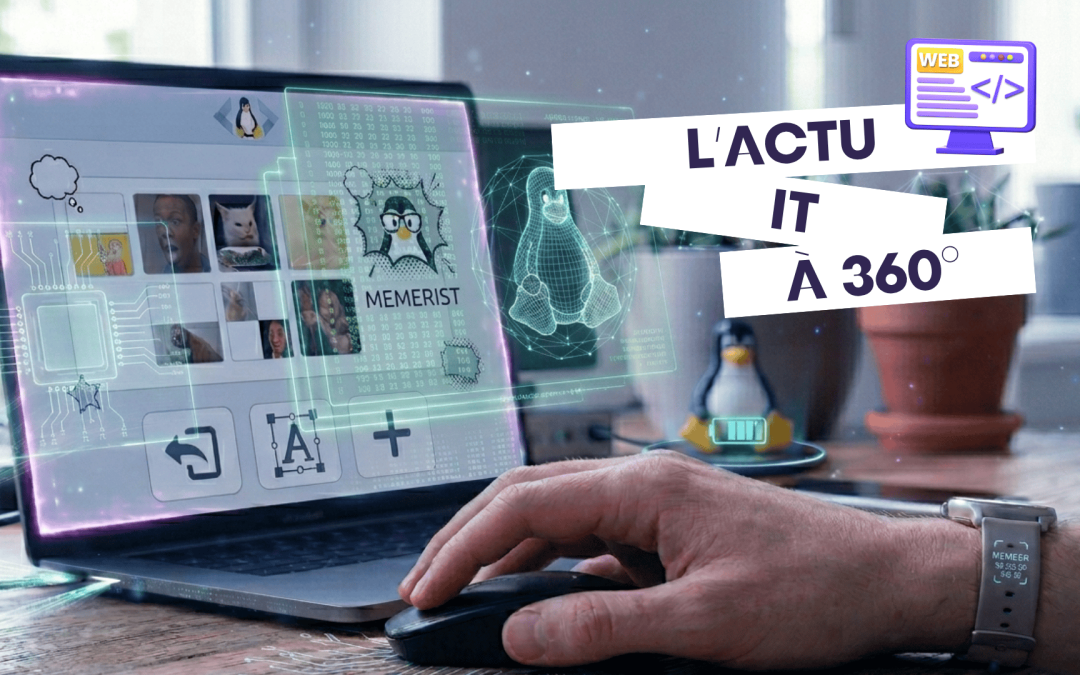
News in brief Creating a meme has become an everyday activity on the internet. Humorous images circulate daily on social networks, forums and messaging apps, often used to comment on the news, share an idea or simply make people laugh. Yet producing a meme quickly is...
Microsoft unveils Microsoft 365 E7: Copilot and AI agents at the heart of its enterprise strategy
News in brief Microsoft recently announced Microsoft 365 E7, a new offering for businesses that places artificial intelligence at the heart of the working environment. This development is part of Microsoft’s overall strategy to transform traditional productivity tools...

Global cyber-espionage: the Salt Typhoon affair shows why cybersecurity is becoming crucial
News in brief A vast cyber-espionage operation called Salt Typhoon has reportedly infiltrated several telecom operators around the world. Hacker groups linked to China are believed to be behind these attacks, which can access sensitive communication infrastructure....

CCCLX wins Bronze Trophy at IT Night 2025!
CCCLX, the 360° IT school, was honored at IT Night 2025 - La Nuit de l'Entreprise Numérique, winning the Bronze Trophy in the Schools / Training category. A fine accolade in the context of this emblematic event for the French digital ecosystem, organized annually...

A revolution in higher education financing by aivancity/CCCLX and Umanity
A concrete solution to democratize access to education for the professions of tomorrow This scheme, the only one of its kind in France, complements a series of measures put in place by aivancity to promote diversity and equitable access to its programs (tuition-free...

White paper: How generative AI is transforming SMEs
White paper: How generative AI is transforming SMEs In a world where technological innovation is redefining the rules of the game, small and medium-sized businesses have never had so much to gain... or lose. Against this ever-changing backdrop, CCCLX unveils its new...
CCCLX: A new IT school dedicated to SMEs and startups is born
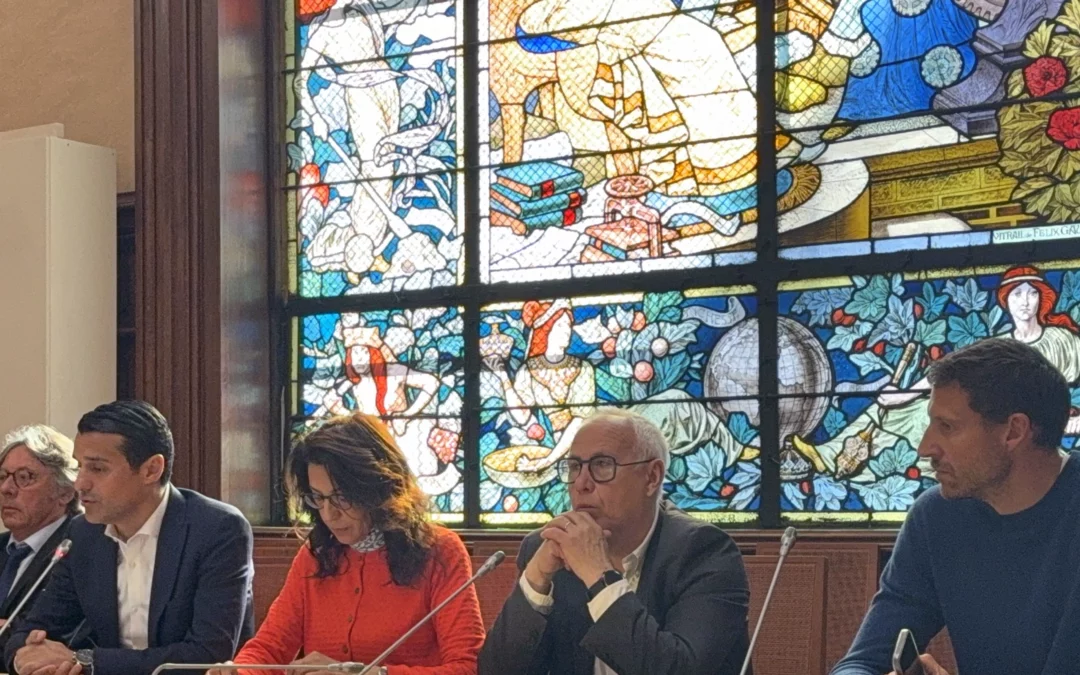
On April 28, 2025, CCCLX was officially unveiled at the CCI Paris during a press conference packed with symbols and commitments. The launch was attended by a number of leading personalities: Soumia Malimbum, President of CCI Paris, Alain Martinez, President of CPME...