


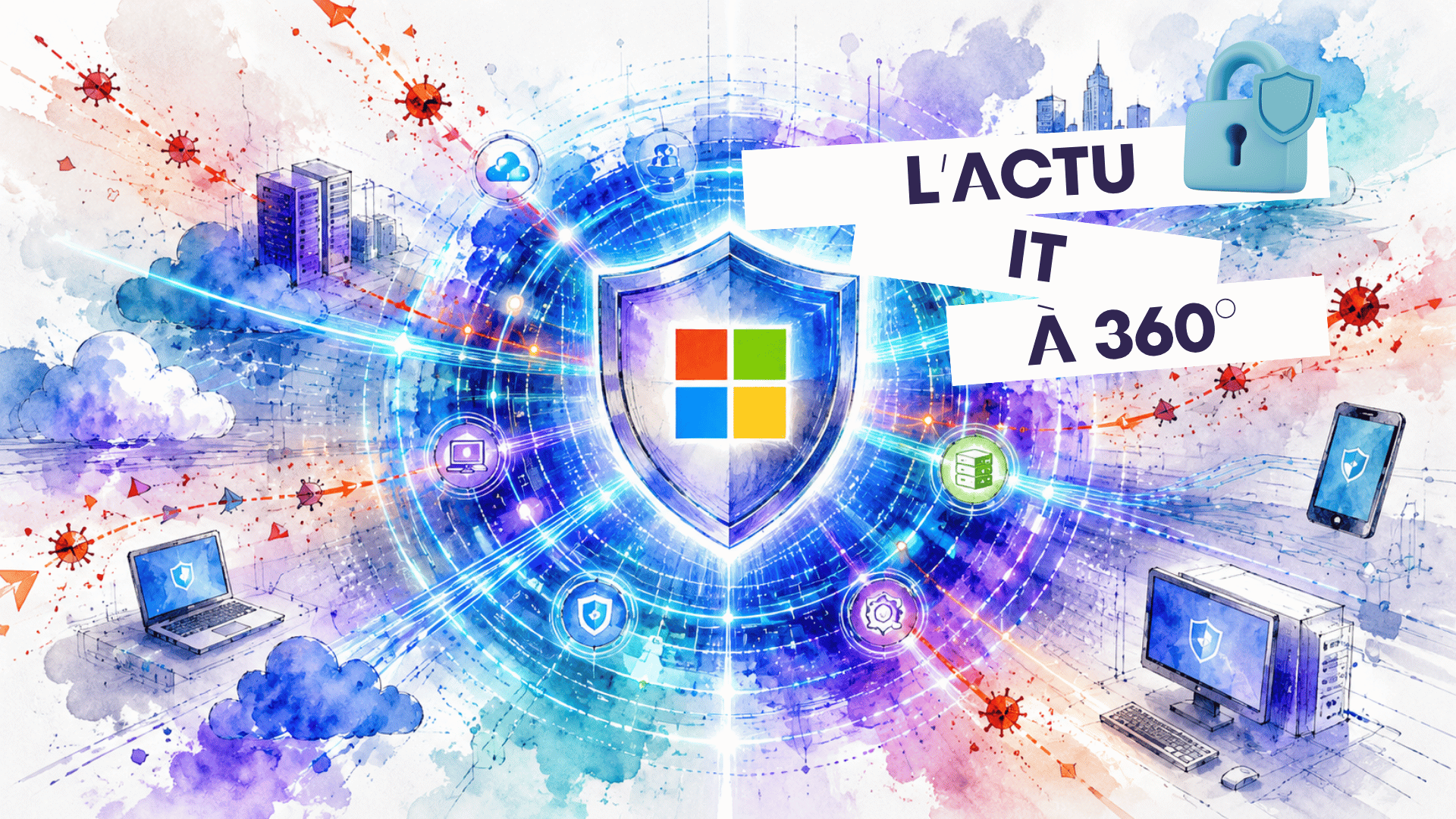
Microsoft wants to regain the upper hand against cyberattacks
Cybercriminals are now using artificial intelligence to discover vulnerabilities, automate their attacks and speed up their malicious campaigns. In response, Microsoft is pressing ahead with its Secure Future Initiative (SFI), a wide-ranging programme launched to strengthen the security of its products, infrastructure and cloud services. In its progress report published on 10 July 2026, the company explains that AI is now becoming a central pillar of its defence strategy, able to help security teams detect, prioritise and remediate threats at a speed comparable to that of attackers.1
Cybersecurity built in by design
With the Secure Future Initiative, Microsoft is no longer content to add protections after software has been developed. The company is seeking to build security into its platforms from the design stage. This approach rests on several priorities: strengthening digital identities, protecting cloud environments, securing critical infrastructure and making automated security checks the norm. The aim is to reduce the time needed to identify a flaw and deploy fixes before it is exploited.1
Artificial intelligence becomes a co-pilot for SOC teams
The report also stresses that security operations centres (SOCs) must now rely on artificial intelligence to cope with the explosion in alert volumes. AI models can analyse millions of events, identify suspicious behaviour, prioritise the most critical incidents and help analysts respond more quickly. Microsoft believes this automation is becoming indispensable to counter attacks that now operate at machine scale.2
Attackers are using AI too
One of the report’s key findings is that artificial intelligence now benefits attackers as much as defenders. Cybercriminals are exploiting advanced models to speed up vulnerability research, produce malicious code or improve their phishing campaigns. This development considerably shortens the time between the discovery of a flaw and its exploitation. For Microsoft, businesses must therefore adopt the same technologies in order to keep their ability to respond to these new threats.2
A strategy that goes beyond Microsoft products alone
The Secure Future Initiative is not just about Windows or Azure. Microsoft wants to extend this approach across its entire ecosystem by strengthening the security of identities, cloud services, workstations, business applications and artificial intelligence tools. This move confirms that cybersecurity is becoming a shared responsibility that involves infrastructure as much as software, users and development processes.3
Cybersecurity evolves in the age of artificial intelligence
This development shows why Cybersecurity is becoming an essential skill. Professionals must no longer simply understand traditional attack techniques. They must also know how to harness artificial intelligence to analyse threats, automate incident detection and strengthen the protection of information systems. Mastering these new tools is becoming essential to protect digital infrastructure effectively.
The race between attackers and defenders is accelerating
With its new report on the Secure Future Initiative, Microsoft confirms that artificial intelligence is profoundly redefining the balance of power in cybersecurity. Organisations able to integrate these technologies into their defence operations will have a decisive advantage against ever faster and more sophisticated cyberattacks. The future of IT security will depend as much on the quality of the algorithms as on that of the infrastructure they protect.
360° IT News — decoding technology to understand the jobs of tomorrow.
Further reading
Using artificial intelligence to strengthen security operations is becoming an underlying trend in the industry. On a related topic, read our article “IBM and OpenAI want to arm businesses against machine-speed cyberattacks”, which shows how AI models are now built directly into cybersecurity workflows to speed up the detection and remediation of vulnerabilities.
References
1. Microsoft. (2026). Secure Future Initiative Progress Report – July 2026.
https://www.microsoft.com/security
2. Microsoft Security. (2026). Secure by Design, Secure by Default, Secure Operations.
https://www.microsoft.com/security
3. Microsoft. (2026). Secure Future Initiative.
https://www.microsoft.com/security/blog
The IT Clinic: when students take care of SMEs’ digital systems
A CCCLX innovation in education and solidarity What if students were to become digital "field doctors"? This is the bold gamble taken by CCCLX with the Clinique de l'IT, an innovative educational program inspired by legal clinics and the model launched in AI by...
Generative AI and the final year project: towards an augmented and responsible PFE
At CCCLX, Artificial Intelligence is not a marginal discipline: it is one of the pillars of the curriculum. This is why, in the fourth year, each student carries out a Final Year Project (FDP ) enriched by generative AI tools. But beyond technical use, the stakes are...
The Diploma Update Guarantee: a lifetime commitment with CCCLX
At CCCLX, ambition doesn't stop at graduation. Because technology is constantly evolving, and because skills become obsolete as quickly as they are acquired, CCCLX has taken a daring gamble: to offer a Diploma Update Guarantee©, a unique system that keeps every...

IT jobs in France: a strategic opportunity for multi-skilled talent
More than 6,000 IT offers analyzed: CCCLX reveals the market's true expectations In a rapidly changing job market, where artificial intelligence and the cloud are redefining standards, CCCLX has conducted an extensive study of over 6,000 job offers published between...