


Proton wants to prove that a high-performing AI can also be private
The artificial intelligence race is no longer played out solely on model performance. User trust and data protection are now becoming major differentiators. With Lumo AI 2.0, Proton is upgrading its intelligent assistant by improving its speed, reasoning capabilities and multimodal features, while maintaining a strong commitment to privacy. The Swiss company thus intends to show that it is possible to use advanced artificial intelligence without giving up control of one’s personal information.1
A more comprehensive artificial intelligence
This new version is no longer limited to text exchanges. Lumo AI 2.0 can now analyse images, generate them from descriptions and draw on web results to enrich its answers with up-to-date information such as news, weather or financial data. Proton is also announcing improved reasoning capabilities for the model, enabling it to better understand complex requests and provide more relevant answers. Users can also choose what information the assistant remembers or forgets in order to personalise their future interactions.1
Privacy becomes a technological selling point
Whereas most players emphasise above all the performance of their models, Proton is focusing on data protection. The company states that its users’ conversations are never used to train future artificial intelligence models. Exchanges are encrypted so that they cannot be viewed, including by Proton itself. This approach is in keeping with the company’s long-standing strategy, already known for its secure email and storage services, in which privacy is central to its offering.2
Europe as a guarantee of digital sovereignty
Another distinctive feature of Lumo AI 2.0 is that its infrastructure relies on servers located in Europe. This choice allows Proton to limit its services’ exposure to certain extraterritorial laws and to meet the requirements of many organisations concerned about where their data is located. The company also offers a dedicated business plan enabling companies to analyse internal documents or use artificial intelligence on sensitive information while maintaining a high level of data protection.2
Companies are now looking for trustworthy AI
The evolution of Lumo AI illustrates an underlying market trend. Organisations no longer choose an artificial intelligence assistant solely on the basis of its speed or the quality of its answers. They also assess how their data is stored, used and protected. Questions of digital sovereignty, regulatory compliance and privacy are gradually becoming as important as the technical performance of models, particularly in sectors that handle sensitive information.3
Ethics becomes a criterion for choosing AI technologies
The development of solutions such as Lumo AI 2.0 shows that ethical and data protection issues are taking on a growing role in artificial intelligence. Understanding data governance mechanisms, privacy principles, applicable regulations and the technology choices that protect users’ information is becoming essential for deploying responsible AI solutions in companies.
The future of AI will also depend on trust
With Lumo AI 2.0, Proton is a reminder that competition between intelligent assistants no longer rests solely on model capabilities. The trust placed in platforms, transparency about how data is used and the ability to protect personal information are becoming decisive factors. As artificial intelligence becomes part of the everyday lives of individuals and businesses alike, privacy could become a competitive advantage as important as performance.
360° IT News — decoding technology to understand the jobs of tomorrow.
Further reading
The evolution of Azure Linux illustrates the rapid transformation of IT infrastructure, which is increasingly geared towards the cloud, distributed environments and artificial intelligence. On a related topic, read our article “The cloud gets ready for autonomous agents: AWS evolves Lambda”, which shows how cloud platforms are also adapting their architectures to new generations of applications driven by AI agents.
References
1. Proton. (2026). Introducing Lumo AI 2.0.
https://proton.me
2. Proton. (2026). Privacy and Security at Proton AI.
https://proton.me
3. European Commission. (2024). AI Act.
https://artificial-intelligence-act.eu
Data centres in space: why Nvidia wants to revolutionise the cloud
News in brief At the GTC 2026 conference, Nvidia announced its intention to accelerate the development of artificial intelligence in space, joining an emerging movement around orbital data centres. The company is no longer content to supply chips for satellites; it is...
Claude Marketplace: what Anthropic’s new platform changes for businesses
News in brief Anthropic has just announced Claude Marketplace, a new platform that allows companies to access, share and use artificial intelligence agents based on its Claude model. The aim is no longer just to offer conversational AI, but to create a genuine...
Automated code review: Anthropic’s Claude now analyses developers’ code
News in brief Artificial intelligence continues to transform developers’ work. Anthropic, the company behind the Claude AI model, has just announced new capabilities that allow its assistant to analyse computer code and help developers with their code review...
Memerist: the free Linux app for creating memes in seconds
News in brief Creating a meme has become an everyday activity on the internet. Humorous images circulate daily on social networks, forums and messaging apps, often used to comment on the news, share an idea or simply make people laugh. Yet producing a meme quickly is...
Microsoft unveils Microsoft 365 E7: Copilot and AI agents at the heart of its enterprise strategy
News in brief Microsoft recently announced Microsoft 365 E7, a new offering for businesses that places artificial intelligence at the heart of the working environment. This development is part of Microsoft’s overall strategy to transform traditional productivity tools...

Global cyber-espionage: the Salt Typhoon affair shows why cybersecurity is becoming crucial
News in brief A vast cyber-espionage operation called Salt Typhoon has reportedly infiltrated several telecom operators around the world. Hacker groups linked to China are believed to be behind these attacks, which can access sensitive communication infrastructure....

CCCLX wins Bronze Trophy at IT Night 2025!
CCCLX, the 360° IT school, was honored at IT Night 2025 - La Nuit de l'Entreprise Numérique, winning the Bronze Trophy in the Schools / Training category. A fine accolade in the context of this emblematic event for the French digital ecosystem, organized annually...

A revolution in higher education financing by aivancity/CCCLX and Umanity
A concrete solution to democratize access to education for the professions of tomorrow This scheme, the only one of its kind in France, complements a series of measures put in place by aivancity to promote diversity and equitable access to its programs (tuition-free...
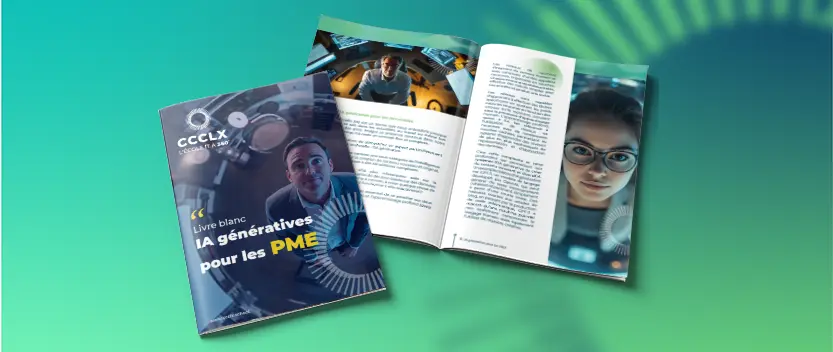
White paper: How generative AI is transforming SMEs
White paper: How generative AI is transforming SMEs In a world where technological innovation is redefining the rules of the game, small and medium-sized businesses have never had so much to gain... or lose. Against this ever-changing backdrop, CCCLX unveils its new...

CCCLX: A new IT school dedicated to SMEs and startups is born
On April 28, 2025, CCCLX was officially unveiled at the CCI Paris during a press conference packed with symbols and commitments. The launch was attended by a number of leading personalities: Soumia Malimbum, President of CCI Paris, Alain Martinez, President of CPME...