


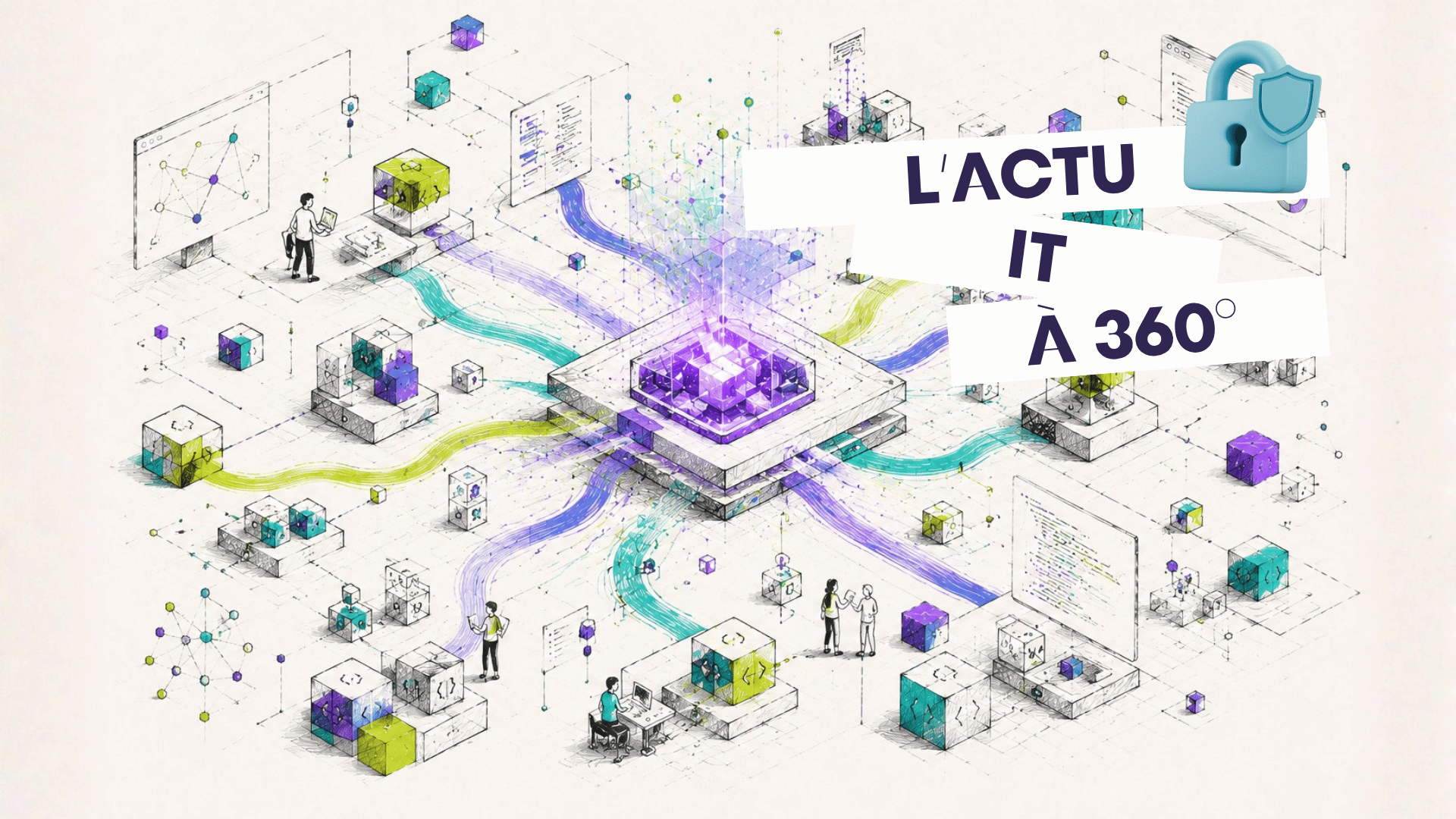
Cyberattacks push IT giants to join forces
Open-source components are present in virtually all modern applications, from cloud platforms to business software. This dependence, however, comes with a growing risk: vulnerabilities are now discovered and exploited much faster thanks to artificial intelligence. To respond to this new reality, IBM, Red Hat and Palo Alto Networks have announced a partnership to strengthen the protection of open-source projects. The aim is to speed up the detection of flaws, secure applications even before official patches are released and improve the resilience of the software supply chain used by businesses.1
Artificial intelligence changes the rules of cybersecurity
Models specialised in cybersecurity can now analyse millions of lines of code in moments and identify vulnerabilities that were previously hard to detect. This development benefits defenders and attackers alike. Companies have less and less time to react, as a flaw can now be exploited just minutes after it is discovered. Traditional patching methods, which relied on sometimes lengthy development cycles, are struggling to keep up with this new pace set by AI.2
Lightwell becomes the core of this strategy
To respond to this acceleration, IBM and Red Hat are relying on the Lightwell project, unveiled a few months earlier. This platform combines artificial intelligence and human expertise to coordinate the validation, testing and deployment of patches across large volumes of open-source software. With this partnership, its scope now extends to commercial software, IoT environments and the various building blocks of the software supply chain. The goal is to let companies quickly integrate validated patches without interrupting their critical applications.1
Palo Alto provides protection even before patches arrive
Palo Alto Networks’ contribution is based mainly on its virtual patching technology, built into the Prisma platform. When a vulnerability is identified, it is not always possible to deploy a software patch to production immediately. Virtual patches then create a temporary layer of protection that blocks exploitation attempts while teams finalise testing and deployment of the official patch. This approach considerably reduces the exposure window and is particularly relevant in the face of AI-automated attacks.3
Cooperation becomes as important as technology
Beyond the technical tools, IBM, Red Hat and Palo Alto want to establish a secure mechanism for sharing vulnerability information. Software vendors, technology suppliers and security teams will be able to exchange data more quickly on detected flaws, observed exploitation attempts and available protective measures. This collaboration should shorten the time between identifying a threat and implementing a coordinated response, which has become essential now that the same open-source components are used by thousands of companies around the world.1
This alliance shows why Cybersecurity has become an essential skill
Protecting information systems is no longer just about securing servers or workstations. Professionals now need to understand how the software supply chain works, analyse open-source dependencies, assess vulnerabilities, prioritise patches and implement protection mechanisms capable of reacting even before an official patch is available. With AI-driven attacks accelerating, cybersecurity is becoming an increasingly cross-functional field, involving developers, system administrators, cloud teams and security experts alike.
Protecting open source becomes a strategic issue
This alliance illustrates a profound shift in the IT industry. Open-source components are no longer mere software building blocks used by developers; they now form the foundations of cloud infrastructure, business applications and artificial intelligence platforms. As cyberattacks gain speed thanks to AI, the ability to detect vulnerabilities quickly, share information and deploy protections is becoming a key resilience factor for businesses.
360° IT News — decoding technology to understand the jobs of tomorrow.
Further reading
Securing open source is part of a wider transformation of cybersecurity, in which companies must protect their applications against increasingly automated attacks. On a related topic, read our article “F5 strengthens its WAF to tackle AI-era cyber threats”, which explains how artificial intelligence improves behavioural detection and speeds up the protection of web applications.
References
1. IBM. (2026). IBM, Red Hat and Palo Alto Networks expand open source security collaboration.
https://www.ibm.com
2. OpenAI. (2026). GPT-5.5-Cyber Technical Overview.
https://openai.com
3. Palo Alto Networks. (2026). Prisma Cloud Virtual Patching.
https://www.paloaltonetworks.com

Data centres in space: why Nvidia wants to revolutionise the cloud
News in brief At the GTC 2026 conference, Nvidia announced its intention to accelerate the development of artificial intelligence in space, joining an emerging movement around orbital data centres. The company is no longer content to supply chips for satellites; it is...

Claude Marketplace: what Anthropic’s new platform changes for businesses
News in brief Anthropic has just announced Claude Marketplace, a new platform that allows companies to access, share and use artificial intelligence agents based on its Claude model. The aim is no longer just to offer conversational AI, but to create a genuine...
Automated code review: Anthropic’s Claude now analyses developers’ code
News in brief Artificial intelligence continues to transform developers’ work. Anthropic, the company behind the Claude AI model, has just announced new capabilities that allow its assistant to analyse computer code and help developers with their code review...
Memerist: the free Linux app for creating memes in seconds
News in brief Creating a meme has become an everyday activity on the internet. Humorous images circulate daily on social networks, forums and messaging apps, often used to comment on the news, share an idea or simply make people laugh. Yet producing a meme quickly is...
Microsoft unveils Microsoft 365 E7: Copilot and AI agents at the heart of its enterprise strategy
News in brief Microsoft recently announced Microsoft 365 E7, a new offering for businesses that places artificial intelligence at the heart of the working environment. This development is part of Microsoft’s overall strategy to transform traditional productivity tools...

Global cyber-espionage: the Salt Typhoon affair shows why cybersecurity is becoming crucial
News in brief A vast cyber-espionage operation called Salt Typhoon has reportedly infiltrated several telecom operators around the world. Hacker groups linked to China are believed to be behind these attacks, which can access sensitive communication infrastructure....

CCCLX wins Bronze Trophy at IT Night 2025!
CCCLX, the 360° IT school, was honored at IT Night 2025 - La Nuit de l'Entreprise Numérique, winning the Bronze Trophy in the Schools / Training category. A fine accolade in the context of this emblematic event for the French digital ecosystem, organized annually...

A revolution in higher education financing by aivancity/CCCLX and Umanity
A concrete solution to democratize access to education for the professions of tomorrow This scheme, the only one of its kind in France, complements a series of measures put in place by aivancity to promote diversity and equitable access to its programs (tuition-free...

White paper: How generative AI is transforming SMEs
White paper: How generative AI is transforming SMEs In a world where technological innovation is redefining the rules of the game, small and medium-sized businesses have never had so much to gain... or lose. Against this ever-changing backdrop, CCCLX unveils its new...

CCCLX: A new IT school dedicated to SMEs and startups is born
On April 28, 2025, CCCLX was officially unveiled at the CCI Paris during a press conference packed with symbols and commitments. The launch was attended by a number of leading personalities: Soumia Malimbum, President of CCI Paris, Alain Martinez, President of CPME...