


AI agents are forcing Google to rethink data architecture
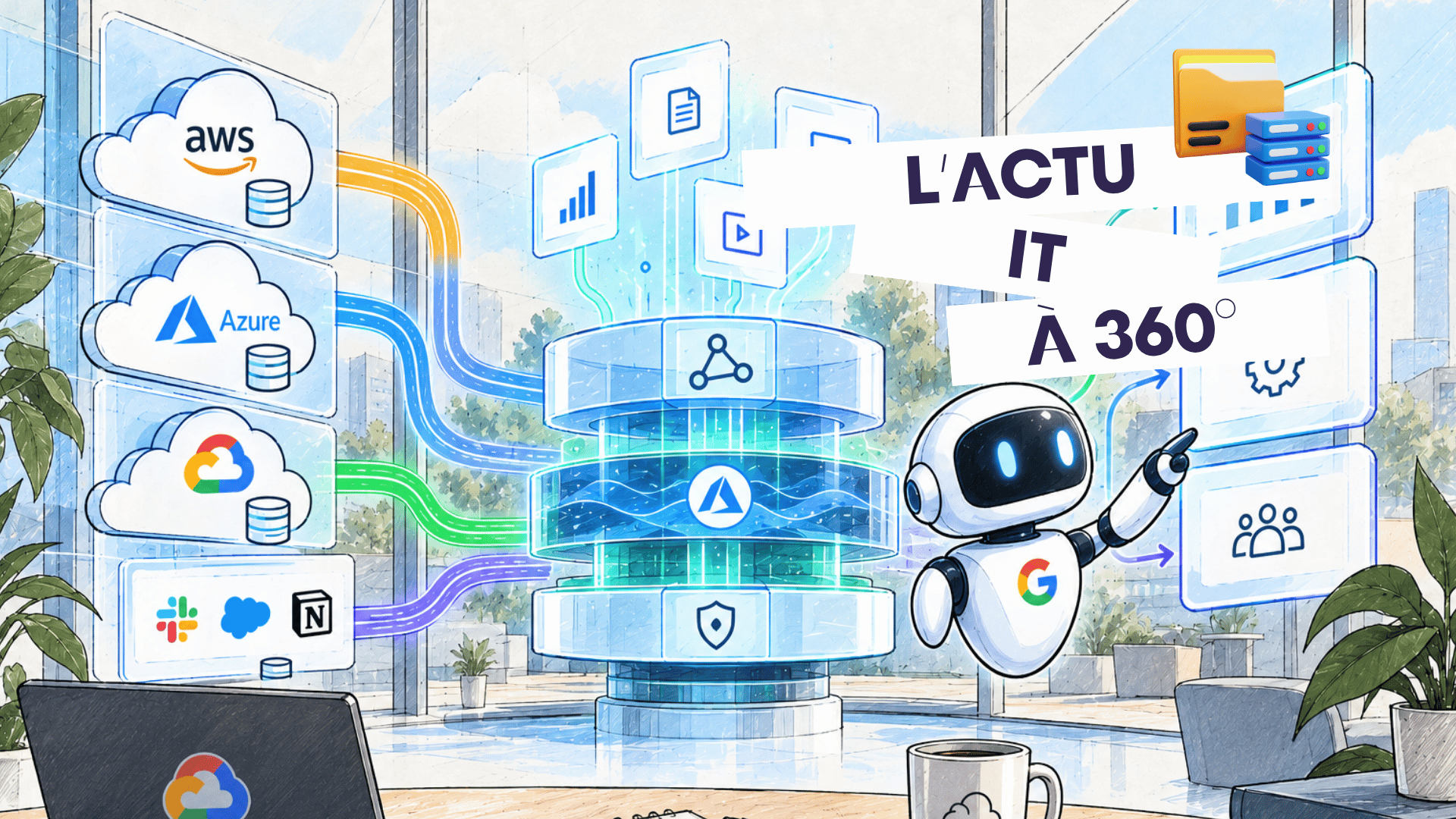
AI agents promise to search for information, make decisions and act directly within company systems, but this autonomy depends on one essential condition: accessing the right data and, above all, understanding its context. Google Cloud is tackling this challenge with its Agentic Data Cloud, an AI-native architecture designed to move traditional data platforms towards what Google calls a “System of Action”, capable of powering agents that perceive, reason and act on the organisation’s information.¹ The stakes therefore go far beyond adding Gemini to a database: Google is seeking to bring together structured and unstructured data, metadata, business rules, governance and analytics engines so that agents can make use of scattered information without having to rebuild its context for every new task.
A Cross-Cloud Lakehouse to fetch data wherever it lives
The first major building block of this architecture is a Cross-Cloud Lakehouse based on Apache Iceberg, an open format that keeps the architecture interoperable rather than locking data into a proprietary environment. Google Cloud wants its engines and agents to be able to access data hosted directly in other clouds, notably AWS and Azure, without first requiring it to be migrated to Google Cloud.² The architecture can federate catalogues such as AWS Glue, Databricks Unity Catalog and Snowflake Horizon, while BigQuery and other engines can query the remote data. This approach is particularly important for large enterprises whose information assets are already spread across several clouds, data warehouses, lakehouses and SaaS applications: asking an agent to act across the organisation assumes it can cross these silos without multiplying copies and ETL pipelines.
Google wants to avoid moving petabytes to feed an AI
This approach also addresses an economic and operational problem. Continuously moving large volumes of data between clouds incurs egress costs, adds latency and forces teams to maintain additional pipelines. For its cross-cloud architecture, Google relies in particular on Cross-Cloud Interconnect, federation of Iceberg catalogues and caching mechanisms to let analytics engines work on remote data without systematically duplicating files.² For an agent, this capability can prove decisive: a complex task may require combining sales data in one environment, operational data in another and information from business applications, sometimes within seconds. Data architecture thus becomes a direct prerequisite for AI autonomy.
The Knowledge Catalog aims to give meaning to company data
Yet accessing all the data is not enough. An agent may find a column called “margin” without knowing whether it refers to gross, net or forecast margin, or one calculated according to a rule specific to the company. This is precisely the role of the Knowledge Catalog, an evolution of Dataplex Universal Catalog, which Google presents as a universal context engine for agents.¹ It aggregates metadata from Google Cloud environments and partner platforms, continuously enriches its meaning based on usage and uses Gemini in particular to extract meaning from unstructured content and generate some missing semantic information. Google also links this layer to Looker, LookML and BigQuery Measures to incorporate more business logic into the context available to agents. The aim is to turn the traditional data catalogue, long used to inventory and govern assets, into an active layer that enables AI to understand what it is handling.
Governance becomes part of the agent’s reasoning
This contextualisation must also respect access rights. Google states that Knowledge Catalog search takes access controls into account, so that an agent can only find and use the assets it is authorised to access.¹ This is essential as agents begin to go beyond simple text generation and take part in operations: an AI tasked with analysing sales should not automatically gain access to HR files or confidential financial information simply because that data sits in the same lakehouse. Governance must therefore follow information from its discovery to its use by the agent, covering aspects such as quality, lineage, permissions and business meaning. The Agentic Data Cloud thus brings together two disciplines that have long been treated separately: data governance and AI system governance.
Without reliable context, an agent remains blind
This development directly transforms Data Management. Data engineers and data professionals no longer simply prepare tables for analysts, dashboards or machine learning models: they must now build information that is reliable and contextualised enough for an agent to interpret it without constant human intervention. Data quality, metadata, semantic models, cataloguing, lineage and access policies therefore become integral parts of the AI’s reasoning. A poor business definition or outdated data can now cause not only a flawed analysis but also a wrong action, if the agent uses that information to trigger an operation automatically. In the agentic enterprise, the quality of the AI’s decisions depends directly on the quality of the data architecture that feeds it.
The battle of the agents is also a battle of data architectures
Google is therefore no longer simply trying to offer better-performing models. With the Agentic Data Cloud, the group wants to control a much larger part of the chain linking information to action: storage, databases, lakehouse, analytics, business context, search, governance, Gemini models and the agentic platform. This strategy reflects a significant shift in the market: companies may find that their difficulties in industrialising agents stem less from model capabilities than from data that is fragmented, poorly documented or hard to connect to AI systems. A Google Cloud study published in 2026 indeed found that 43% of IT leaders surveyed see difficulties integrating with legacy APIs and data sources as their main infrastructure gap for agentic AI.³
The next critical infrastructure could be the one that gives AI context
Ultimately, the Agentic Data Cloud shows that the age of agents will not simply be about multiplying autonomous assistants. For an agent to manage a sales process, analyse a supply chain or work within a business application, it needs to know where the information is, what it means, whether it is reliable enough and whether it has the right to use it. The Cross-Cloud Lakehouse addresses the problem of accessing distributed data, while the Knowledge Catalog seeks to provide the layer of context and governance needed to interpret it. Google Cloud is thus betting on a simple yet far-reaching idea: in the next phase of enterprise AI, the advantage may not go only to whoever has the best agent, but to whoever can supply it with the most reliable data and the most precise business context.
360° IT News — decoding technology to understand the jobs of tomorrow.
Further reading
This development extends a transformation already visible in modern data architectures. Read our CCCLX article “ AWS strengthens OpenSearch to connect AI to enterprise data ”, which looks at another central challenge of professional AI: enabling models and intelligent applications to find and make effective use of information scattered across the organisation’s systems.
References
1. Google Cloud. (2026). What's new in the Agentic Data Cloud: Powering the System of Action.
https://cloud.google.com/blog/products/data-analytics/whats-new-in-the-agentic-data-cloud
2. Google Cloud. (2026). The future of data lakehouse: Open and interoperable for the agentic era.
https://cloud.google.com/blog/products/data-analytics/the-future-of-data-lakehouse-for-the-agentic-era
3. Google Cloud. (2026). State of AI infrastructure report and the Agentic Data Cloud.
https://cloud.google.com/blog/topics/ai-infrastructure/state-of-ai-infrastructure-report-and-the-agentic-data-cloud
4. Google Cloud. (2026). About cross-cloud data access.
https://docs.cloud.google.com/lakehouse/docs/about-cross-cloud-data-access
ServiceNow wants to turn process improvement into a continuous AI-driven loop
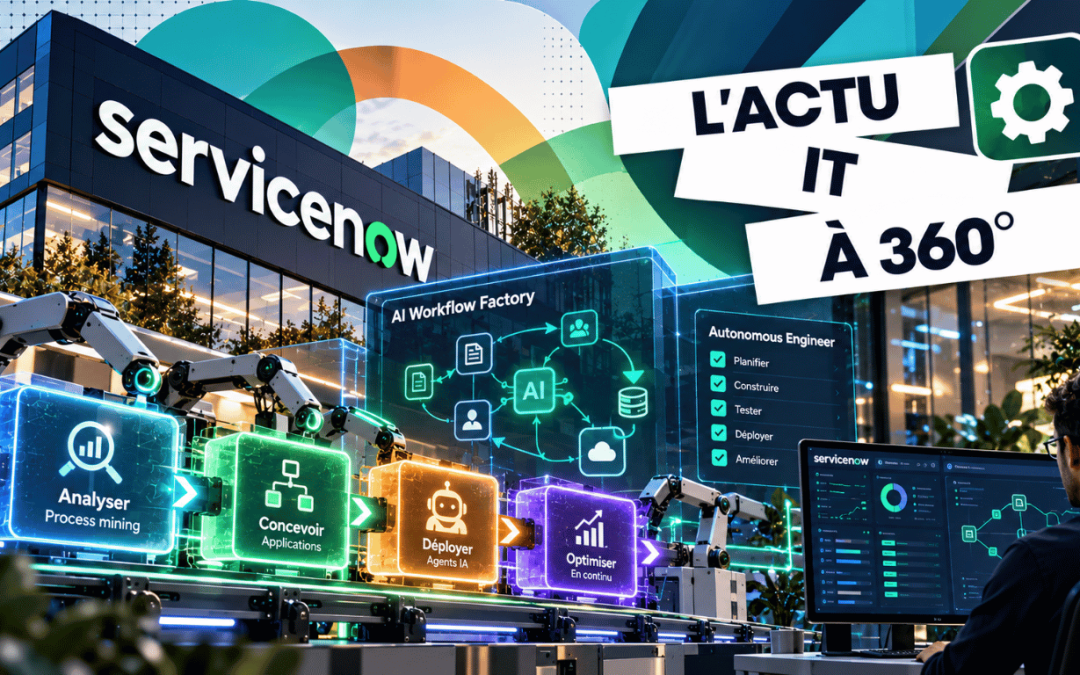
With AI Workflow Factory, ServiceNow aims to link the identification of inefficient processes with building and running their improvements. The announcement notably includes Autonomous Engineer, a tool designed to automate more of the implementation work.[1] For...
Mistral Large 4: what its trillion-parameter model could change for businesses
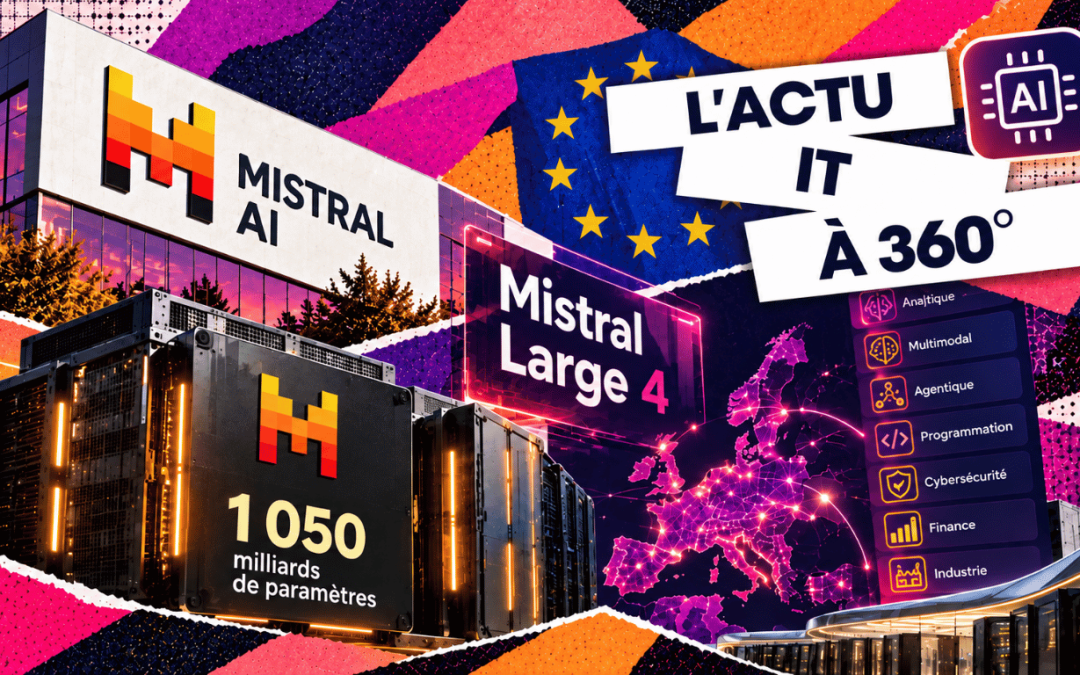
Mistral has opened the public preview of Mistral Large 4, nicknamed “Le Chonk”, and plans to release its weights by the end of the month.[1] This European model targets agentic use cases in particular, as well as cybersecurity, finance and industry. For businesses,...
IBM Bob: developing with AI without your code leaving the company
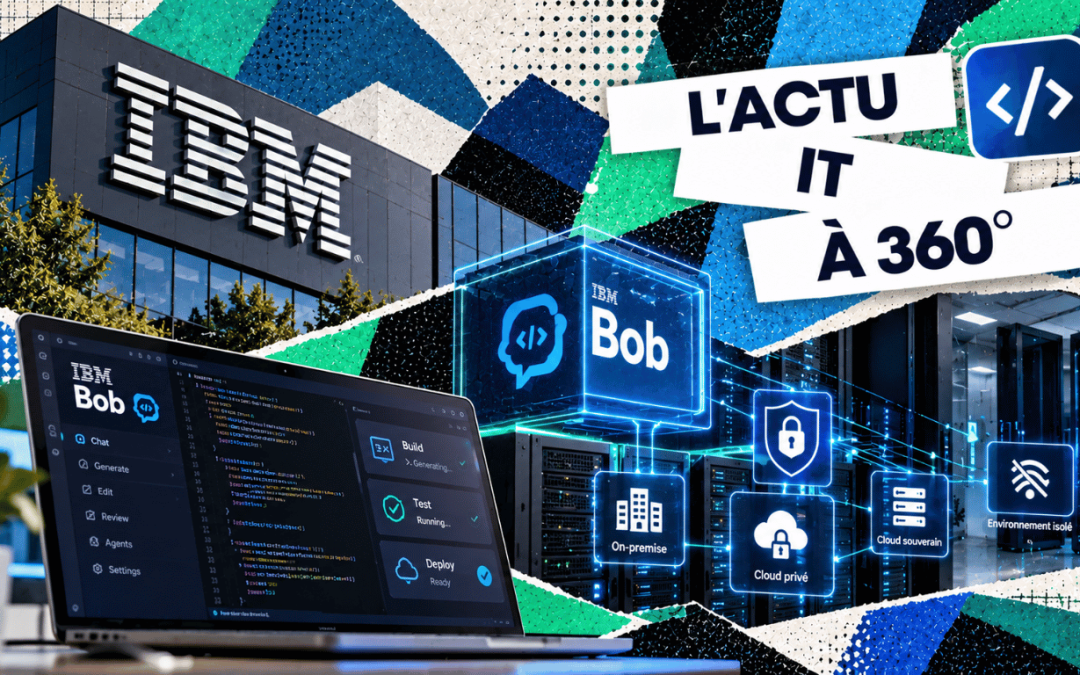
IIBM has announced a self-hosted version of Bob, its agentic development platform, for internal infrastructure, private or sovereign clouds and environments isolated from the internet.[1] This option addresses a concrete obstacle: some applications contain code, data...

HPE is preparing a network that anticipates incidents and automates certain interventions
HPE plans to deploy a Self-Driving Network for the 2027 Ryder Cup, with Wi-Fi 7 and an operations centre bringing together data and AI tools.[1] The stated aim is to monitor usage, adapt the network and move towards autonomous interventions. For businesses, the...
Can your AI agent really defend your company? Hack The Box puts its skills to the test
Hack The Box is launching AI Range Enterprise Edition to let security teams assess their own AI agents on the roles assigned to them.[1] For businesses, the stakes are concrete: having evidence before delegating a task, then checking that this evidence remains valid...
VAST Data wants AI to work with sensitive data in a protected environment
VAST Data has unveiled DataEnclave, a confidential execution capability designed to bring artificial intelligence models closer to companies’ sensitive data. Presented as a preview, it is due to go on sale in the first quarter of 2027.[1] The aim is to make certain...
Databricks buys Row Zero to bring spreadsheets closer to governed data
Databricks has announced the acquisition of Row Zero and plans to integrate its spreadsheet experience into Genie.[1] The aim is to let business teams explore data in a familiar interface, with greater control over access and usage. For companies, the challenge is to...
Google Cloud takes its X5 instances to 48 TB for large SAP databases
Google Cloud has announced the general availability of the X5 series, which raises the maximum advertised memory capacity on a single node to 48 TB, compared with 32 TB for X4.[1] Aimed in particular at very large SAP HANA databases, the offering is based on bare...
Cloud Storage: Google automates the detection of anomalies
A rise in reads, cross-region transfers or stored volume can inflate the cloud bill and disrupt applications. With Storage Intelligence advisor, Google offers a view of unusual changes in Cloud Storage, along with leads for investigating them. For businesses, the...
AI voice agents: Oracle details a LiveKit architecture on OCI
Oracle has described an architecture that pairs the LiveKit Agents framework with Oracle Cloud Infrastructure to automate real-time voice calls. The design links telephony, AI models and business services, while placing internal components in private subnets. For...