


AI agents raise a new problem: how much does a task really cost?
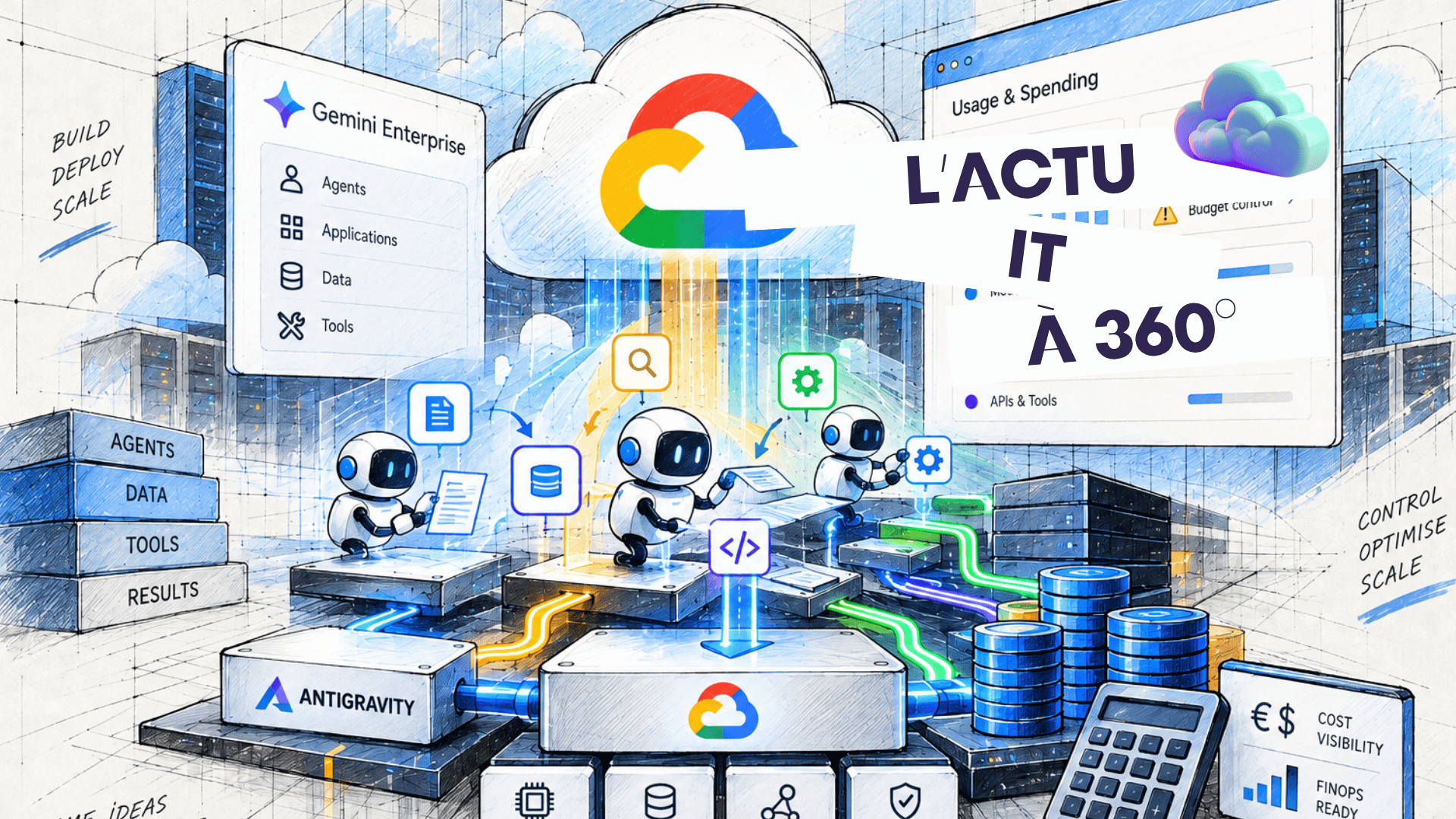
As companies move from chatbots to AI agents able to work through multiple steps, the question of cost becomes much more complex. A chatbot generally handles a request and generates an answer, whereas an agent may query several models, search for data, call APIs, use tools, keep a memory and repeat certain operations before reaching its goal. Google Cloud wants to make this consumption more predictable with new billing and spending control options for agentic workloads in Gemini Enterprise, as well as for developer tools such as Google Antigravity.¹ The aim is clear: to let companies give their agents more autonomy without discovering too late that this autonomy comes with a bill that is hard to anticipate.
Google introduces more flexible billing for Gemini Enterprise
The first change directly concerns Gemini Enterprise’s business model. Until now largely structured around per-user licences with pooled quotas, the service is gaining a pay-as-you-go option that lets agentic workloads keep running without interrupting a task when the included quota is reached.¹ Organisations can also combine this on-demand consumption with their existing subscriptions, an approach designed for uses whose intensity can vary greatly from one project to another. This flexibility reflects a fundamental feature of agentic AI: two users with the same tool can generate very different consumption depending on the length of the tasks given to their agents, the number of tools used and the amount of reasoning required.
A monthly cap to stop an agent from exceeding the budget
Above all, Google is adding mechanisms that let IT and finance teams regain control over this consumption. Administrators can view spending and how it evolves in the Usage & Spending area of Gemini Enterprise, with a breakdown between the Gemini Enterprise application, the agent platform and development tools such as Antigravity.² They can also set a monthly spending limit at project level: once this cap is reached, usage billed as overage is automatically stopped.³ The principle brings the operation of AI agents directly in line with FinOps practices already applied to the cloud, with centralised visibility of consumption and safeguards designed to prevent an experiment or a particularly intensive workflow from turning a small budget line into uncontrolled spending.
Antigravity also puts the cost of agentic development under scrutiny
Developers are directly affected, since Google Antigravity, Google’s agentic environment for software development, is integrated into Gemini Enterprise’s AI tools. Google explains that administrators can thus manage spending, usage metrics, security and observability of developer tools in a single environment, rather than juggling multiple licences and billing consoles.⁴ This centralisation becomes particularly relevant when development agents can explore a codebase, modify several files, run tests and pursue a task over a long period: a single human instruction may hide numerous model calls and intermediate operations. The challenge is therefore no longer just knowing the price of a coding assistant subscription, but measuring what it really costs to run the workflows it automates.
Tokens, memory, sessions, tools: an agent’s bill becomes multidimensional
Above all, Google Cloud’s pricing model shows that an agent’s cost can no longer be reduced to the tokens consumed by its model. The platform can also charge for resources linked to its memory, sessions, storage and API calls. Since 1 September 2026, for example, Memory Bank has been billed according to the volume stored and the operations performed, while the tokens used to generate memories and embeddings are still billed separately. The Sessions and Skill Registry services also follow pricing that combines storage with read or write operations.⁵ An autonomous agent can therefore generate several layers of consumption at once: model reasoning, retaining its state, retrieving information, calling tools and the infrastructure needed to run it. For FinOps teams, tracking only the number of tokens therefore risks giving an incomplete view of the real cost of an agentic workflow.
With agents, every decision can carry a cloud cost
This transformation gives Cloud Computing a new dimension. Professionals responsible for designing and running AI architectures now need to understand how an agentic workflow consumes the various cloud resources, identify the most expensive steps and set limits in line with the value actually produced. An extremely powerful model is not necessarily the best choice for every operation: a simple task can be handed to a cheaper model, while a more powerful model is reserved for steps requiring more reasoning. Likewise, an agent’s memory, how long its sessions are kept or the number of calls to its tools can all be optimised. Cloud skills are thus moving closer to FinOps, with a new objective: no longer simply sizing an infrastructure, but building agents capable of producing enough value to justify every resource they consume.
Cost per task could replace cost per token
This development could ultimately change the indicators used to assess the economics of AI. Comparing the price of a million tokens remains useful, but becomes insufficient when an agent may carry out a variable sequence of operations to complete a single mission. Two agents using the same model can have radically different costs depending on their orchestration, their memory, the number of calls to their tools or their ability to avoid unnecessary steps. Google Cloud is therefore pushing companies towards a logic closer to cost per workflow or per result achieved, with tools to track spending and keep it in check before it becomes a problem. As agents move from experiments to deployments involving thousands of employees, this financial discipline could become as important as their accuracy or autonomy.
After the race for agents, the race for their profitability begins
Google Cloud’s new controls ultimately show that agentic AI is entering a more industrial phase. Companies no longer just want to know whether an agent can carry out a task; they need to determine how much that task costs when it is repeated thousands of times and how to prevent autonomous workflows from consuming more resources than planned. Visibility over spending, budget caps and flexible billing models are therefore becoming essential building blocks of agentic platforms. Having sought to make agents smarter and more autonomous, cloud providers are now starting to answer another equally strategic question: how can they be made economically sustainable at scale?
360° IT News — decoding technology to understand the jobs of tomorrow.
Further reading
The question of agent costs did not start with Google Cloud. Read our CCCLX article “The token war begins: Headroom wants to make AI less expensive”, which analyses how optimising context and token consumption can reduce the running cost of AI systems, another lever that complements the FinOps mechanisms now offered by cloud platforms.
References
1. Google Cloud. (2026). FinOps for the AI era: New flexible billing and cost controls for agents.
https://cloud.google.com/blog/products/ai-machine-learning/flexible-billing-and-cost-controls-for-agents-on-google-cloud
2. Google Cloud. (2026). View costs in Gemini Enterprise.
https://docs.cloud.google.com/gemini/enterprise/docs/view-costs
3. Google Cloud. (2026). Overview of overages and spend controls.
https://docs.cloud.google.com/gemini/enterprise/docs/manage-costs-overview
4. Google Cloud. (2026). Expanding Google Antigravity for enterprise customers.
https://cloud.google.com/blog/products/ai-machine-learning/expanding-google-antigravity-for-enterprise-customers
5. Google Cloud. (2026). Gemini Enterprise Agent Platform pricing.
https://cloud.google.com/products/gemini-enterprise-agent-platform/pricing

Data centres in space: why Nvidia wants to revolutionise the cloud
News in brief At the GTC 2026 conference, Nvidia announced its intention to accelerate the development of artificial intelligence in space, joining an emerging movement around orbital data centres. The company is no longer content to supply chips for satellites; it is...

Claude Marketplace: what Anthropic’s new platform changes for businesses
News in brief Anthropic has just announced Claude Marketplace, a new platform that allows companies to access, share and use artificial intelligence agents based on its Claude model. The aim is no longer just to offer conversational AI, but to create a genuine...

Automated code review: Anthropic’s Claude now analyses developers’ code
News in brief Artificial intelligence continues to transform developers’ work. Anthropic, the company behind the Claude AI model, has just announced new capabilities that allow its assistant to analyse computer code and help developers with their code review...

Memerist: the free Linux app for creating memes in seconds
News in brief Creating a meme has become an everyday activity on the internet. Humorous images circulate daily on social networks, forums and messaging apps, often used to comment on the news, share an idea or simply make people laugh. Yet producing a meme quickly is...

Microsoft unveils Microsoft 365 E7: Copilot and AI agents at the heart of its enterprise strategy
News in brief Microsoft recently announced Microsoft 365 E7, a new offering for businesses that places artificial intelligence at the heart of the working environment. This development is part of Microsoft’s overall strategy to transform traditional productivity tools...

Global cyber-espionage: the Salt Typhoon affair shows why cybersecurity is becoming crucial
News in brief A vast cyber-espionage operation called Salt Typhoon has reportedly infiltrated several telecom operators around the world. Hacker groups linked to China are believed to be behind these attacks, which can access sensitive communication infrastructure....

CCCLX wins Bronze Trophy at IT Night 2025!
CCCLX, the 360° IT school, was honored at IT Night 2025 - La Nuit de l'Entreprise Numérique, winning the Bronze Trophy in the Schools / Training category. A fine accolade in the context of this emblematic event for the French digital ecosystem, organized annually...

A revolution in higher education financing by aivancity/CCCLX and Umanity
A concrete solution to democratize access to education for the professions of tomorrow This scheme, the only one of its kind in France, complements a series of measures put in place by aivancity to promote diversity and equitable access to its programs (tuition-free...

White paper: How generative AI is transforming SMEs
White paper: How generative AI is transforming SMEs In a world where technological innovation is redefining the rules of the game, small and medium-sized businesses have never had so much to gain... or lose. Against this ever-changing backdrop, CCCLX unveils its new...

CCCLX: A new IT school dedicated to SMEs and startups is born
On April 28, 2025, CCCLX was officially unveiled at the CCI Paris during a press conference packed with symbols and commitments. The launch was attended by a number of leading personalities: Soumia Malimbum, President of CCI Paris, Alain Martinez, President of CPME...