



A spectacular raise for a start-up barely out of the shadows
Two months after emerging from stealth mode, River AI has just completed one of the most spectacular funding rounds of the year in artificial intelligence. The start-up founded by Igor Babuschkin, a former co-founder of xAI who also worked at DeepMind and OpenAI, has raised $1.1 billion through seed and Series A rounds. The operation was led by General Catalyst and AMP PBC, with strategic participation from Nvidia, AMD Ventures, Y Combinator and Temasek.¹ River AI was incorporated in April 2026 before coming out of stealth mode in June, which makes the speed and scale of this raise particularly remarkable.
Behind the billion, a different vision of artificial intelligence
River AI does not simply want to add yet another model to the long list of AI systems on the market. The company advocates an approach in which organisations and users can train, customise and run their own models, rather than relying exclusively on proprietary systems controlled by a handful of large labs. Its first product, River API, makes it possible to customise open-weight models and carry out reinforcement learning without a dedicated machine learning infrastructure team.² River claims it can complete some complex training runs in 15 to 20 minutes and cites costs two to four times lower than comparable proprietary solutions, although these performance figures remain the company’s own claims.
Nvidia and AMD bet on a more open AI
The presence of both Nvidia and AMD Ventures among the investors is particularly telling. The two groups are at the heart of the global battle to supply the accelerators needed to train and run artificial intelligence models, while River AI aims precisely to build a platform covering a large part of this technology chain. The start-up wants to give companies greater control over models, the data used to customise them and their deployment.³ For chipmakers, backing this kind of player is also a way of supporting the emergence of new uses likely to drive lasting growth in demand for computing capacity.
Investors now fund visions before empires
Above all, the River AI case illustrates the dramatic shift in artificial intelligence funding. In May 2026, when the company was still extremely young, talks were already reported about a raise of up to one billion dollars at a valuation of up to 5 billion. Forbes then described River AI as part of a new wave of “neolabs”: companies founded by renowned researchers and able to raise considerable sums to pursue ambitious research projects even before building a commercial business comparable to that of traditional technology companies.⁴ Igor Babuschkin’s background, having worked at DeepMind and OpenAI before helping to create xAI, therefore plays a central role in the confidence placed in the project.
Customised AI becomes the next battleground
River AI is betting on a major shift in the market: companies may gradually want more than access to a general-purpose model delivered as a service. They may seek AI tailored to their data, their business lines and their own rules, while retaining more control over how it works. The start-up thus wants to enable organisations to build and improve open models that precisely match their needs. This vision pits River AI against an industry dominated by OpenAI, Anthropic, Google and Meta, but with a different proposition: giving more control to those who use and train artificial intelligence.
Training and customising models becomes a new technical challenge
This news particularly highlights Generative Artificial Intelligence and the skills needed to adapt it to professional contexts. If companies gradually move from general-purpose models to systems customised on their own data, IT professionals will need to understand fine-tuning, reinforcement learning, open-weight models, deployment and performance evaluation. It will no longer be enough to know how to use generative AI: they will also need to understand how to specialise it, integrate it into an information system and control its behaviour, all skills that are growing in importance as AI becomes genuine business infrastructure.
$1.1 billion to bet on the post-ChatGPT era
River AI’s raise shows just how far investors are already anticipating the next stage of the market. After an initial period dominated by large general-purpose models available to all, a new battle could be fought over customisable models, agents and the infrastructure that lets companies take back control of their artificial intelligence. River AI still has to turn this ambition and its exceptional funding into widely adopted products, but raising $1.1 billion just a few months after its creation shows that, in AI, investors are now prepared to fund very early the players they believe can build the next generation of platforms.
360° IT News — decoding technology to understand the jobs of tomorrow.
Further reading
The competition around artificial intelligence is also being played out in the tools that turn models into practical applications. Read our article “OpenAI bets on modular AI with Sol, Terra and Luna”, on how OpenAI is segmenting its new generation of models according to users’ uses and needs.
References
1. River AI. (2026). River AI announces $1.1 billion in funding.
https://river.ai
2. SiliconANGLE. (2026). Personalized AI startup River AI raises $1.1B.
https://siliconangle.com
3. Tech Funding News. (2026). xAI co-founder raises $1.1B for River AI to build an open AI stack.
https://techfundingnews.com
4. Forbes. (2026). xAI Cofounder Igor Babuschkin In Talks To Raise Up To $1 Billion For A New AI Startup.
https://www.forbes.com

Data centre boom: Legrand goes on the offensive in China and the UK
Data centres are becoming the heart of the global digital economy Legrand is stepping up its investments in China and the United Kingdom to strengthen its presence in the data centre sector, which has become critical infrastructure for the digital economy. This...

GPT-5.4-Cyber: OpenAI responds to Claude Mythos in the AI cybersecurity battle
A new front line in the artificial intelligence war On 14 April 2026, OpenAI launched GPT-5.4-Cyber, a model specialising in cybersecurity, just days after Anthropic announced Claude Mythos. This timing is no coincidence: it marks an acceleration in the competition...

Claude Mythos: beyond the buzz, what are the real stakes for IT security?
An AI that promises to transform cybersecurity With Claude Mythos, Anthropic is showcasing a new generation of artificial intelligence able to analyse, detect and anticipate cybersecurity threats. At a time when cyberattacks are soaring, with more than 2,200 attacks a...

Microsoft reinvents development with AI agents in VS Code
Software development enters the age of agents Microsoft is taking a new step by integrating artificial intelligence agents into Visual Studio Code, with a beta version available via the Insiders channel. This development comes at a time when VS Code is used by more...

In the cloud era, enterprise networks are changing standards
The network is no longer just support: it is becoming a driver of performance For a long time, the enterprise network was regarded as a simple technical infrastructure, often invisible as long as it worked. But with the explosion of the cloud, SaaS applications and...

Windows 11: Microsoft wants to speed up user testing with Insider
Software testing becomes a lever for innovation Microsoft is overhauling its Windows Insider programme, which now brings together more than 10 million testers worldwide, to simplify access to experimental versions of Windows 11 and speed up user feedback. In an...

51,600 satellites: Jeff Bezos steps up the battle for the global internet
News in brief With Project Kuiper, Jeff Bezos is committing Amazon to a major transformation of the world’s internet infrastructure by deploying tens of thousands of satellites in low Earth orbit. The goal is not limited to connecting isolated areas, but to building a...
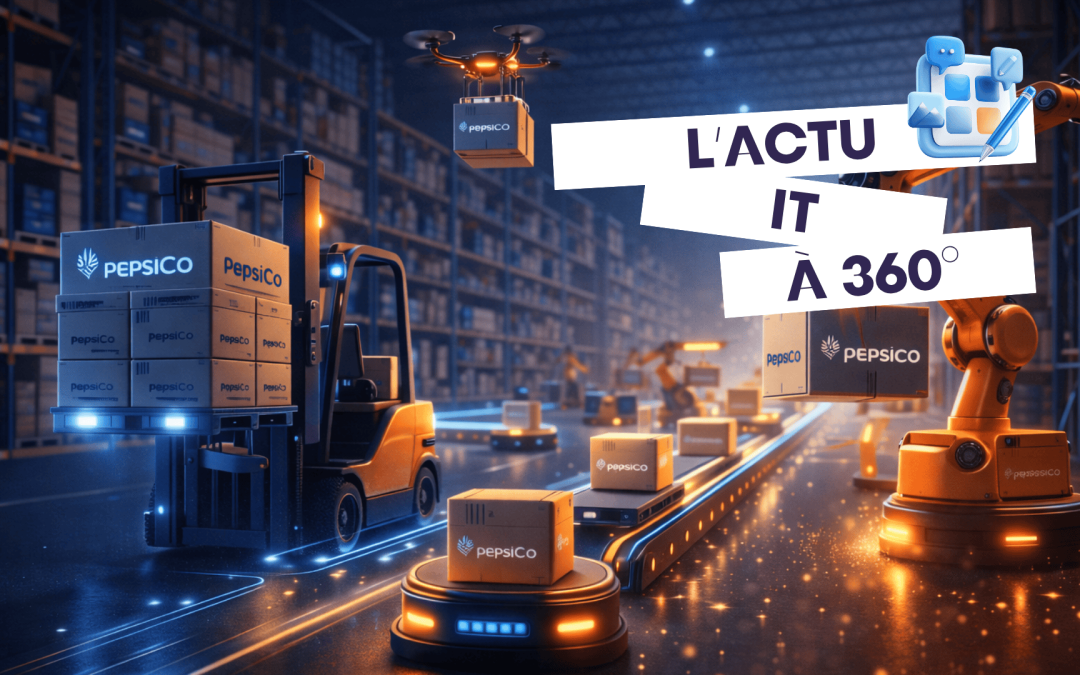
PepsiCo automates its logistics: a turning point for smart warehouses
News in brief PepsiCo France is investing in an automated, multimodal warehouse that combines robotics, digital systems and intelligent management of logistics flows. The aim is no longer simply to store and distribute products, but to turn the warehouse into a...

Windows 11: Microsoft finally relaxes forced updates
News in brief Microsoft is preparing to overhaul the way updates are managed in Windows 11, giving users greater control over their installation, notably by making it easier to postpone them or avoid certain enforced interruptions. This change responds to a...

WeChat goes autonomous AI: Tencent steps up with OpenClaw
News in brief Tencent has just integrated OpenClaw into WeChat, turning the app into far more than a simple communication tool. This development introduces agents capable of carrying out tasks directly from the interface, without going through several applications or...