



A spectacular raise for a start-up barely out of the shadows
Two months after emerging from stealth mode, River AI has just completed one of the most spectacular funding rounds of the year in artificial intelligence. The start-up founded by Igor Babuschkin, a former co-founder of xAI who also worked at DeepMind and OpenAI, has raised $1.1 billion through seed and Series A rounds. The operation was led by General Catalyst and AMP PBC, with strategic participation from Nvidia, AMD Ventures, Y Combinator and Temasek.¹ River AI was incorporated in April 2026 before coming out of stealth mode in June, which makes the speed and scale of this raise particularly remarkable.
Behind the billion, a different vision of artificial intelligence
River AI does not simply want to add yet another model to the long list of AI systems on the market. The company advocates an approach in which organisations and users can train, customise and run their own models, rather than relying exclusively on proprietary systems controlled by a handful of large labs. Its first product, River API, makes it possible to customise open-weight models and carry out reinforcement learning without a dedicated machine learning infrastructure team.² River claims it can complete some complex training runs in 15 to 20 minutes and cites costs two to four times lower than comparable proprietary solutions, although these performance figures remain the company’s own claims.
Nvidia and AMD bet on a more open AI
The presence of both Nvidia and AMD Ventures among the investors is particularly telling. The two groups are at the heart of the global battle to supply the accelerators needed to train and run artificial intelligence models, while River AI aims precisely to build a platform covering a large part of this technology chain. The start-up wants to give companies greater control over models, the data used to customise them and their deployment.³ For chipmakers, backing this kind of player is also a way of supporting the emergence of new uses likely to drive lasting growth in demand for computing capacity.
Investors now fund visions before empires
Above all, the River AI case illustrates the dramatic shift in artificial intelligence funding. In May 2026, when the company was still extremely young, talks were already reported about a raise of up to one billion dollars at a valuation of up to 5 billion. Forbes then described River AI as part of a new wave of “neolabs”: companies founded by renowned researchers and able to raise considerable sums to pursue ambitious research projects even before building a commercial business comparable to that of traditional technology companies.⁴ Igor Babuschkin’s background, having worked at DeepMind and OpenAI before helping to create xAI, therefore plays a central role in the confidence placed in the project.
Customised AI becomes the next battleground
River AI is betting on a major shift in the market: companies may gradually want more than access to a general-purpose model delivered as a service. They may seek AI tailored to their data, their business lines and their own rules, while retaining more control over how it works. The start-up thus wants to enable organisations to build and improve open models that precisely match their needs. This vision pits River AI against an industry dominated by OpenAI, Anthropic, Google and Meta, but with a different proposition: giving more control to those who use and train artificial intelligence.
Training and customising models becomes a new technical challenge
This news particularly highlights Generative Artificial Intelligence and the skills needed to adapt it to professional contexts. If companies gradually move from general-purpose models to systems customised on their own data, IT professionals will need to understand fine-tuning, reinforcement learning, open-weight models, deployment and performance evaluation. It will no longer be enough to know how to use generative AI: they will also need to understand how to specialise it, integrate it into an information system and control its behaviour, all skills that are growing in importance as AI becomes genuine business infrastructure.
$1.1 billion to bet on the post-ChatGPT era
River AI’s raise shows just how far investors are already anticipating the next stage of the market. After an initial period dominated by large general-purpose models available to all, a new battle could be fought over customisable models, agents and the infrastructure that lets companies take back control of their artificial intelligence. River AI still has to turn this ambition and its exceptional funding into widely adopted products, but raising $1.1 billion just a few months after its creation shows that, in AI, investors are now prepared to fund very early the players they believe can build the next generation of platforms.
360° IT News — decoding technology to understand the jobs of tomorrow.
Further reading
The competition around artificial intelligence is also being played out in the tools that turn models into practical applications. Read our article “OpenAI bets on modular AI with Sol, Terra and Luna”, on how OpenAI is segmenting its new generation of models according to users’ uses and needs.
References
1. River AI. (2026). River AI announces $1.1 billion in funding.
https://river.ai
2. SiliconANGLE. (2026). Personalized AI startup River AI raises $1.1B.
https://siliconangle.com
3. Tech Funding News. (2026). xAI co-founder raises $1.1B for River AI to build an open AI stack.
https://techfundingnews.com
4. Forbes. (2026). xAI Cofounder Igor Babuschkin In Talks To Raise Up To $1 Billion For A New AI Startup.
https://www.forbes.com

ServiceNow wants to turn process improvement into a continuous AI-driven loop
With AI Workflow Factory, ServiceNow aims to link the identification of inefficient processes with building and running their improvements. The announcement notably includes Autonomous Engineer, a tool designed to automate more of the implementation work.[1] For...

Mistral Large 4: what its trillion-parameter model could change for businesses
Mistral has opened the public preview of Mistral Large 4, nicknamed “Le Chonk”, and plans to release its weights by the end of the month.[1] This European model targets agentic use cases in particular, as well as cybersecurity, finance and industry. For businesses,...

IBM Bob: developing with AI without your code leaving the company
IIBM has announced a self-hosted version of Bob, its agentic development platform, for internal infrastructure, private or sovereign clouds and environments isolated from the internet.[1] This option addresses a concrete obstacle: some applications contain code, data...

HPE is preparing a network that anticipates incidents and automates certain interventions
HPE plans to deploy a Self-Driving Network for the 2027 Ryder Cup, with Wi-Fi 7 and an operations centre bringing together data and AI tools.[1] The stated aim is to monitor usage, adapt the network and move towards autonomous interventions. For businesses, the...
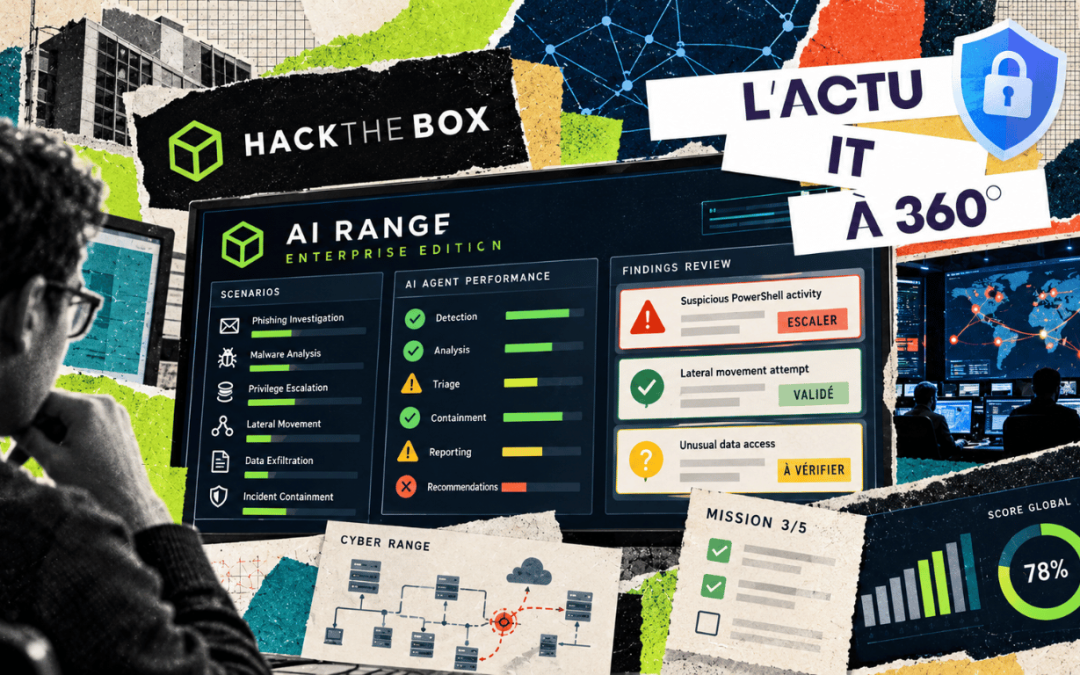
Can your AI agent really defend your company? Hack The Box puts its skills to the test
Hack The Box is launching AI Range Enterprise Edition to let security teams assess their own AI agents on the roles assigned to them.[1] For businesses, the stakes are concrete: having evidence before delegating a task, then checking that this evidence remains valid...

VAST Data wants AI to work with sensitive data in a protected environment
VAST Data has unveiled DataEnclave, a confidential execution capability designed to bring artificial intelligence models closer to companies’ sensitive data. Presented as a preview, it is due to go on sale in the first quarter of 2027.[1] The aim is to make certain...
Databricks buys Row Zero to bring spreadsheets closer to governed data
Databricks has announced the acquisition of Row Zero and plans to integrate its spreadsheet experience into Genie.[1] The aim is to let business teams explore data in a familiar interface, with greater control over access and usage. For companies, the challenge is to...

Google Cloud takes its X5 instances to 48 TB for large SAP databases
Google Cloud has announced the general availability of the X5 series, which raises the maximum advertised memory capacity on a single node to 48 TB, compared with 32 TB for X4.[1] Aimed in particular at very large SAP HANA databases, the offering is based on bare...

Cloud Storage: Google automates the detection of anomalies
A rise in reads, cross-region transfers or stored volume can inflate the cloud bill and disrupt applications. With Storage Intelligence advisor, Google offers a view of unusual changes in Cloud Storage, along with leads for investigating them. For businesses, the...
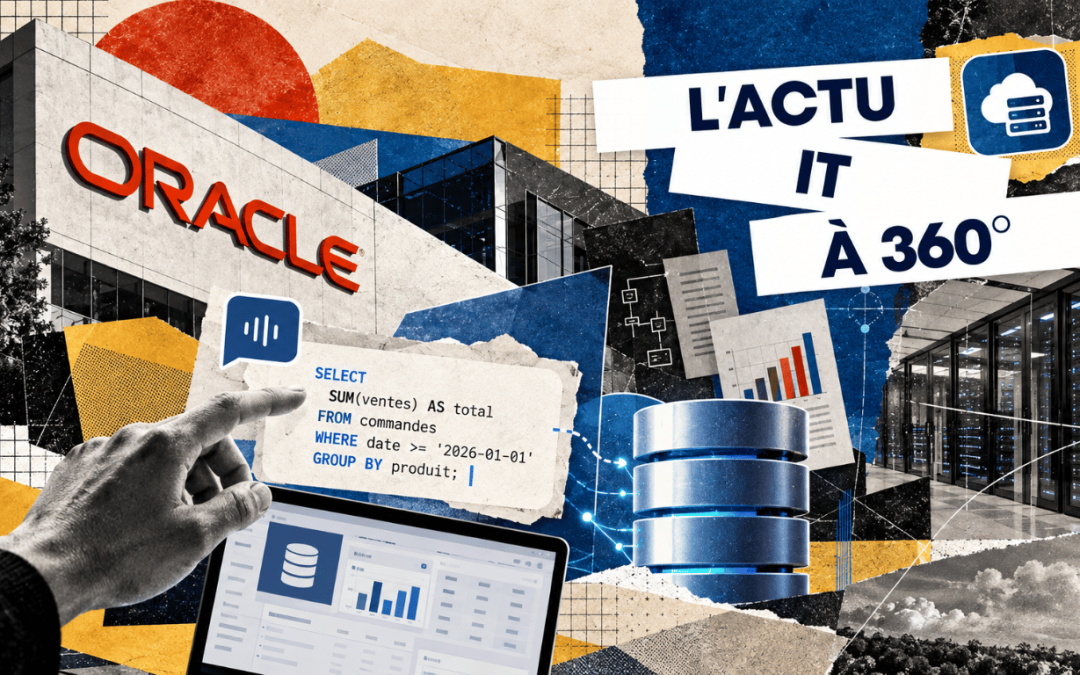
AI voice agents: Oracle details a LiveKit architecture on OCI
Oracle has described an architecture that pairs the LiveKit Agents framework with Oracle Cloud Infrastructure to automate real-time voice calls. The design links telephony, AI models and business services, while placing internal components in private subnets. For...