


AI agents settle at the heart of collaborative work
Artificial intelligence is no longer limited to assistants accessed in a chat window. With Claude Tag, Anthropic is taking a new step by building an AI agent directly into Slack. Available in beta for Claude Enterprise and Team customers, this new solution lets teams call on AI within their own workspaces to track projects, analyse information, handle support tickets or help identify the source of malfunctions. The aim is no longer just to assist one user, but to collaborate with an entire team on a daily basis.1
AI becomes a member of the team
Unlike conventional assistants that only respond to individual requests, Claude Tag works like a genuine digital colleague. Users can simply mention @Claude in a Slack conversation to give it a task or ask it for an analysis. The agent can use the context of the exchanges, find relevant information and work on ongoing projects without anyone having to leave their working environment. This integration is gradually turning Slack into a platform where interactions between humans and artificial intelligence become natural.1
Uses that go well beyond a simple chatbot
Anthropic positions Claude Tag as a tool capable of supporting a range of roles. Development teams can ask it to analyse a bug or trace the source of an error, while support teams can use it to handle recurring requests or quickly find technical information. Project managers can also ask it to track the progress of a project, summarise discussions or highlight the next actions to take. The agent thus becomes a cross-functional assistant capable of improving the flow of information within the company.2
Collaborative tools are changing role
This development illustrates a broader trend in the digital world. Until now, collaborative tools were mainly used to exchange messages, share documents or organise meetings. With the arrival of AI agents, these platforms are gradually becoming environments capable of analysing conversations, producing summaries, automating certain tasks and supporting teams in their daily activities. Artificial intelligence is no longer an external service: it is built directly into the software that employees already use every day.2
Generative AI is transforming the new tools of work
The arrival of Claude Tag shows that generative artificial intelligence is no longer used solely to produce text or code. It is becoming agents capable of understanding the context of a project, interacting with several users and taking part in company workflows. Professionals will need to learn to collaborate with these new assistants, define the tasks they can automate and supervise their output in order to take full advantage of these augmented working environments.
Towards companies where humans and agents collaborate constantly
With Claude Tag, Anthropic confirms a major market shift: AI agents are gradually leaving dedicated interfaces to be built directly into collaborative tools. This approach could quickly spread to other professional platforms, where agents will assist teams with project tracking, document management, technical support and software development. More than just a new feature, Claude Tag illustrates how artificial intelligence is gradually becoming a fully fledged player in collaborative work.
360° IT News — decoding technology to understand the jobs of tomorrow.
Further reading
The integration of AI agents into collaborative tools is part of a broader evolution of business software, in which artificial intelligence intervenes directly in business processes. On a related topic, read our article “With Code Layers, Figma brings design and development together for good”, which shows how AI agents are now being built into creative platforms to bring design and development teams closer together.
References
1. Anthropic. (2026). Introducing Claude Tag for Slack.
https://www.anthropic.com
2. Anthropic. (2026). Claude Enterprise Documentation.
https://docs.anthropic.com
Data centre boom: Legrand goes on the offensive in China and the UK
Data centres are becoming the heart of the global digital economy Legrand is stepping up its investments in China and the United Kingdom to strengthen its presence in the data centre sector, which has become critical infrastructure for the digital economy. This...
GPT-5.4-Cyber: OpenAI responds to Claude Mythos in the AI cybersecurity battle
A new front line in the artificial intelligence war On 14 April 2026, OpenAI launched GPT-5.4-Cyber, a model specialising in cybersecurity, just days after Anthropic announced Claude Mythos. This timing is no coincidence: it marks an acceleration in the competition...

Claude Mythos: beyond the buzz, what are the real stakes for IT security?
An AI that promises to transform cybersecurity With Claude Mythos, Anthropic is showcasing a new generation of artificial intelligence able to analyse, detect and anticipate cybersecurity threats. At a time when cyberattacks are soaring, with more than 2,200 attacks a...
Microsoft reinvents development with AI agents in VS Code
Software development enters the age of agents Microsoft is taking a new step by integrating artificial intelligence agents into Visual Studio Code, with a beta version available via the Insiders channel. This development comes at a time when VS Code is used by more...

In the cloud era, enterprise networks are changing standards
The network is no longer just support: it is becoming a driver of performance For a long time, the enterprise network was regarded as a simple technical infrastructure, often invisible as long as it worked. But with the explosion of the cloud, SaaS applications and...
Windows 11: Microsoft wants to speed up user testing with Insider
Software testing becomes a lever for innovation Microsoft is overhauling its Windows Insider programme, which now brings together more than 10 million testers worldwide, to simplify access to experimental versions of Windows 11 and speed up user feedback. In an...
51,600 satellites: Jeff Bezos steps up the battle for the global internet
News in brief With Project Kuiper, Jeff Bezos is committing Amazon to a major transformation of the world’s internet infrastructure by deploying tens of thousands of satellites in low Earth orbit. The goal is not limited to connecting isolated areas, but to building a...
PepsiCo automates its logistics: a turning point for smart warehouses
News in brief PepsiCo France is investing in an automated, multimodal warehouse that combines robotics, digital systems and intelligent management of logistics flows. The aim is no longer simply to store and distribute products, but to turn the warehouse into a...
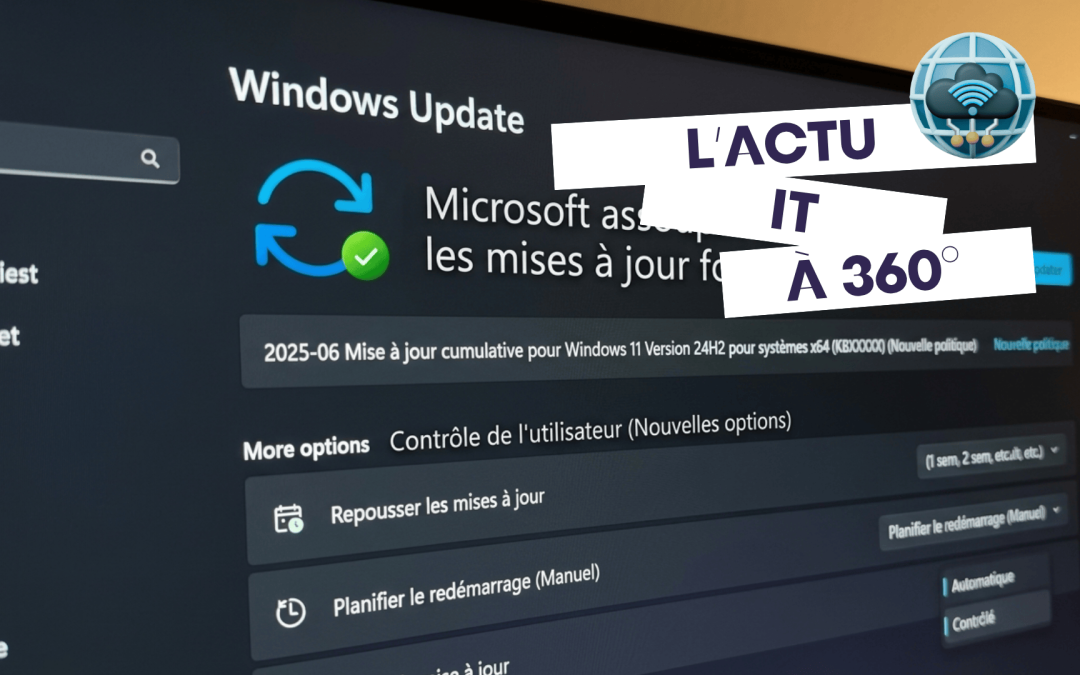
Windows 11: Microsoft finally relaxes forced updates
News in brief Microsoft is preparing to overhaul the way updates are managed in Windows 11, giving users greater control over their installation, notably by making it easier to postpone them or avoid certain enforced interruptions. This change responds to a...
WeChat goes autonomous AI: Tencent steps up with OpenClaw
News in brief Tencent has just integrated OpenClaw into WeChat, turning the app into far more than a simple communication tool. This development introduces agents capable of carrying out tasks directly from the interface, without going through several applications or...