



A US decision that sparks an international crisis
The sudden suspension of access to Anthropic’s Fable 5 and Mythos 5 models outside the United States now goes well beyond technology. What initially looked like a national security measure is taking on a major geopolitical dimension. The European Commission has officially responded by describing the decision as potentially discriminatory, arguing that European companies should not bear the consequences of a unilateral measure decided in Washington. The affair is thus reigniting the debate on Europe’s technological dependence on American artificial intelligence players.
Cybersecurity at the heart of the US decision
The situation stems from an order by US Commerce Secretary Howard Lutnick, which led Anthropic to suspend international access to its most advanced models. US authorities are concerned about the exceptional capabilities of these systems, particularly in cybersecurity. According to several sources, tests reportedly showed that certain ways of bypassing the safeguards made it possible to identify or exploit IT vulnerabilities at unprecedented speed1. For Washington, temporarily limiting their distribution is therefore a precautionary measure.
Brussels challenges the method used
The European Commission acknowledges that these advanced models carry risks. However, it questions the way in which this restriction was implemented. For Brussels, measures intended to protect national security should not end up excluding certain economic partners or penalising companies based outside the United States2. This position marks a hardening of Europe’s tone towards decisions taken by major American tech companies under the influence of federal authorities.
European companies caught off guard
Beyond diplomatic considerations, the consequences are immediate for organisations that had built Fable 5 into their processes. Many workflows relying on the model’s advanced capabilities have been disrupted. Some platforms are automatically falling back to earlier versions, while automation chains linked to software development or data analysis are losing efficiency. The situation is a reminder of how dependent companies have become on a limited number of AI providers.
A concrete demonstration of European dependence
The incident lays bare the continent’s weaknesses. While European companies are investing heavily in artificial intelligence, an essential part of the infrastructure and models remains controlled by foreign players. When access to a critical technology can be cut off overnight for geopolitical reasons, digital sovereignty stops being a theoretical question and becomes an operational issue.
AI becomes a lever of strategic power
The Fable 5 affair illustrates a deeper shift: artificial intelligence models are gradually being regarded as strategic assets comparable to certain energy resources or critical infrastructure. Access to them, their distribution and their control are becoming instruments of economic and political influence. This transformation could lead governments to step up their intervention in the AI sector, particularly where technologies deemed sensitive are concerned.
Europe steps up its thinking on technological sovereignty
In response, European leaders are increasingly calling for the continent’s technological capabilities to be strengthened. The goal is no longer just to develop regulations such as the AI Act, but also to support the emergence of models, cloud infrastructure and platforms capable of reducing dependence on foreign providers3. Several European sovereign AI initiatives could benefit from renewed interest in the wake of this episode.
A precedent that could leave its mark on the industry
The embargo on Fable 5 could prove a milestone in the history of artificial intelligence. For the first time, a frontier model has become the subject of a diplomatic dispute directly involving the United States and the European Union. The situation shows that the stakes of AI now extend far beyond technological innovation alone, touching on questions of sovereignty, national security and economic competitiveness.
Understanding the geopolitics of AI is becoming essential
This development highlights an increasingly strategic skill: understanding the governance and sovereignty issues linked to artificial intelligence. Future IT professionals will not only need to master the technologies, but also understand regulatory constraints, international power dynamics and the risks associated with dependence on foreign players.
A new stage in the global AI war
With the Fable 5 affair, artificial intelligence is entering a new phase in which access to models is as much a political issue as a technological one. For students and future digital professionals, this episode sends a strong signal: the future of AI will depend as much on technical innovation as on the strategic decisions taken by states and by the large companies that control these technologies.
360° IT News — decoding technology to understand the jobs of tomorrow.
Further reading
The Fable 5 affair shows that artificial intelligence is now at the heart of the power struggles between states, companies and technology providers. As models become more powerful, controlling them and accessing them take on a strategic dimension that goes far beyond innovation. On a related topic, read our article “Shaken by the competition, Anthropic strikes back with Claude Opus 4.8”, which analyses how AI players are accelerating the development of ever more powerful models amid global competition.
References
1. Reuters. (2026). European Commission reacts to Anthropic AI restrictions.
https://www.reuters.com
2. European Commission. (2026). Statements regarding access to advanced AI systems.
https://ec.europa.eu
3. European Parliament Research Service. (2026). Digital Sovereignty and Artificial Intelligence in Europe.
https://www.europarl.europa.eu
Data centre boom: Legrand goes on the offensive in China and the UK
Data centres are becoming the heart of the global digital economy Legrand is stepping up its investments in China and the United Kingdom to strengthen its presence in the data centre sector, which has become critical infrastructure for the digital economy. This...
GPT-5.4-Cyber: OpenAI responds to Claude Mythos in the AI cybersecurity battle
A new front line in the artificial intelligence war On 14 April 2026, OpenAI launched GPT-5.4-Cyber, a model specialising in cybersecurity, just days after Anthropic announced Claude Mythos. This timing is no coincidence: it marks an acceleration in the competition...
Claude Mythos: beyond the buzz, what are the real stakes for IT security?
An AI that promises to transform cybersecurity With Claude Mythos, Anthropic is showcasing a new generation of artificial intelligence able to analyse, detect and anticipate cybersecurity threats. At a time when cyberattacks are soaring, with more than 2,200 attacks a...
Microsoft reinvents development with AI agents in VS Code
Software development enters the age of agents Microsoft is taking a new step by integrating artificial intelligence agents into Visual Studio Code, with a beta version available via the Insiders channel. This development comes at a time when VS Code is used by more...

In the cloud era, enterprise networks are changing standards
The network is no longer just support: it is becoming a driver of performance For a long time, the enterprise network was regarded as a simple technical infrastructure, often invisible as long as it worked. But with the explosion of the cloud, SaaS applications and...
Windows 11: Microsoft wants to speed up user testing with Insider
Software testing becomes a lever for innovation Microsoft is overhauling its Windows Insider programme, which now brings together more than 10 million testers worldwide, to simplify access to experimental versions of Windows 11 and speed up user feedback. In an...
51,600 satellites: Jeff Bezos steps up the battle for the global internet
News in brief With Project Kuiper, Jeff Bezos is committing Amazon to a major transformation of the world’s internet infrastructure by deploying tens of thousands of satellites in low Earth orbit. The goal is not limited to connecting isolated areas, but to building a...
PepsiCo automates its logistics: a turning point for smart warehouses
News in brief PepsiCo France is investing in an automated, multimodal warehouse that combines robotics, digital systems and intelligent management of logistics flows. The aim is no longer simply to store and distribute products, but to turn the warehouse into a...
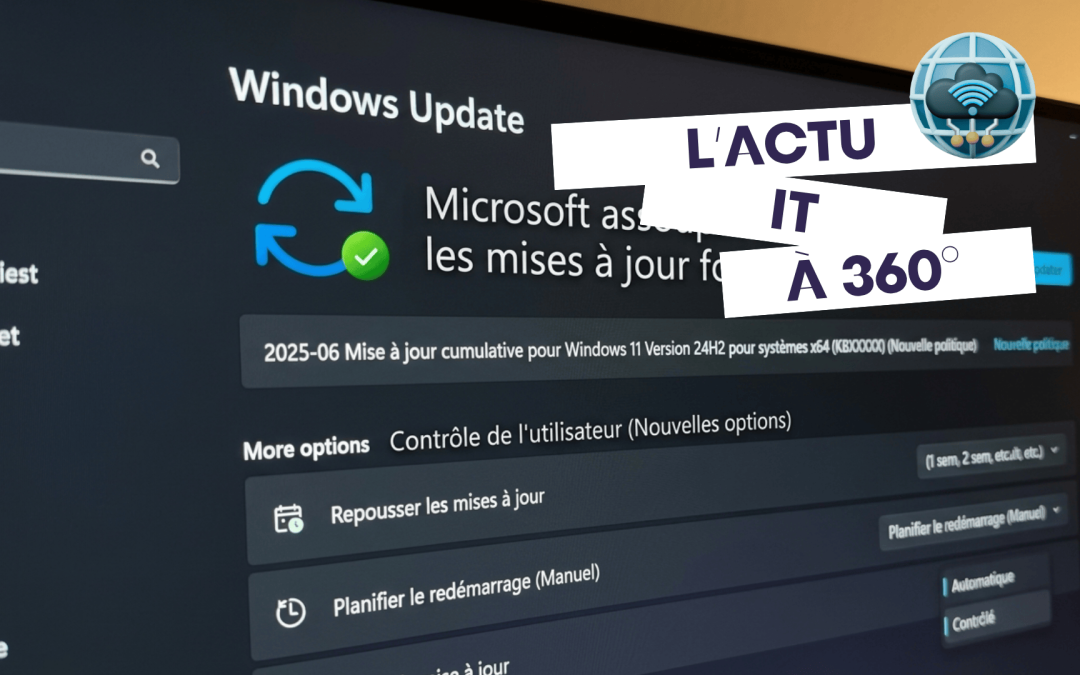
Windows 11: Microsoft finally relaxes forced updates
News in brief Microsoft is preparing to overhaul the way updates are managed in Windows 11, giving users greater control over their installation, notably by making it easier to postpone them or avoid certain enforced interruptions. This change responds to a...
WeChat goes autonomous AI: Tencent steps up with OpenClaw
News in brief Tencent has just integrated OpenClaw into WeChat, turning the app into far more than a simple communication tool. This development introduces agents capable of carrying out tasks directly from the interface, without going through several applications or...