


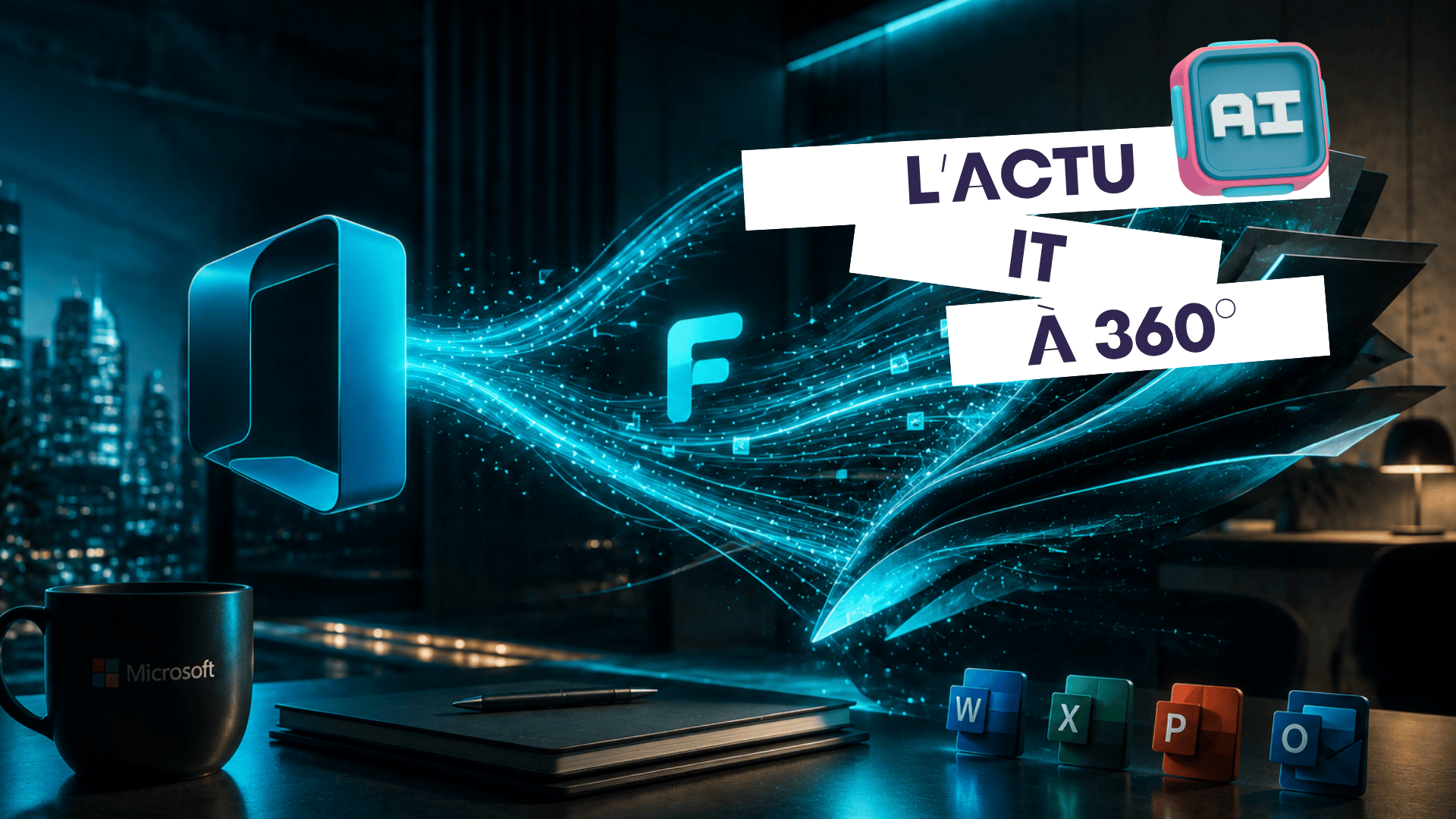
Office enters the age of intelligent agents
Microsoft is stepping up its agentic artificial intelligence strategy with the acquisition of Fintool, a start-up specialising in automated financial analysis. Founded in San Francisco by Frenchmen Nicolas Bustamante and Édouard Godfrey, the company develops agents capable of carrying out complex tasks directly in tools such as Excel, Word or PowerPoint. This acquisition illustrates a major transformation: Office is no longer just an office suite, but a platform of intelligent assistants able to act autonomously within professional workflows.
AI no longer just assists, it acts
Until now, the AI tools built into Office were mainly used to summarise, draft or suggest content. With Fintool, Microsoft is taking a new step. The agents developed by the start-up can analyse financial documents, automatically build DCF models in Excel or generate research memos in Word. This development marks the shift from “copilot” AI to “agentic” AI, capable of carrying out complex actions without constant user intervention.
Excel becomes an intelligent financial analysis platform
Fintool’s core technology is based on qualitative analysis of financial data. The tool can read regulatory filings, extract relevant information and produce detailed summaries in a matter of minutes. According to Nicolas Bustamante, the automation of quantitative finance was already well advanced, but qualitative analysis represented the next frontier. By building these capabilities directly into Excel and Office, Microsoft is turning its software into genuine expert platforms able to handle complex data at a level close to that of a human analyst.
A new generation of productivity for businesses
For finance departments and large companies, the potential impact is considerable. Employees will no longer need to use specialised external tools for certain analyses. AI agents will be able to automate time-consuming tasks directly in the software used every day. This approach could shorten analysis times, improve productivity and speed up decision-making. According to Microsoft, more than 400 million people use Microsoft 365 worldwide, which gives this development a massive reach[^1].
Office becomes an intelligent business platform
This acquisition also reveals a broader strategy: verticalising AI by profession. Microsoft no longer just wants to offer general-purpose assistants, but specialised agents able to meet the specific needs of sectors such as finance, law or project management. This approach is gradually turning Office into an intelligent professional platform, able to understand business contexts and automate certain areas of expertise.
Governance and confidentiality issues intensify
Integrating AI agents capable of handling sensitive data nevertheless raises important questions. In the financial sector, regulatory compliance and confidentiality are critical. Microsoft will have to ensure that these systems meet high standards of security and governance. The more autonomous agents become, the more strategic data oversight and control become for companies and CISOs.
Understanding agentic AI becomes essential
This transformation highlights a key skill: artificial intelligence and business workflow automation. IT professionals will need to understand how to integrate AI agents into existing tools, supervise their actions and guarantee the quality of the results produced. It is no longer just about using Office, but about steering systems capable of carrying out complex tasks autonomously.
The end of traditional office software?
With the acquisition of Fintool, Microsoft shows that the future of office software no longer rests solely on word processing or the traditional spreadsheet. Work tools are gradually becoming intelligent platforms able to analyse, decide and automate certain business tasks. For students and future IT professionals, this is a major development. It shows that agentic AI could profoundly transform office work and redefine the way companies use their data.
360° IT News — decoding technology to understand the jobs of tomorrow.
Further reading
The integration of AI agents into Office illustrates a broader trend: professional software is gradually becoming capable of automating complex tasks and acting autonomously. This development also affects development tools and technical environments, where agentic AI is starting to transform everyday workflows. On a related topic, read our article “Microsoft reinvents development with AI agents in VS Code”, which analyses how autonomous artificial intelligence is now being built into the heart of the tools developers use.
References
1. Microsoft. (2025). Microsoft 365 usage statistics.
https://www.microsoft.com

The IT Clinic: when students take care of SMEs’ digital systems
A CCCLX innovation in education and solidarity What if students were to become digital "field doctors"? This is the bold gamble taken by CCCLX with the Clinique de l'IT, an innovative educational program inspired by legal clinics and the model launched in AI by...

Generative AI and the final year project: towards an augmented and responsible PFE
At CCCLX, Artificial Intelligence is not a marginal discipline: it is one of the pillars of the curriculum. This is why, in the fourth year, each student carries out a Final Year Project (FDP ) enriched by generative AI tools. But beyond technical use, the stakes are...

The Diploma Update Guarantee: a lifetime commitment with CCCLX
At CCCLX, ambition doesn't stop at graduation. Because technology is constantly evolving, and because skills become obsolete as quickly as they are acquired, CCCLX has taken a daring gamble: to offer a Diploma Update Guarantee©, a unique system that keeps every...

IT jobs in France: a strategic opportunity for multi-skilled talent
More than 6,000 IT offers analyzed: CCCLX reveals the market's true expectations In a rapidly changing job market, where artificial intelligence and the cloud are redefining standards, CCCLX has conducted an extensive study of over 6,000 job offers published between...