


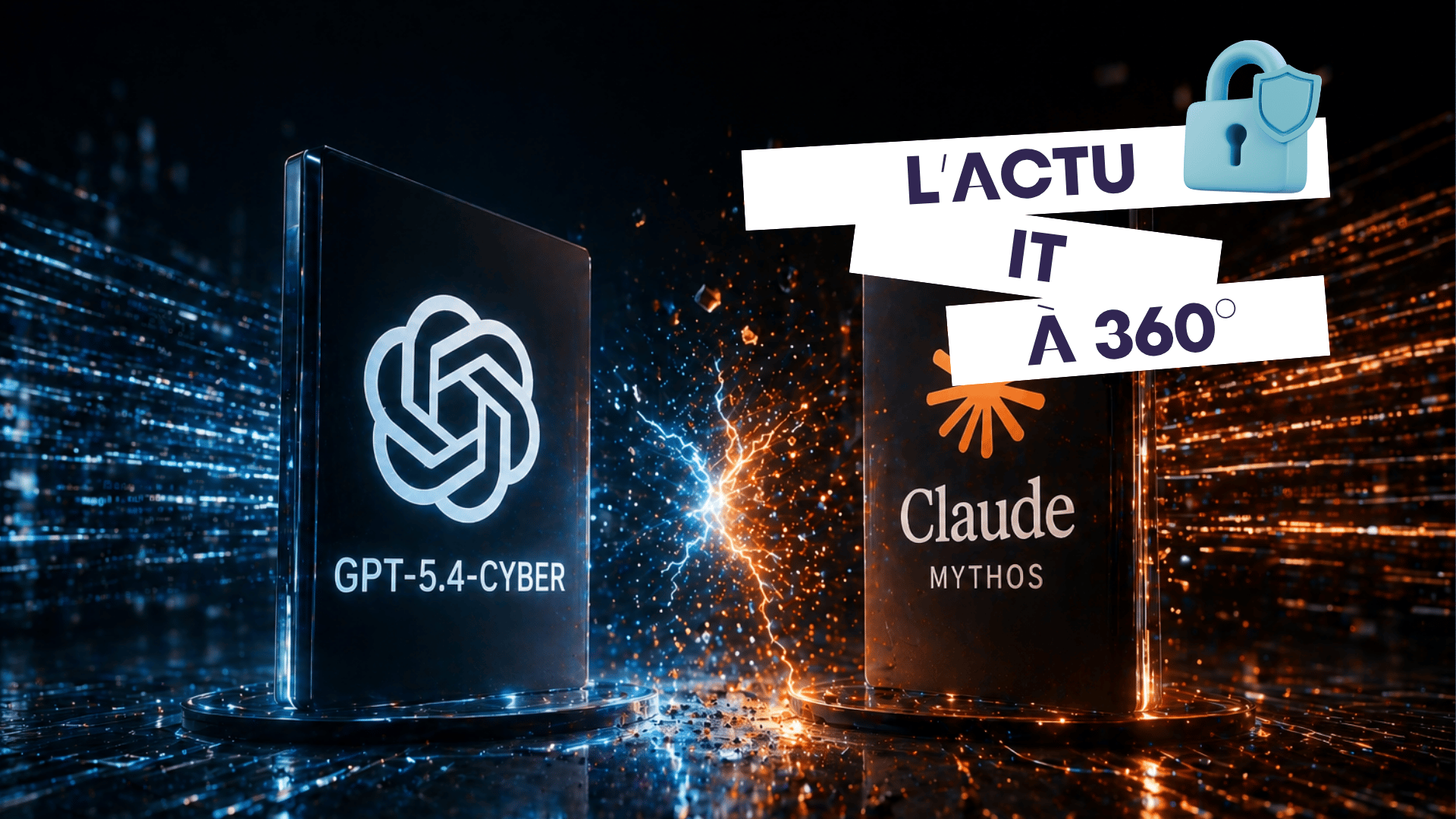
A new front line in the artificial intelligence war
On 14 April 2026, OpenAI launched GPT-5.4-Cyber, a model specialising in cybersecurity, just days after Anthropic announced Claude Mythos. This timing is no coincidence: it marks an acceleration in the competition between AI giants on what has become critical ground, the security of IT systems. In a world where cyberattacks now cost more than 10 trillion dollars a year globally, cybersecurity is becoming a major strategic issue for businesses1. AI is no longer just a productivity tool; it is becoming a pillar of defence.
Models able to understand attacks, not just detect them
GPT-5.4-Cyber does not merely analyse logs or apply conventional detection rules. It draws on advanced contextual understanding to identify abnormal behaviour, correlate events and simulate attack scenarios. This approach makes it possible to move from a detection mindset to one of anticipation. In practice, the model can analyse network traffic, detect weak signals and suggest corrective actions in near real time. This development is essential at a time when the volume of security data is exploding, making traditional approaches inadequate.
A technology race between OpenAI and Anthropic
The launch of GPT-5.4-Cyber is part of a direct rivalry with Claude Mythos. Both models aim to automate part of cybersecurity to improve the speed and accuracy of responses. But beyond the technology, this showdown reflects a broader battle for control of critical infrastructure. AI players are seeking to become indispensable partners for businesses in managing their systems, data and security. Cybersecurity is thus becoming a strategic lever in the competition between AI platforms.
Significant operational gains for businesses
For businesses, and SMEs in particular, these tools represent a major opportunity. Cybersecurity is often complex and costly to implement, especially for organisations with limited resources. Models such as GPT-5.4-Cyber make it possible to automate certain tasks, such as monitoring, analysis or incident prioritisation. According to IBM, using AI can cut data breach costs by up to 40% and significantly speed up response times2. This allows businesses to strengthen their security without proportionally expanding their IT teams.
Growing dependence on intelligent systems
However, this automation brings new risks. Businesses are becoming increasingly dependent on AI models whose inner workings they do not always understand. Misinterpretations, biases or false positives can have serious consequences. Moreover, the concentration of these tools in the hands of a few players raises questions of sovereignty and data control. Cybersecurity no longer depends solely on internal infrastructure, but also on the AI platforms used.
Cyberattacks are also being supercharged by artificial intelligence
One of the major issues with this development is that attackers are using AI too. Cybercriminals exploit models to automate the creation of malware, improve phishing attacks or bypass detection systems. This is creating a genuine technological arms race, in which every defensive advance triggers an offensive adaptation. GPT-5.4-Cyber and Claude Mythos are part of this dynamic: they strengthen defences, but also help raise the overall level of sophistication of attacks.
Cybersecurity and AI: a new generation of IT skills
This transformation highlights a key skill: cybersecurity, now inseparable from artificial intelligence. IT professionals must understand how models work, know how to integrate them into an overall architecture and be able to interpret their results. It is no longer just about protecting systems, but about managing intelligent tools capable of evolving continuously. This hybridisation is redefining IT jobs and the digital skills expected by businesses.
A revolution under way, but still far from settled
GPT-5.4-Cyber illustrates a profound transformation of cybersecurity, but this revolution is still taking shape. While AI can improve threat detection and response, it does not replace human expertise. Businesses must learn to use these tools with discernment, combining automation and oversight. For students and future IT professionals, understanding this duality is essential: tomorrow’s cybersecurity will rest on a balance between human intelligence and artificial intelligence, in a constantly changing environment.
360° IT News — decoding technology to understand the jobs of tomorrow.
References
1. Cybersecurity Ventures. (2024). Cybercrime damages report.
https://cybersecurityventures.com
2. IBM. (2024). Cost of a Data Breach Report.
https://www.ibm.com/security/data-breach
The IT Clinic: when students take care of SMEs’ digital systems
A CCCLX innovation in education and solidarity What if students were to become digital "field doctors"? This is the bold gamble taken by CCCLX with the Clinique de l'IT, an innovative educational program inspired by legal clinics and the model launched in AI by...
Generative AI and the final year project: towards an augmented and responsible PFE
At CCCLX, Artificial Intelligence is not a marginal discipline: it is one of the pillars of the curriculum. This is why, in the fourth year, each student carries out a Final Year Project (FDP ) enriched by generative AI tools. But beyond technical use, the stakes are...
The Diploma Update Guarantee: a lifetime commitment with CCCLX
At CCCLX, ambition doesn't stop at graduation. Because technology is constantly evolving, and because skills become obsolete as quickly as they are acquired, CCCLX has taken a daring gamble: to offer a Diploma Update Guarantee©, a unique system that keeps every...

IT jobs in France: a strategic opportunity for multi-skilled talent
More than 6,000 IT offers analyzed: CCCLX reveals the market's true expectations In a rapidly changing job market, where artificial intelligence and the cloud are redefining standards, CCCLX has conducted an extensive study of over 6,000 job offers published between...