


News in brief
With Project Kuiper, Jeff Bezos is committing Amazon to a major transformation of the world’s internet infrastructure by deploying tens of thousands of satellites in low Earth orbit. The goal is not limited to connecting isolated areas, but to building a global alternative to traditional terrestrial networks. At the same time, the launch of a smartphone shows a clear determination to control the entire value chain, from the network to the end user. This strategy is part of a global race in which digital infrastructure is becoming a lever of economic and technological power.¹
Controlling the network means controlling digital usage
The real breakthrough lies not only in satellite technology, but in the logic of a global platform. By combining space connectivity, cloud services (AWS) and devices, Amazon can offer a complete ecosystem in which data, applications and users are interconnected. This makes it possible to optimise performance, reduce latency and offer new services, particularly for the Internet of Things, real-time applications or critical services. This approach turns the internet into an integrated infrastructure, run by a handful of major players able to control its flows.
Connecting businesses everywhere, even beyond conventional networks
For SMEs, this development could be a real accelerator. In rural, industrial or poorly served areas, internet access remains an obstacle to digital transformation. Satellite constellations can remove this barrier by offering fast, stable connectivity regardless of local infrastructure. This opens the door to using the cloud, managing data in real time and integrating artificial intelligence solutions. The stakes are high: enabling all companies, wherever they are located, to access the same digital opportunities.
An explosion of uses driven by global connectivity
Beyond internet access, these infrastructures will transform usage. We can imagine applications in logistics, with real-time tracking of goods anywhere in the world, in connected agriculture, or in crisis and natural disaster management. Satellites are becoming a relay for distributed systems, in which data flows continuously between objects, users and cloud platforms. This permanent connectivity will accelerate the adoption of technologies such as AI, cloud computing and IoT by making them accessible on a larger scale.
A growing dependence on tech giants
But this transformation also raises critical issues. With infrastructure concentrated in the hands of a few players, companies become dependent on global platforms for their connectivity, data and services. This dependence raises questions of digital sovereignty, cybersecurity and governance. Companies will need to be able to diversify their solutions, secure their data and understand the implications of these technology choices for their IT strategy.
Managing hybrid networks becomes essential
This development highlights a key skill: systems and network administration in a hybrid environment. IT professionals now have to manage infrastructure combining terrestrial networks, satellites and the cloud. This means understanding global connectivity, optimising performance and ensuring the security of exchanges. This ability to orchestrate complex systems is becoming essential to support companies’ digital transformation and make full use of new infrastructure.
Towards a global, distributed and strategic internet
With projects such as Kuiper, the internet is entering a new phase in which infrastructure is becoming global, distributed and strategic. The boundaries between network, cloud and services are gradually disappearing in favour of integrated ecosystems. For students and future IT professionals, this means jobs are evolving towards architect roles able to understand, connect and manage these complex environments. The challenge is no longer just technical; it is also economic and strategic, in a world where connectivity is becoming a key competitive factor.
360° IT News — decoding technology to understand the jobs of tomorrow.
References
1. PepsiCo. Logistics and supply chain innovation initiatives.
https://www.pepsico.com
Data centres in space: why Nvidia wants to revolutionise the cloud
News in brief At the GTC 2026 conference, Nvidia announced its intention to accelerate the development of artificial intelligence in space, joining an emerging movement around orbital data centres. The company is no longer content to supply chips for satellites; it is...

Claude Marketplace: what Anthropic’s new platform changes for businesses
News in brief Anthropic has just announced Claude Marketplace, a new platform that allows companies to access, share and use artificial intelligence agents based on its Claude model. The aim is no longer just to offer conversational AI, but to create a genuine...
Automated code review: Anthropic’s Claude now analyses developers’ code
News in brief Artificial intelligence continues to transform developers’ work. Anthropic, the company behind the Claude AI model, has just announced new capabilities that allow its assistant to analyse computer code and help developers with their code review...
Memerist: the free Linux app for creating memes in seconds
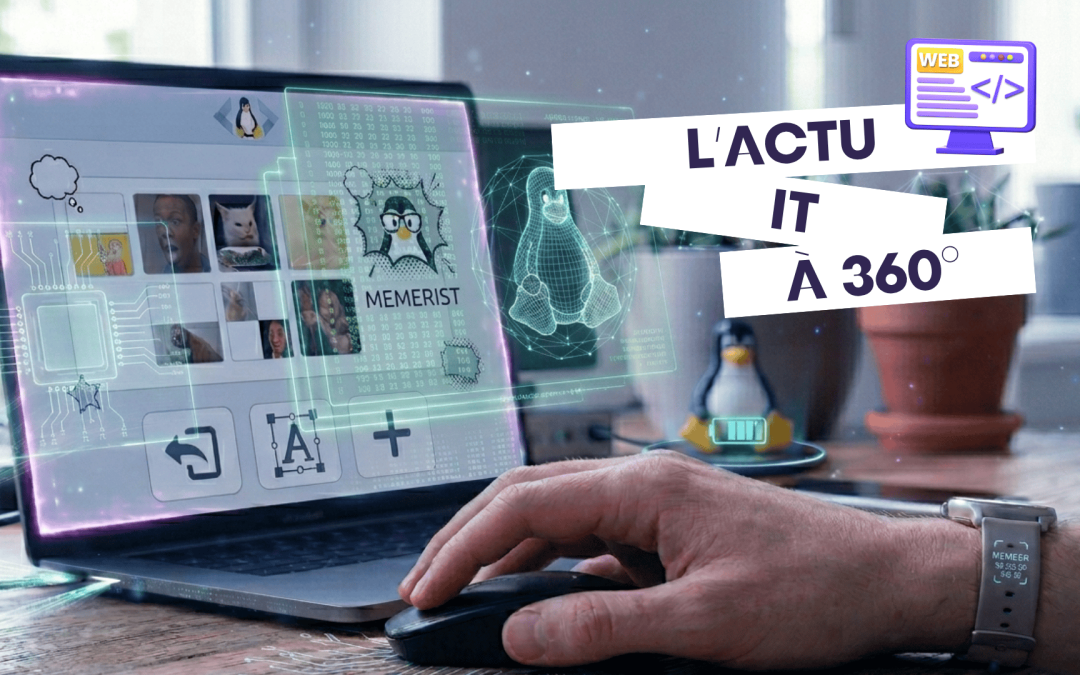
News in brief Creating a meme has become an everyday activity on the internet. Humorous images circulate daily on social networks, forums and messaging apps, often used to comment on the news, share an idea or simply make people laugh. Yet producing a meme quickly is...
Microsoft unveils Microsoft 365 E7: Copilot and AI agents at the heart of its enterprise strategy
News in brief Microsoft recently announced Microsoft 365 E7, a new offering for businesses that places artificial intelligence at the heart of the working environment. This development is part of Microsoft’s overall strategy to transform traditional productivity tools...
Global cyber-espionage: the Salt Typhoon affair shows why cybersecurity is becoming crucial
News in brief A vast cyber-espionage operation called Salt Typhoon has reportedly infiltrated several telecom operators around the world. Hacker groups linked to China are believed to be behind these attacks, which can access sensitive communication infrastructure....

CCCLX wins Bronze Trophy at IT Night 2025!
CCCLX, the 360° IT school, was honored at IT Night 2025 - La Nuit de l'Entreprise Numérique, winning the Bronze Trophy in the Schools / Training category. A fine accolade in the context of this emblematic event for the French digital ecosystem, organized annually...

A revolution in higher education financing by aivancity/CCCLX and Umanity
A concrete solution to democratize access to education for the professions of tomorrow This scheme, the only one of its kind in France, complements a series of measures put in place by aivancity to promote diversity and equitable access to its programs (tuition-free...

White paper: How generative AI is transforming SMEs
White paper: How generative AI is transforming SMEs In a world where technological innovation is redefining the rules of the game, small and medium-sized businesses have never had so much to gain... or lose. Against this ever-changing backdrop, CCCLX unveils its new...

CCCLX: A new IT school dedicated to SMEs and startups is born
On April 28, 2025, CCCLX was officially unveiled at the CCI Paris during a press conference packed with symbols and commitments. The launch was attended by a number of leading personalities: Soumia Malimbum, President of CCI Paris, Alain Martinez, President of CPME...